
Spike Theatre Takes the Scenic Route Into ‘Jonah’
For its inaugural production, Spike Theatre chooses Rachel Bonds’ Jonah—a fractured, intimate drama about memory, desire, and the stories we invent when reality becomes too difficult to hold whole.
Words Bernadette Soriano
Photos Courtesy of Spike Theatre
September 16, 2026
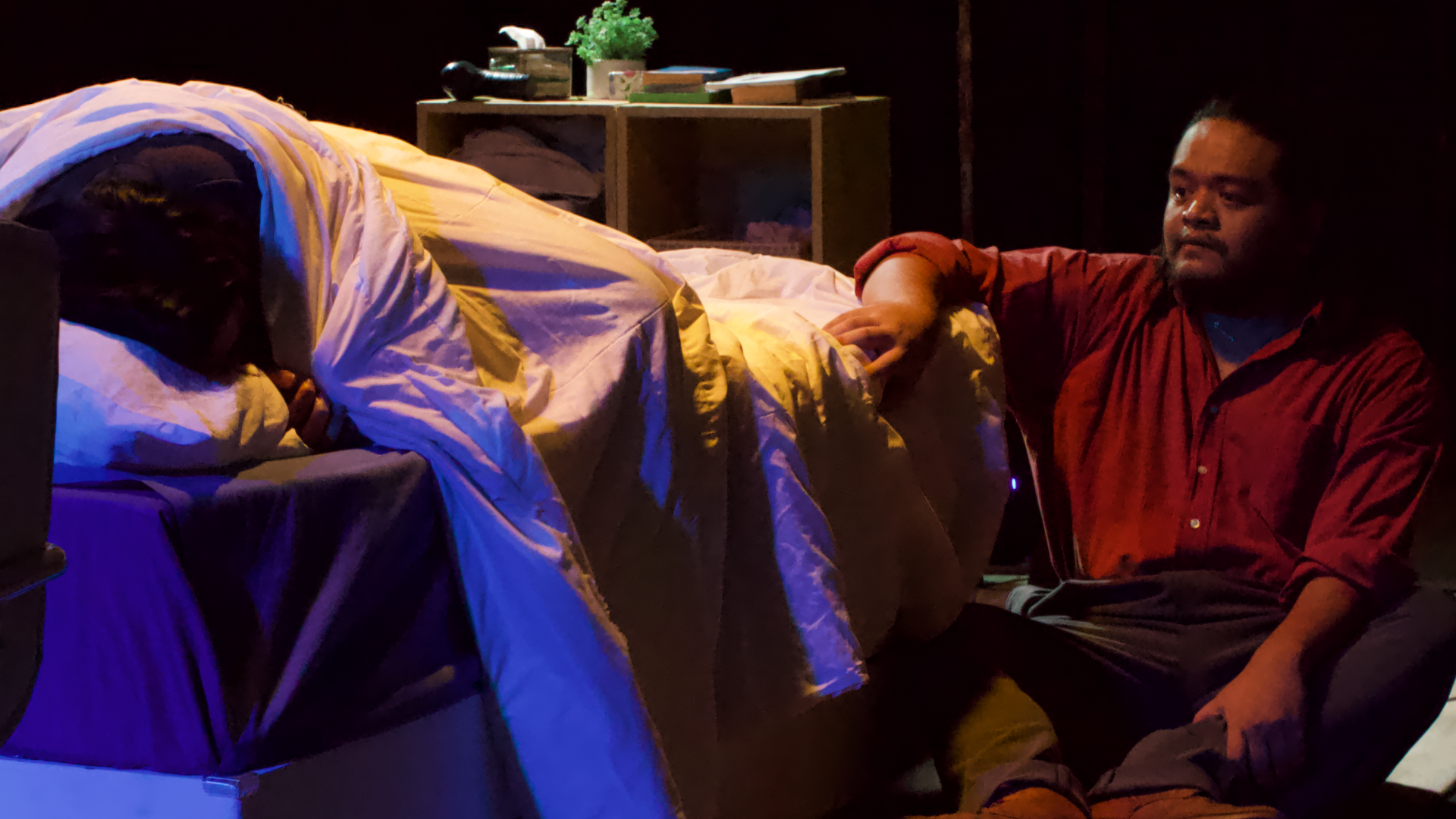
One might more discreetly launch a theater company by way of the familiar, more so the crowd-pleasing—a staple that spares its audience the unsettling work of piecing the evening on its head.
Spike Theatre has opted for the more instinctive route.
For its maiden outing, the nascent company takes on Rachel Bonds’ Jonah—a slippery piece of dramaturgy where memory runs amok, temporal logic goes somewhat off the rails, and fantasy has no trouble passing for fact.
After winning the 2024 Laurents/Hatcher Prize and making its Off-Broadway debut to divided reactions over precisely that slipperiness, Jonah arrives here with its edges pleasingly intact.
Directed by Edith Garcia, Spike does not, mercifully, attempt to cure the play of it.
Thank God. Jonah works best when the story leaves the stage bearing something you cannot place, akin to a name overheard years ago and somehow still lodged in the wrong drawer of your mind.
The Room Knows Before We Do
Spike gives Jonah a dance studio in Greenfield District, fifty seats gathered in the round, and within that circle a bedroom, made to hold several years of life.
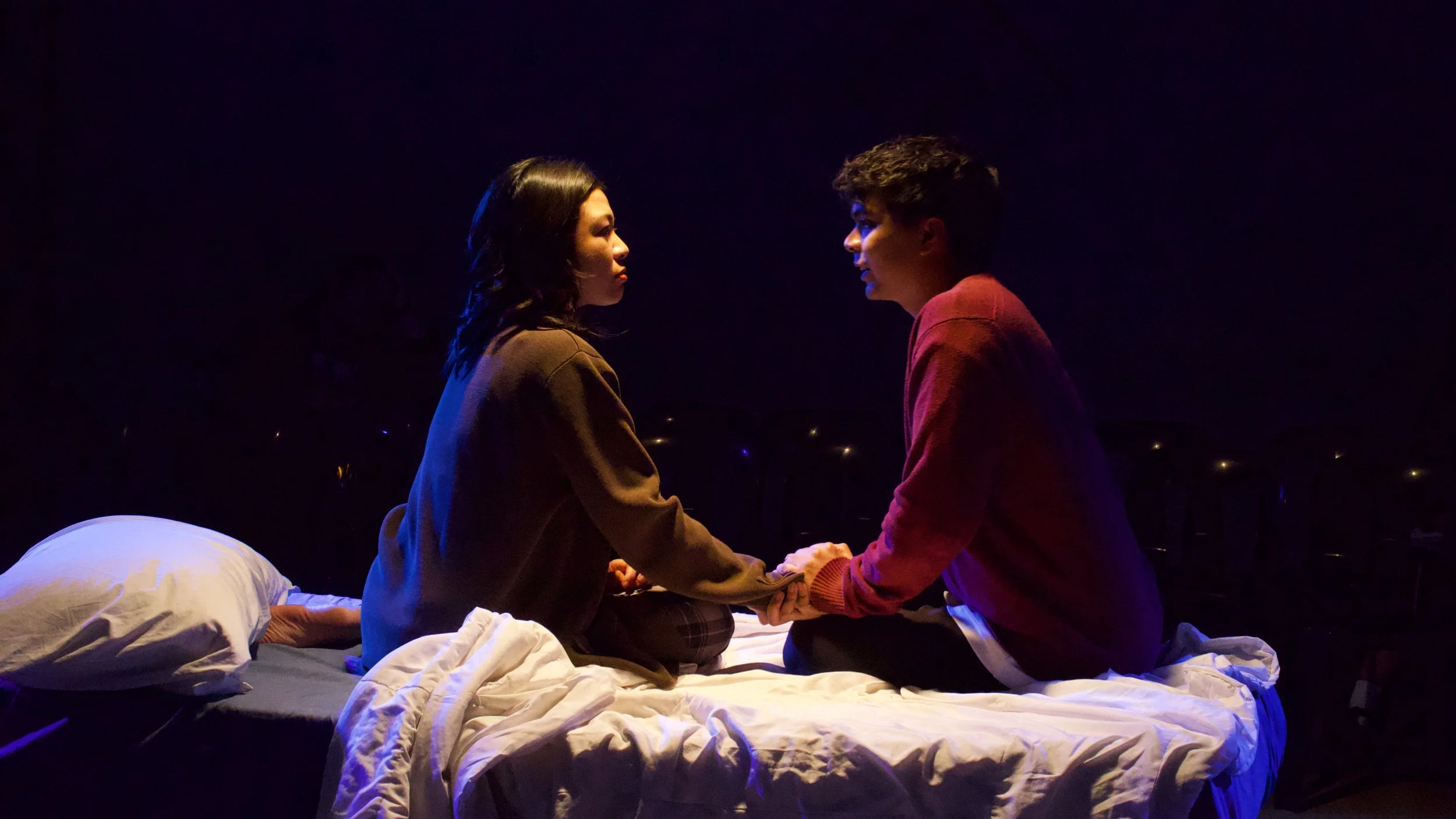
Actors Chelsea Nikole Apolto and Riel Geli in Rachel Bonds’ Jonah | Photo by Spike Theatre
Trapped in such tight proximity, performance is stripped of all structural insulation: the breath snagged on the verge of a lie, the glance landing a fraction late, the smile that says ‘I like you’ while quietly negotiating the more complicated plea of ‘please don’t ask me that.’
The staging is well met by a drama in which memory refuses any orderly ledger.
The room holds its ground, while Ana—evading its perimeter as effortlessly as she does her own history—is green and boarding-school-bound one moment, adrift with Danny or Steven the next, each iteration clutching some fragment the others inadvertently let drop.
Chronology moves here by fitful fits and turns: doubling back, repeating its lines, and returning to the selfsame spot with the emotional accounting somehow all the worse for wear.
Spike wisely leaves those folds showing. A light cue, a sound returning from another time, a phrase that gathers its afterlife only in retrospect, and suddenly the ordinary is made answerable to a past it had seemed to have none of.
The transitions occasionally show their machinery, but perhaps fittingly so.
Because memory has never been one for clean handoffs.
Ana, in Pieces
Chelsea Nikole Apolto has the production’s cruelest assignment: to play Ana as she keeps becoming someone else, only for the earlier versions to keep turning up in the room with her.
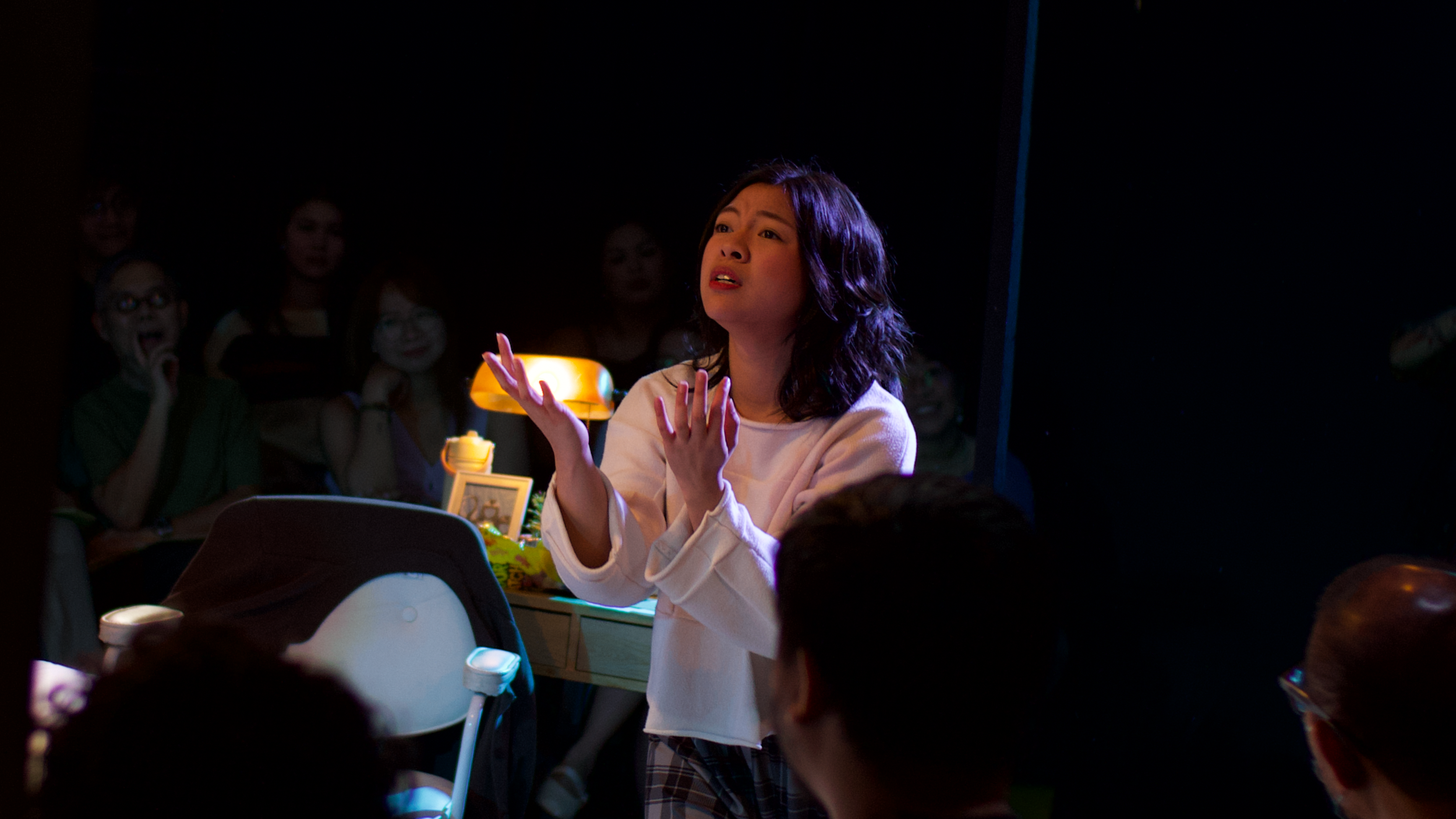
Chelsea Nikole Apolto as Ana in Rachel Bonds’ Jonah | Photo by Spike Theatre
Ana appears in installments—bright, curious, newly discovering what a body can permit; later guarded, funny, worn thin; then, with indecent speed, young enough to surprise herself again.
Apolto refuses to put these selves in their proper partitioning, letting one trespass into another: the girl surfacing in the woman’s silences, the woman’s weariness briefly misbehaving in the girl’s light.
She is sharpest when Ana’s words acquire a will of their own, giving away what she has taken such pains to withhold: a laugh that makes a convenient end, a pause beneath which the unfinished sentence keeps working, a certainty arriving already halfway to its undoing. Her evasions fare little better; however carefully they skirt the question, they return with the evidence in tow, by then inseparable from the very story she's meant to keep intact.
Yet Apolto never lets hurt make Ana solemn.
She is petty, awkward, flirtatious, desirous, occasionally ridiculous—still subject to the small indignities of being human, pain notwithstanding.
Ana remains gloriously, inconveniently human.
Which is why Ana’s returns to girlhood carry a charge the years cannot quite explain away. Time has done its recording; the body, a different score.
Enters Jonah
Riel Geli’s Jonah ushers in with the improbable ease of a boy who has wandered into the wrong romantic comedy and finding the error rather to his liking.
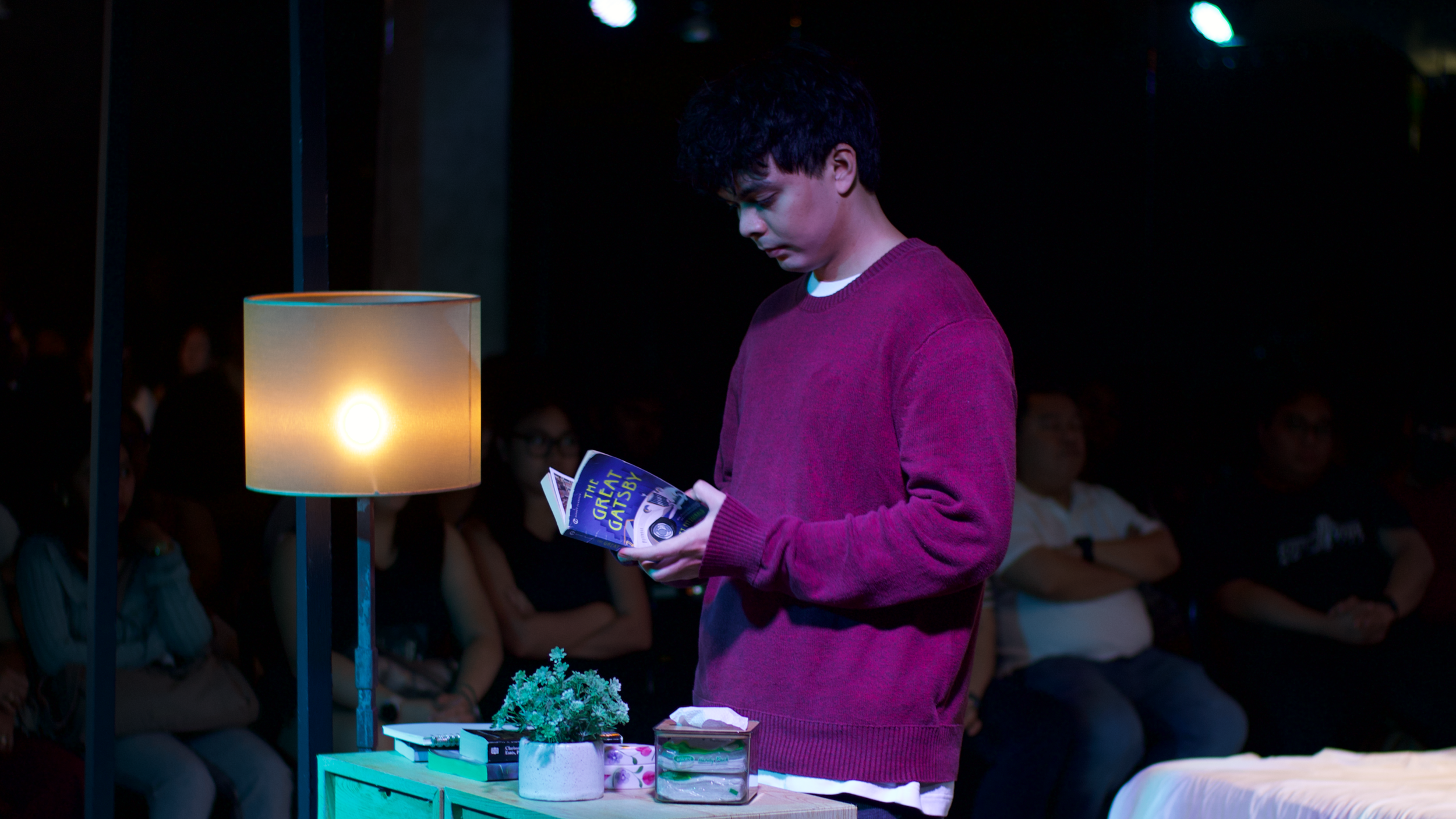
Riel Geli as Jonah in Rachel Bonds’ Jonah | Photo by Spike Theatre
Awkward, eager, earnestly strange, Jonah wears his vulnerability without much attempt at concealment. Geli lets him be goofy without filing down the goofiness into charm, so that his sweetness retains a little mischief—and, occasionally, the faint possibility of embarrassment.
Then there is the small matter of Jonah being safe.
In a play where safety is assembled from memory as much as experience, Jonah arrives almost too neatly into the space Ana has left open for it. Geli resists making him exemplary; he is attentive, awkward, unassuming, and, most disarming of all, easy to be around—a small mercy, perhaps, were it not that for Ana it comes to mean far too much.
So when he disappears, he takes a loophole with him: that brief reprieve from consequence, that borrowed stretch of intimacy before history comes calling to collect what is owed.
Geli plays that possibility lightly enough that we want to believe in it; quietly enough, too, that its vanishing leaves behind the more awkward question of why we did.
That for a moment, Jonah gives Ana a future she can borrow.
Only for its loan to come due.
Then Danny Arrives
Johnny Maglinao’s Danny has the unnerving habit of making need look already routine.
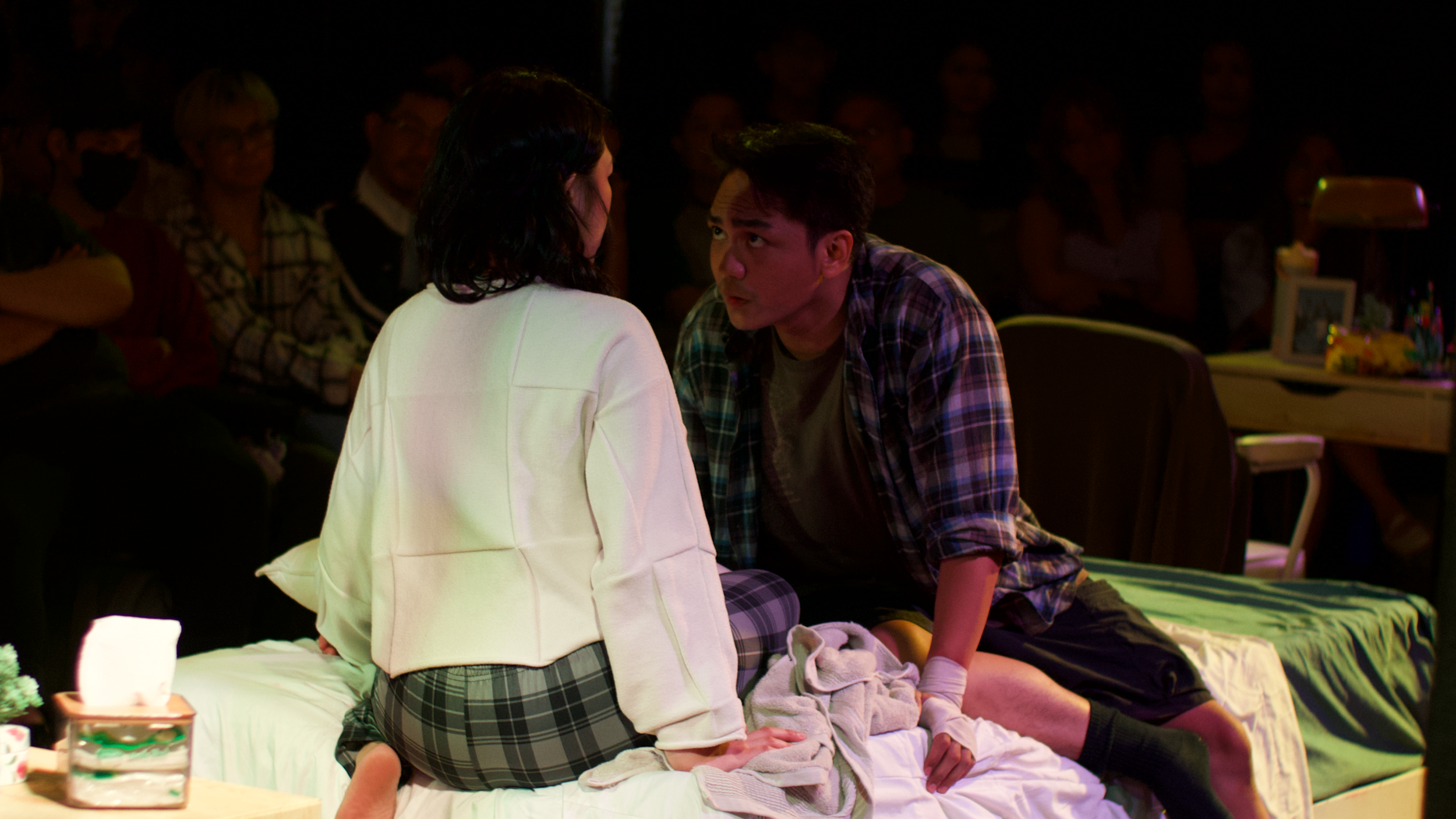
Johnny Maglinao as Danny in Rachel Bonds’ Jonah | Photo by Spike Theatre
Danny arrives without the useful warning signs of a villain—wounded, needy, occasionally pathetic, sympathetic for just long enough to make sympathy feel like an error in judgment.
Maglinao locates the rot within the recurrence: Danny needs Ana, wounds her, then returns to need her anew.
His damage snaps in specifics: guilt, dependence, entitlement, in the most absurd tenderness of someone who keeps knocking on a door after having habituated it to closure.
That keeps Danny from doing the convenient work of explaining Ana to us. Maglinao leaves him embarrassingly human instead—someone whose damage remains comprehensible without thereby becoming exculpatory, which may be the least comfortable thing the play makes of our sympathy, our forgiveness much less.
You can pity Danny.
And the play makes sure that pity gets you nowhere.
Steven, or the Possibility of Something Gentle
Edward Solon’s Steven has perfected the oddly radical knack of leaving people at face value when they ask to be left be—a minor act of consideration that, in Ana’s world, has somehow come to seem almost extraordinary.
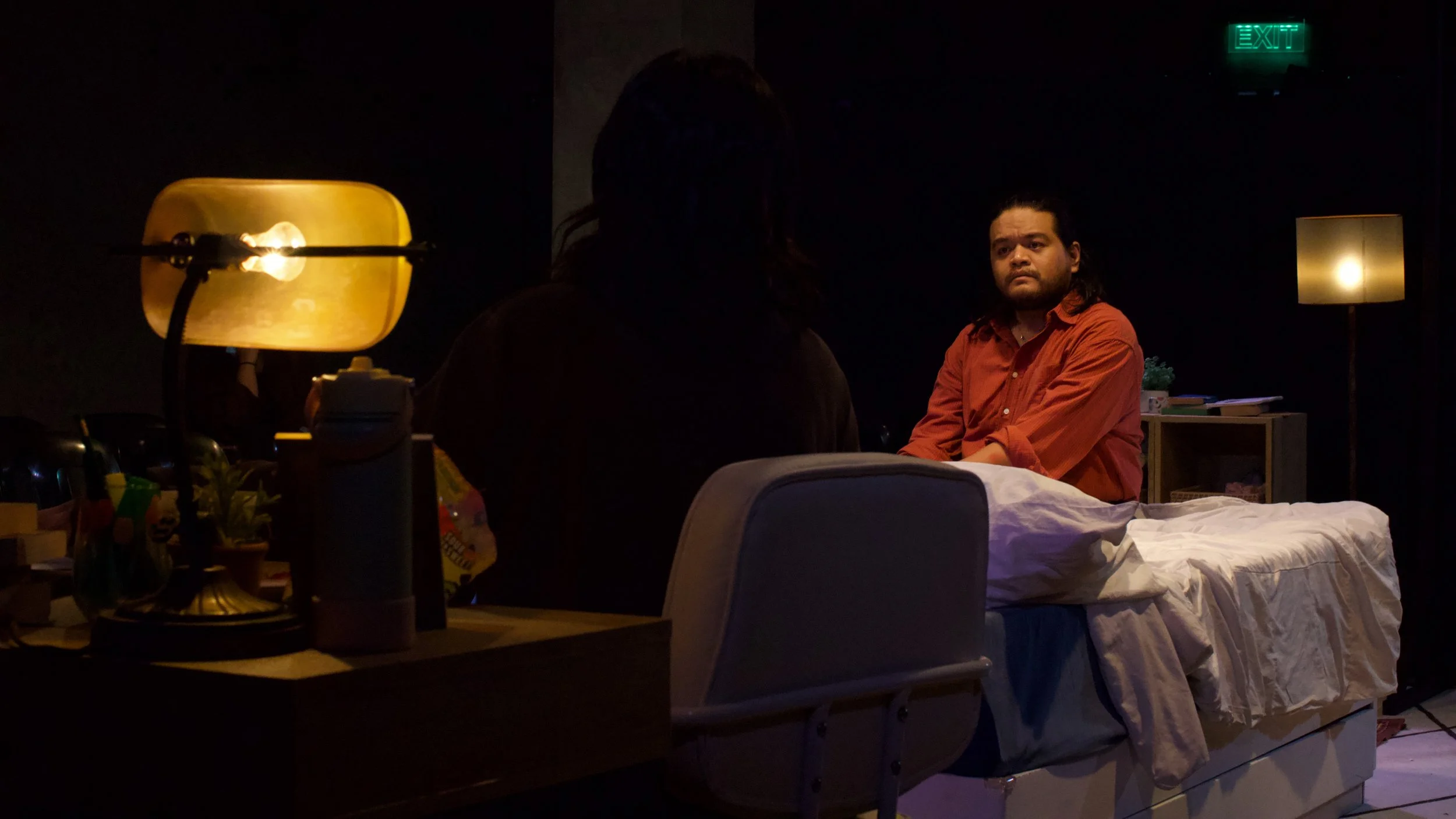
Edward Solon as Steven in Rachel Bonds’ Jonah | Photo by Spike Theatre
He makes no grand display of tenderness; he listens, waits, lets Ana change her mind sans taking that reversal for a slight. After Jonah’s sweetness and Danny’s need acquired their own aftermath, Steven’s restraint assumes a weight disproportionate to its scale: he does so little, and all the more discretion for Ana over herself.
Even the word okay gets recruited into the evasions. Bonds repeats it until reassurance becomes beside the point, the word left doing the dull administrative work of containing whatever Ana cannot yet say aloud.
Steven does not insist on clearing it out.
He lets Ana leave something unfinished.
The Men Ana Invents, The Men Ana Survives
The men around Ana become three competing theories of intimacy: Jonah, tenderness before history; Danny, history with nowhere safe to put it; Steven, tenderness after history has already left the furniture askew.
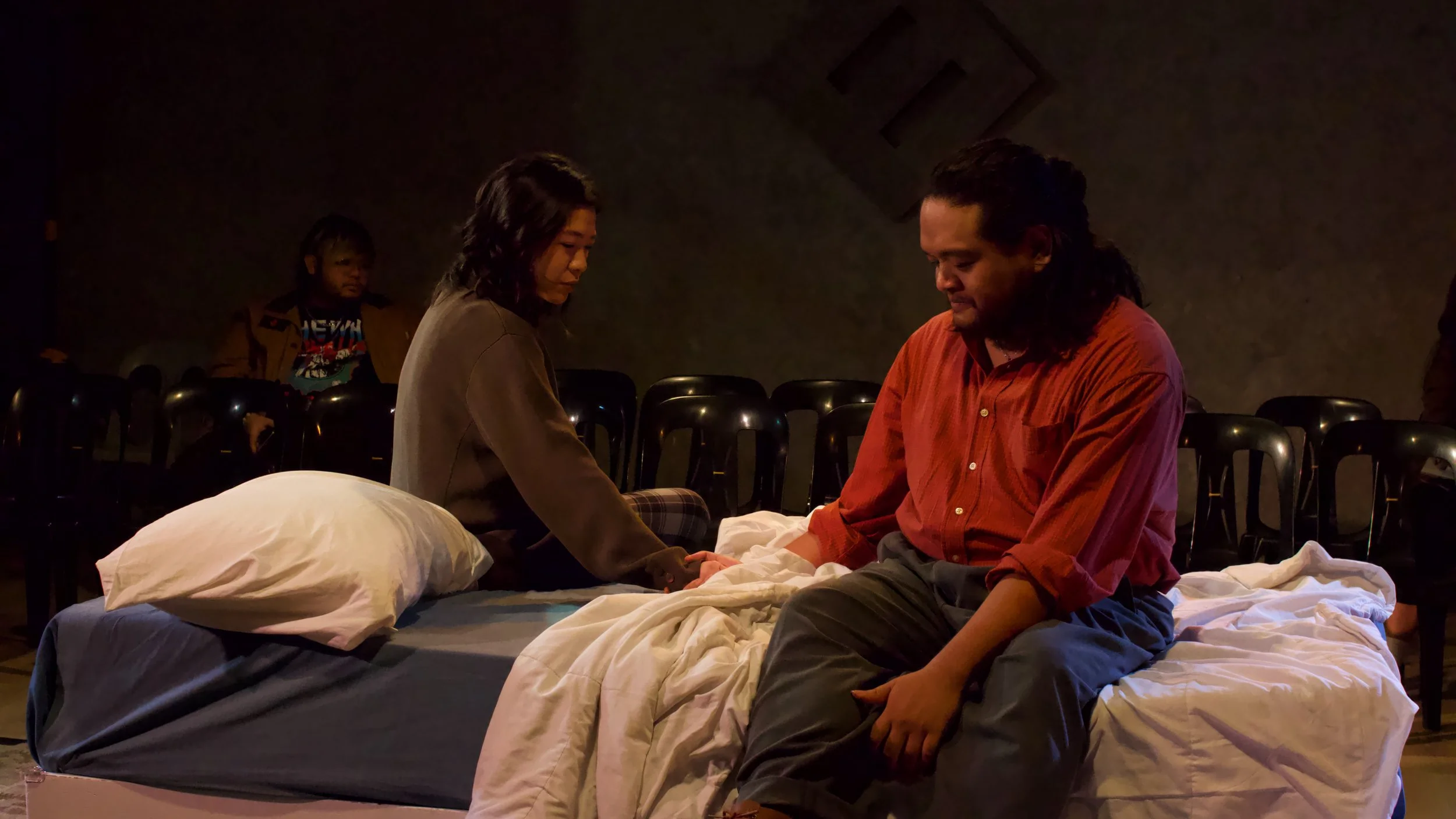
Actors Chelsea Nikole Apolto and Edward Solon in Rachel Bonds’ Jonah | Photo by Spike Theatre
Somewhere along the way, the title starts clicking into place that Jonah is not simply the man left behind in Ana’s memory, but the measure against which the others keep tripping over—the version of intimacy before love became something she had to survive.
Ana keeps herself going by changing the story’s terms. Jonah lets tenderness remain imaginable; Danny gives desire its consequences; Steven makes room for a closeness Ana can approach without surrendering herself to it.
None is a way out, but there is always a way forward.
The play is at its slyest when memory and invention are allowed to sit together without sorting out who belongs to which story; once the play starts pointing fingers, the uncertainty loses some of its appetite.
A transition occasionally shows its workings before the meaning catches up, but Spike has chosen a debut that leaves less for the handrails and less still for certainty—a risky introduction, perhaps, though an honest one for that reason.
By the final scene, the bedroom has become an accomplice to mind: intimate, rearrangeable, liable to move something of consequence while you are looking in the margins beyond.
Spike leaves the room unresolved, its unanswered corners doing more work than any tidy conclusion could: a debut still learning the weight of its walls, what they can shelter, and what they might yet have the nerve to let loose.