
Through Desaparesidos, Scene Change brings a story of Martial Law, disappearance, family, and resistance to the stage, reminding audiences why history must continue to be remembered.
Words Mariz Shane Linsangan
Photos courtesy of Martha Comia, Roldine Ebrada, and Zoë de Ocampo
October 10, 2026
History is often told through dates, names, and events. But behind every historical account are people whose lives were changed by what occurred. For those who disappeared under the Martial Law, their stories are not only part of the past. They are stories that must continue to be remembered.
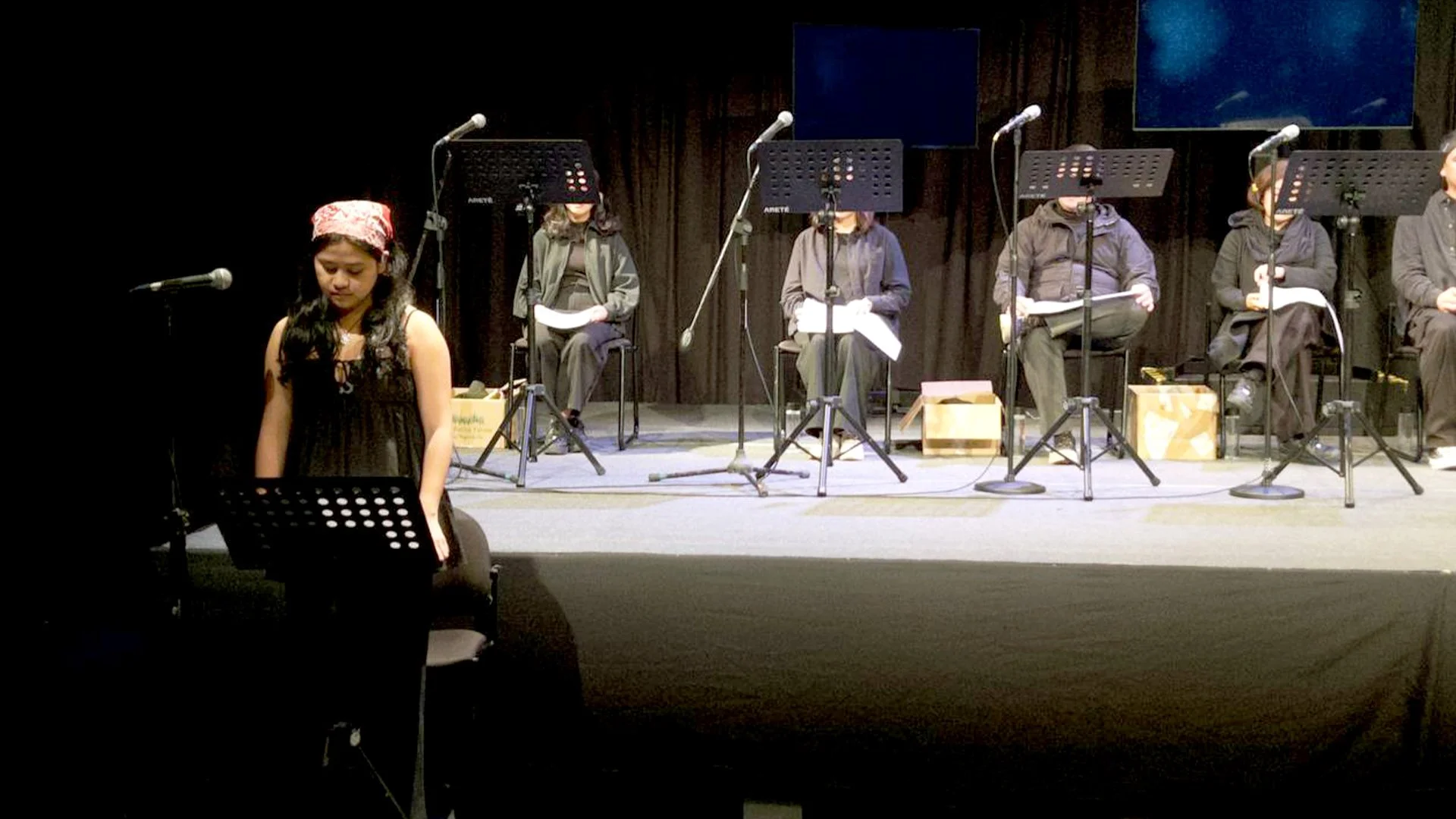
This is at the heart of Desaparesidos, one of the staged readings featured in Bantayog: Alaala at Gunita, a limited cycle presented by Scene Change. Adapted by Guelan Varela-Luarca from Lualhati Bautista’s 2007 novel, the play follows activists Anna and Roy through the years of Martial Law and the decades that follow.
Rather than presenting the period only through its political history, Desaparesidos looks at the people who lived through it. It shows what happens when political violence reaches families, separates mothers from their children, takes away loved ones, and leaves questions that remain unanswered for years.
Directed by Varela-Luarca with Kat Batara as co-director, the staged reading features Sheenly Gener, Marco Viaña, Jojit Lorenzo, Jam Binay, Ge Villamil, Gio Gahol, Yshma Aquino, Toni Go-Yadao, and Maliana Beran.
The Disappearance
At the center of the story is Anna, also known as Ka Leila, an activist whose husband Nonong is killed by authorities. His death becomes one of the many losses that shape her life during the struggle.
Anna is also a mother to a young daughter, Malaya. As the danger around them grows, she has to leave her child in the care of Karla, the pregnant wife of another kasama, Ka Jinkee.
The decision separates Anna from her daughter, but it also creates a relationship that becomes important to the story. Karla takes care of Malaya while Anna continues her involvement in the movement. Their situation reflects the difficult choices made by people who were forced to balance their families with the realities of political repression.
Ka Roy and the other kasama are also faced with the same dangers. Their lives are shaped by surveillance, violence, separation, and the constant possibility that someone may not return.
The story makes clear that political struggle does not happen separately from everyday life. The people involved are not only activists. They are husbands, wives, mothers, fathers, and children who have to make choices while living under an increasingly dangerous political situation.
When the Struggle Reaches the Family
The danger eventually reaches the community where Karla and Malaya are staying. When soldiers attack the village, Karla and the people around her are forced to face another violent disruption.
For Anna, the separation from Malaya becomes part of a longer search. She wants to know what happened to her daughter and where she is, while the people around her continue to face the consequences of the struggle.
This is where Desaparesidos moves beyond the idea of disappearance as simply someone being taken away.
Disappearance creates uncertainty for the people left behind. Families are left without answers. Children grow up without knowing the complete stories of their parents. Those who survive are left to remember the people who were taken from them while continuing to live their own lives.
The play gives these consequences a human face.
She is Malaya
Malaya becomes one of the story’s most important symbols because her name itself points to the idea of freedom.
She grows up with Karla, away from the mother who gave birth to her. For years, she does not know the full circumstances surrounding her childhood or the political struggle that shaped the lives of the people around her.
When Malaya eventually learns that Anna is her biological mother, the revelation changes her understanding of her own life.
The discovery is not simply about finding out who her real mother is. It forces Malaya to confront a history she did not personally experience but that has always been part of her life.
Anna had to leave her because of the circumstances surrounding their struggle. Karla became the person who cared for her. Both women are connected to Malaya in different ways, and the story does not make that relationship simple.
Through them, the play shows how political violence can affect a family long after the immediate event has happened.
Malaya becomes a connection between the generation that experienced Martial Law and the generation that came after it. Her story shows why remembering history remains important even for those who were not there to witness it themselves.
“Bahagi Ito ng Pakikibaka”
The idea of pakikibaka runs through the story, but Desaparesidos does not present it as something easy or romantic.
The characters lose people they love. They are separated from their families. They face violence and uncertainty. They have to make decisions that affect not only themselves but also the people around them.
The line “Bahagi ito ng pakikibaka” becomes significant because the struggle is shown not only through political action but also through the sacrifices made by ordinary people caught in extraordinary circumstances.
For Anna, part of the struggle means living with the pain of being separated from her daughter. For Karla, it means caring for a child while facing the same threats surrounding the movement. For Roy and the other kasama, it means continuing despite the possibility of losing their freedom, their families, or their lives.
The play also shows that pakikibaka can mean continuing to look for the truth.
Anna’s search for Malaya becomes connected to the larger search for people who were taken, killed, or disappeared. It is a search that refuses to accept silence as the final answer.
Remembering the Desaparesidos
The title Desaparesidos refers to the disappeared, but the play is also concerned with those who remain.
Their stories are important because disappearance does not end with the moment someone is taken away. The effects continue in the families, communities, and generations left behind.
This makes the story especially meaningful within Bantayog: Alaala at Gunita. A bantayog serves as a marker of remembrance, giving people and events a place in collective memory. Through theatre, Desaparesidos creates another space where these stories can be heard.
The staged reading also places the Philippine experience alongside Chilean history through Guillermo Calderón’s Villa. Both works engage with countries that experienced dictatorship and the difficult process of remembering political violence.
The connection between the two plays creates a wider conversation about disappearance, denial, memory, and how societies choose to remember their histories.
For the Philippines, Desaparesidos brings the conversation back to the people who lived through Martial Law and the families who continued living with its consequences.
Why These Stories Must Be Remembered
Desaparesidos is important because it does not allow the disappeared to become only names in history.
Anna’s search, Malaya’s discovery, Karla’s role, and the experiences of the kasama show the personal cost behind a period that can otherwise be discussed only through historical facts.
The play reminds audiences that remembering history means remembering the people inside it.
The disappeared had families. They had children, partners, friends, and communities. Their absence changed the lives of the people around them.
Their stories deserve to be told not only because of what happened to them, but because remembering what happened helps prevent those stories from being erased.
For younger generations who did not experience Martial Law firsthand, theatre can become a way to encounter these stories through another person’s eyes. It creates a space to ask questions, listen, and understand why memory continues to matter.
History will always be there, but how people remember it can change. Stories can be forgotten, distorted, or reduced to distant events. Works like Desaparesidos push against that distance by bringing the experiences of the disappeared and those they left behind back into the present.
This is where art becomes part of remembering. Theatre cannot bring back the people who were lost. But it can keep their stories alive. It can give audiences a reason to ask what happened, who was affected, and why those stories should never be forgotten.
In Bantayog: Alaala at Gunita, Desaparesidos becomes more than a staged reading about Martial Law. It becomes a reminder that remembering is an ongoing responsibility—especially for the stories of the desaparecidos, whose lives should remain part of the history we tell.
Produced by Scene Change (Sc.), the cycle continues the company’s work in creating intimate, text-focused theatre through productions such as 3 Upuan, Dagitab, and Ang Linangan.