
Guillermo Calderón’s Chilean drama arrives in Filipino through Giancarlo Abrahan’s charged translation and direction, turning a staged reading into an urgent meditation on dictatorship, memory, and what it means to remember.
Words Randolf Maala-Resueño
Photos courtesy of Martha Comia, Roldine Ebrada, and Zoë de Ocampo
October 9, 2026
What do we do with the ruins of a dictatorship?
Do we preserve them exactly as they were? Rebuild them into monuments? Turn them into contemporary art museums? Or let the past recede into the comforting distance of history?
Guillermo Calderón’s ‘Villa’ is as relevant as it gets. And a Filipino restaging is nigh.
In Calderón’s Villa, three women—all named Alejandra—are asked to decide the fate of Villa Grimaldi, a former detention and torture center under Augusto Pinochet’s dictatorship in Chile.
The original 2011 work turns that debate into something more volatile. A conversation about architecture. On an argument about memory itself. About who gets to shape it and what a country owes its dead.
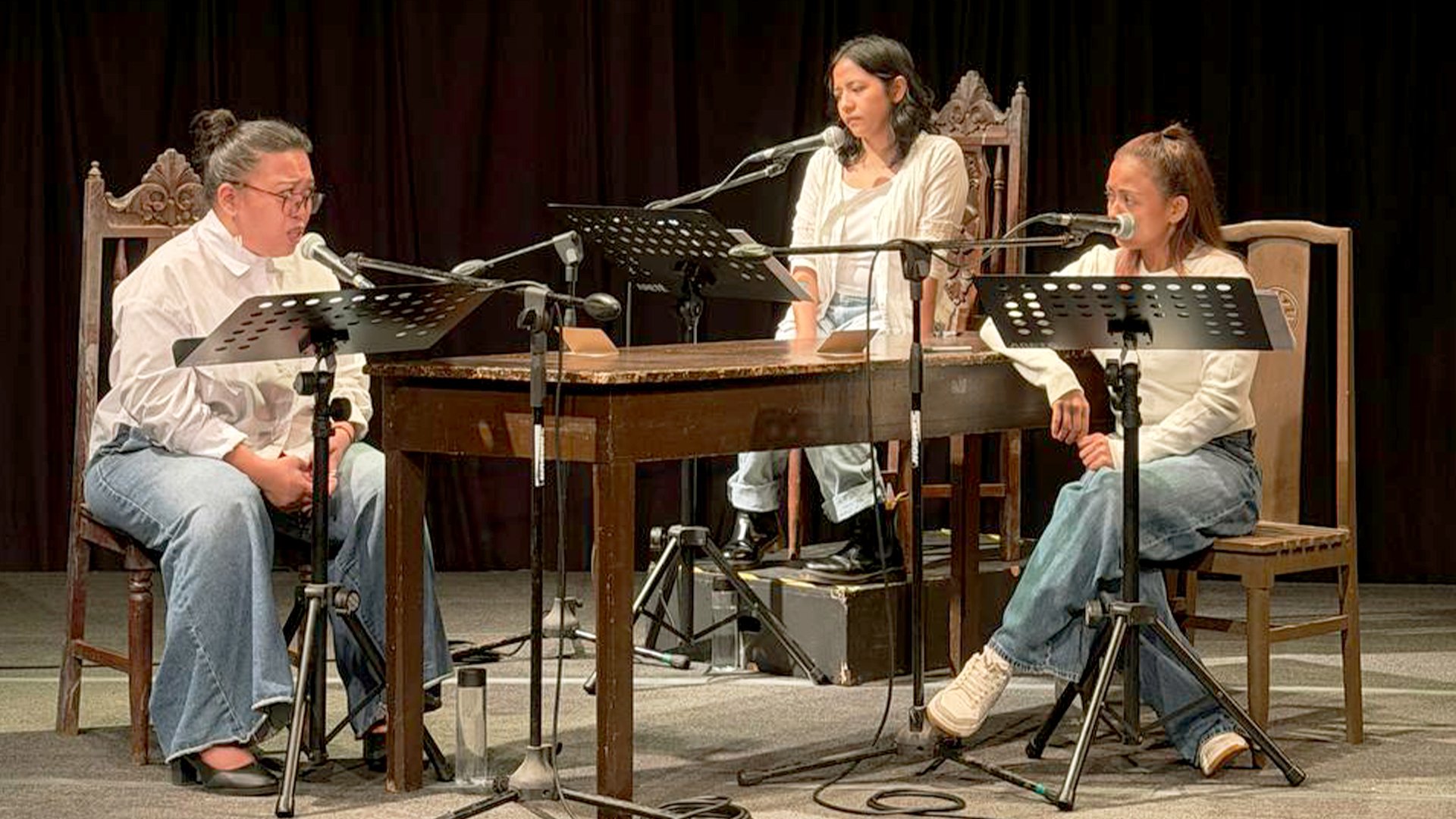
For Bantayog: Alaala at Gunita, Giancarlo Abrahan brings Calderón’s work into Filipino through translation and direction, placing its Chilean ghosts in a distinctly Filipino room. The result, presented September 19 and 20 at the Power Mac Center Spotlight Blackbox Theater in Circuit Makati, was explicitly a dramatic reading, not yet a full production.
And yet, watching Ness Roque, Martha Comia, and Meanne Espinosa work through the text, it was difficult not to imagine what this could become on a fully realized stage.
Three women, three ways of remembering
Roque plays her character as a pot-stirrer with a reservation that feels almost like resistance. Meekness and vindictiveness coexist in her performance, making every opinion feel capable of detonating the room.
Espinosa provides a grounded center. Level-headed and poised, she seems capable of mediating the ideological collisions around her, even as her own convictions quietly emerge.
But Comia supplies much of the reading’s emotional electricity. There is whimsy in her performance, but never frivolity. Her theatrical instincts make her monologues as recitations of a wider emotional excavation.
That matters because Villa is essentially a play about people trying to give language to something language cannot fully contain.
The women debate what should happen to the Villa. Their arguments become increasingly personal, philosophical, absurd, furious.
Each proposal for the memorial carries a different understanding of trauma: Should visitors be made to feel the terror? Should beauty be allowed into a place of horror? Can art transform pain without sanitizing it?
These questions are Chilean in origin. But in Filipino, they begin to hurt differently.
From Pinochet to Marcos
The parallels with the Philippines are difficult to ignore.
Pinochet’s dictatorship and Ferdinand Marcos Sr.’s Martial Law were not identical political histories, and they should not be flattened into one. But Calderón’s central question travels remarkably well: What does a nation do with the physical and psychological remains of authoritarian violence?
What happens when survivors remember one way and institutions remember another? What happens when younger generations inherit the trauma but not necessarily the memory? And what happens when a country decides that forgetting is easier than reckoning?
Abrahan’s Filipino translation makes those questions immediate. The language no longer feels imported. It is now a transmitigated inheritance.
A reading that deserves a stage
The sound design occasionally arrives abruptly, but its restraint ultimately serves the reading. There is no excess for excess’s sake. The momentum never collapses into monotony, even when the women are simply talking.
And what talking it was.
The monologues should be studied for their understanding of speech as theatrical action. Even without the physicality of a fully staged production, Roque, Comia, and Espinosa’s years of theatrical experience sharpen every pause, escalation, hesitation, and emotional turn. The three performers create a rollercoaster from words alone.
That is the strange power of a dramatic reading: it reveals the skeleton of a play.
Villa is not yet the production it could be. There are bodies, but no elaborate world around them; voices, but not the complete architecture of staging. And perhaps that makes the reading feel like a promise.
Abrahan himself called for producers and spaces willing to give these works another life. A challenge. An invitation. Because Villa deserves to be staged.
Not simply because Calderón’s work has already traveled across continents and into former sites of political violence, but because its central argument has found another language here.
The past cannot be rewritten. But neither can it be allowed to become decorative.
If the dead cannot speak, who speaks for them? If the survivors remember, who listens? And if history keeps repeating its questions, perhaps theatre’s responsibility is to keep asking.
Alas, do not forget.