
Designing Memory
Production and set designer Miguel Urbino brings The Notebook: The Musical to life on the Philippine stage.
Words Art+ Magazine Team
Photos courtesy of Theater Group Asia
September 20, 2026
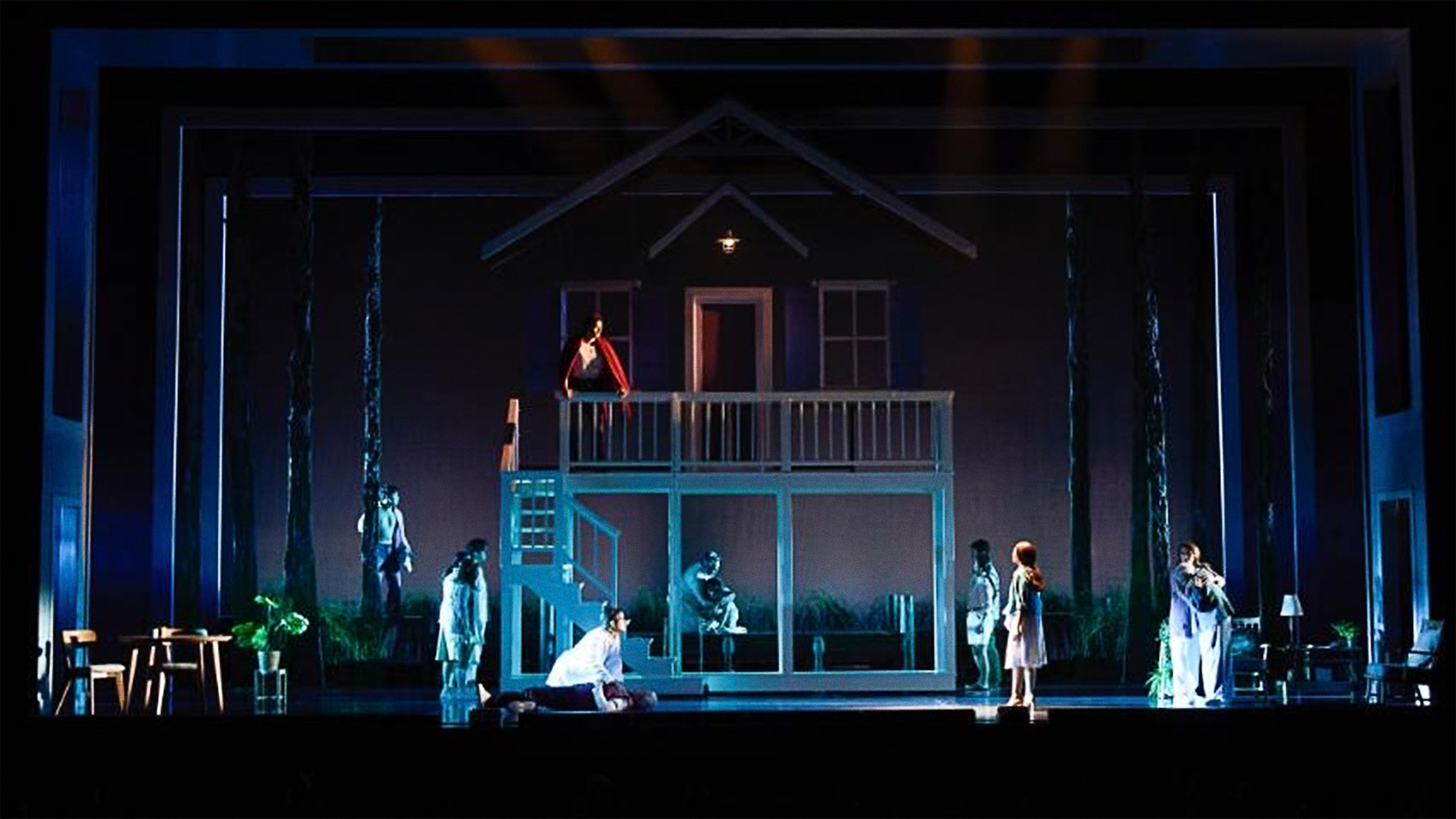
Theater Group Asia’s The Notebook: The Musical | Photo by Jyllan Bitalac and Sherie Bolo
For Miguel Urbino, designing Theatre Group Asia's production of The Notebook: The Musical began with a moment of doubt. Having already seen the Broadway production and enjoyed it, he initially questioned whether he was the right designer for a show of such scale. The task itself was daunting.
But Urbino had long wanted to design the sets and costumes for a major musical. So he returned to the music, and something shifted.
“Listening to the music again, I felt inspired, and all of a sudden ideas were bubbling,” he recalls. “At some point then, there was no doubt that I wanted to do this, and said yes!”
That decision has led Urbino into one of the production’s creative challenges: building a visual world for a story that moves constantly between memory and the present, across three timelines and decades of history.
A World Built Like Memory
Urbino’s approach is based on the idea that memory is rarely linear.

Production and set designer Miguel Urbino of Theater Group Asia’s The Notebook: The Musical | Photo by Ernest Gatpandan III
The Notebook moves between the present-day Memory Care Facility and the memories of Older Noah and Allie at different stages of their lives. Rather than treating these timelines as completely separate worlds, Urbino and director Nicholas Polonio developed a stage environment in which the past gradually emerges from the present.
“Memory being an abstract non-linear idea,” Urbino explains, “I thought about how the things we remember most vividly are in focus and the rest fades to a blur.”
That became the foundation for the scenic design. The present is grounded in realism downstage. Moving further upstage takes audiences progressively deeper into the past. The Middle Allie and Noah’s timeline, set in the late 1970s, occupies the middle of the stage, with a house anchoring that period. Further upstage, the Younger Noah and Allie inhabit the late 1960s, represented by the docks.
The physical progression is also a progression in theatrical language. As the story moves further into the past, the scenery becomes increasingly stylized — less like literal environments and more like the idea of theatrical scenery itself.
But these spaces are not static. Throughout the musical, characters move between them, allowing the boundaries between memory and reality to dissolve. Drops create changes in depth, while moving scenery can “iris-in” on more intimate moments.
The result is a stage that behaves much like memory itself: shifting, selective and constantly reshaping itself around what matters most.
Costume Becomes Character
For Urbino, the visual storytelling doesn't stop with the scenery. Realism in the costumes — expressed through silhouette and color — helps audiences understand who the characters are and when they exist within the story. But because The Notebook is a musical, Urbino has also allowed himself a degree of theatrical abstraction.
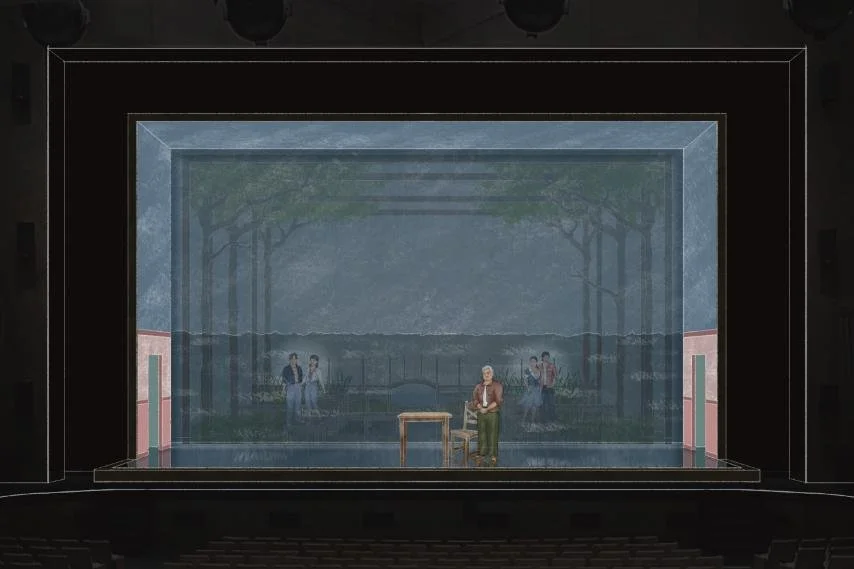
Early process work of Theater Group Asia’s The Notebook: The Musical
In particular, each of the three Noahs and three Allies is associated with a distinct color.
“In real life, most people wouldn’t only wear one color over the course of their lives,” he says. “But this being a musical also allows us to suspend that disbelief.”
Color becomes part of the characters’ identities, while fabric, texture and print can reveal something about their relationships with themselves and with one another.
“I try to find the balance between creating the big picture while being specific,” Urbino says, “paying attention to the granular details and deciding where choices land on the spectrum of ‘costume’ to clothing, and ‘scenery’ to space.”
That balance is particularly important in a story where visual design has to support emotional transitions without calling attention away from the performers.
“I like to think that if my work is unnoticed, I’ve done my job,” he says.
A Love Story with a Filipino Sensibility
Urbino's interpretation is also informed by the television dramas he grew up watching in the Philippines, including Mula Sa Puso, Pangako Sa’yo, and Maalaala Mo Kaya.
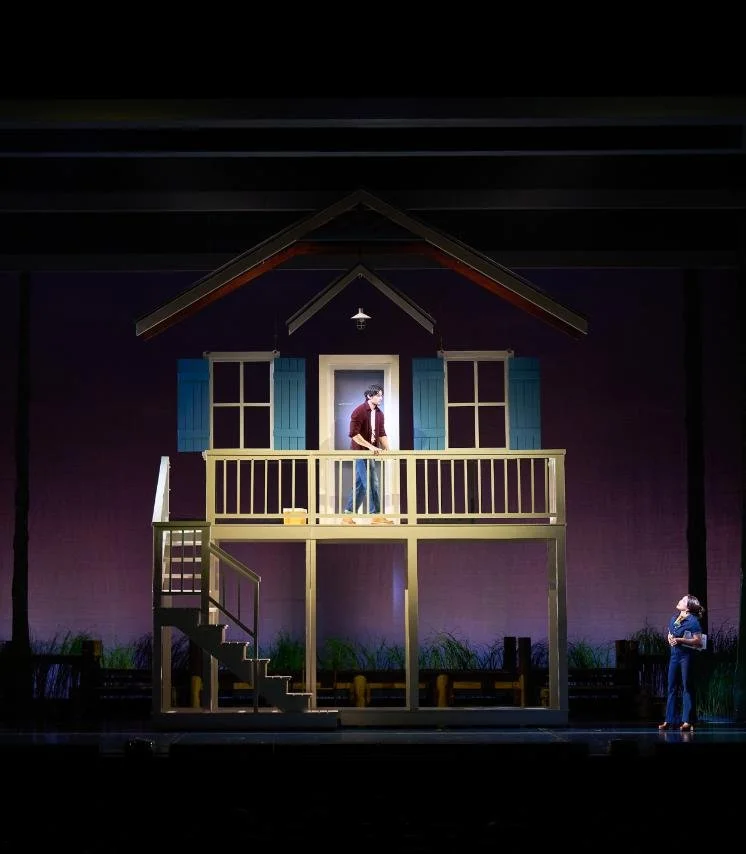
Theater Group Asia’s The Notebook: The Musical | Photo by Jyllan Bitalac and Sherie Bolo
“The Notebook also deals with family, regret, age, and so many human experiences, but it is first and foremost, a love story,” he says. “It reminds me of the teleseryes and dramas I watched growing up.”
Those influences became part of the design vocabulary. Urbino describes the world of the musical as one driven by a “heightened-yet-human drama,” a sensibility that pairs naturally with the visual language of mid-century musical theatre. His goal, however, was not simply to recreate a period aesthetic.
He wanted to “lean into all of that, but at the same time make it feel fresh and modern.”
That combination — heightened theatricality grounded in recognizable human emotion — gives the Philippine production an opportunity to feel both connected to the musical’s established identity and distinctly its own.
Behind the romantic story is an enormous logistical undertaking. The production has to move rapidly between three timelines while maintaining the clarity of a non-linear narrative. There are practical demands, including the musical’s iconic rain sequence. And then there is the fact that all of this has to happen while telling a story through music.
Yet Urbino sees those difficulties as part of what makes the project exciting, and it is so rewarding to see things come together.
“I feel so lucky to be a part of the second team to envision this show,” Urbino says. “And to bring it home to the Philippines makes it extra special.”