Art of Resistance
In a country gutted with crises, artists Pio Abad, Electromilk, and Monokromatiko discuss how art can bring people together in times of social injustice.
Words Marc Nathaniel Servo
Photos courtesy of Banksy, Monokromatiko, Pio Abad, & Electromilk
November 10, 2025
In a world where inequality is the norm, people are bound to resist. However, inequality is a weapon in and of itself: it separates people by status—whereas one could only seek resistance, others could bask in comfort—and so, only by extending the right perspective can people unite into one struggle.
This is where art comes in: to evoke meaning, and to provoke those in power.
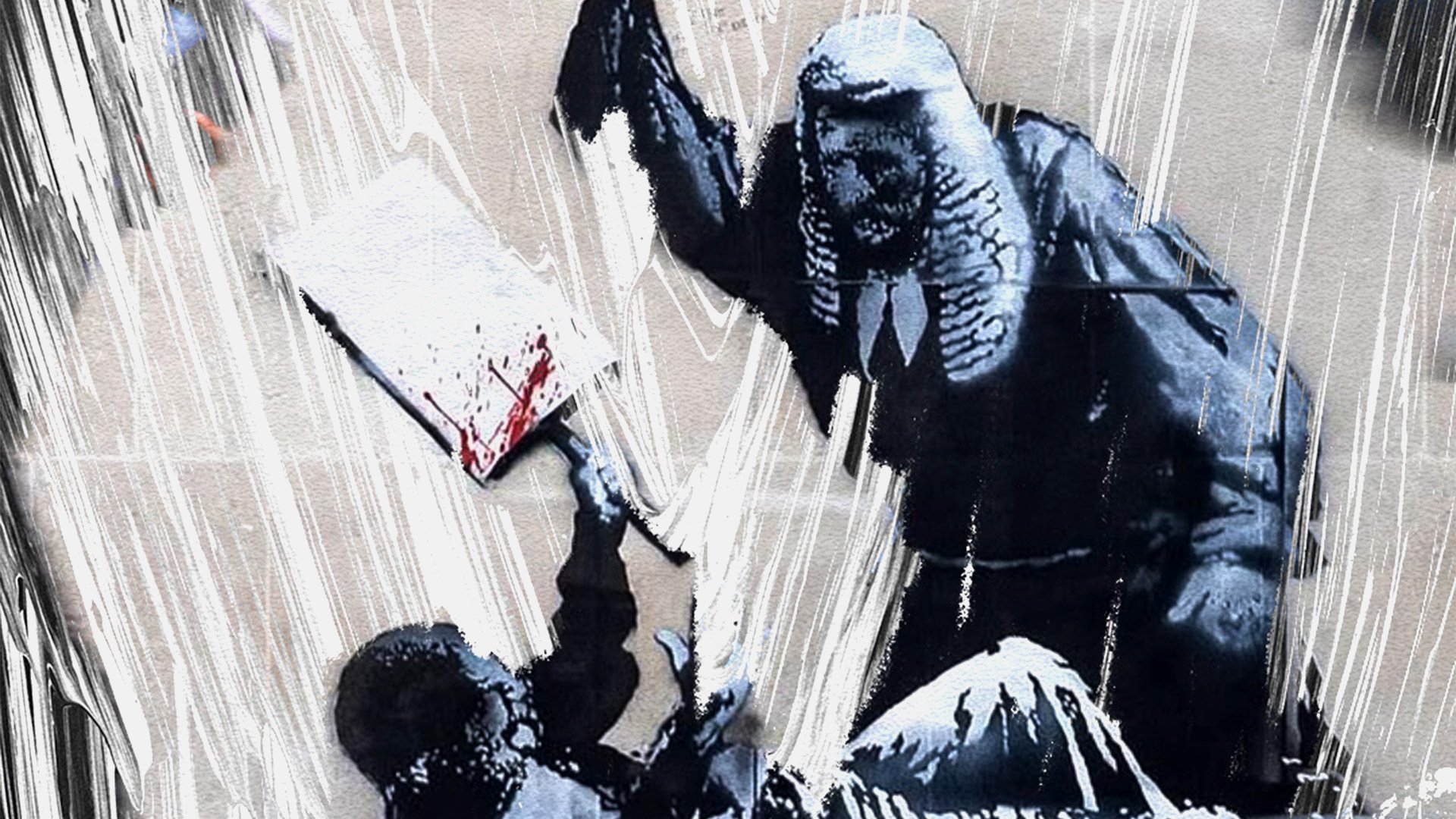
A few months ago, street artist & activist Banksy put up an art piece over the wall of the Royal Courts of Justice in Westminster, London, depicting a judge beating a protester with a gavel, the placard spattered with blood, in response to UK’s crackdown on Palestine protests.
While short-lived, the spraypainted work questioned the propriety of arresting more than 900 protesters during the ban on Palestine Action organization, prompting police hunt to the serial art activist.
All around the world, protests like this unfolds—from Indonesia, and France, to Nepal—and in every step of the resistance is a mark of artistry that carried the will of the people visually: from street arts, One Piece flags, and art performances, to bold caricatured effigies that represent the outrage, and heavily criticize widespread corruption in their own states.
In the Philippines, similar protest actions spark social movements. In the cusp of September 21 anti-corruption rally, art highlighted the ugliness of corruption, and the power of united struggle amid police violence.
For Filipino artists Pio Abad, Monokromatiko, and Electromilk, art can be traced in every moment in history citizens have united against a problem larger than any of them. Art has the capability to challenge the status quo in ways words cannot—through powerful symbolisms and imagery that carries the will to move people into action.
Reflection of reality
Art is a mirror of the reality we live in. For Monokromatiko, an artist has the power to inform, and therefore, carry the weight of shaping opinion in every stroke.
“Art should be political. Kasi kapag neutral ka kasi, you’re siding with the oppressor. Of course, ok lang naman maging [neutral] pero you have the power to inform people, so why wouldn’t you choose that? Nasa iyo ‘yong magsisilbing mitsa, nasa iyo ‘yong sining para makapagpalaganap ng impormasyon,” he shared.
As an editorial cartoonist, Monokromatiko borrows ideas from his daily life, reflecting the state of the nation as reported in the news or shared in online forums. From there, he pours his feelings to his art—the grief, the disappointment, and the outrage to share with his audience, “Nagsisilbi kasi ang art na mitsa ng pakikibaka. Ito yung first step para magkaroon ng ganitong pagtitipon, parang inaamplify kasi ng sining ‘yong nararamdaman natin as a whole.”
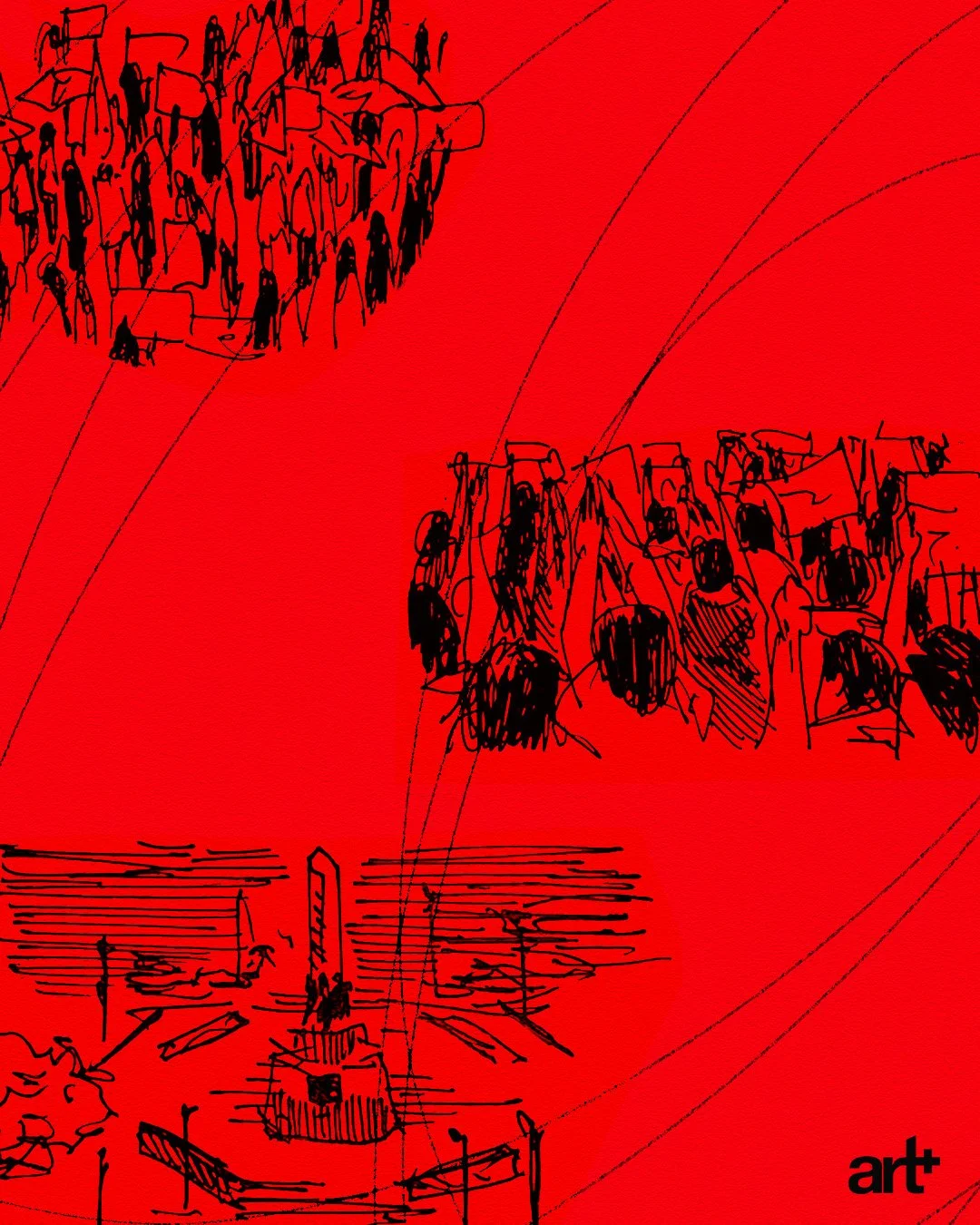
In his most recent work, Monokromatiko drew the idea from “Tatsulok” by Filipino singer Bamboo, dividing the protest lines in three distinct class divisions: the masses (protesters), the police, and the corrupt. In the work, he states, “mas mabigat ang dalawang sulok ng tatsulok,” citing how the united will of masses could defeat those in power.
He also posted a work after former president Rodrigo Duterte’s ICC arrest, transforming the death toll of drug war into tally lines that converge into a jail cell, with Duterte inside—in what is deemed as poetic justice.
Meanwhile, comic artist Electromilk believes that art is political because it is heavily influenced by the personal and social conditions the artist is in. Therefore, an artist should first strive to understand what’s happening in society before they could truly carry the spirit of protest art.
With that, the role of art is to highlight personal experiences that could resonate with the life of many. These similarities in experiences allow people to share the same anger, or at least wear the same shoes, to recognize that the ills of the state affects us all.
“Unlike news and science that’s kinda limited to reporting facts, art can touch on emotions or focus on smaller areas that can easily be overlooked. Art constantly reminds us of our togetherness in spite of distances, when you start to realize you’re not alone in your misery, or that you can just as easily be in worse conditions, it’s like an invitation to move as well,” Electromilk explained.
In Electromilk’s recent work, the artist condemned the backlash against the September 21 protest, after many blamed the protesters for the rally turning violent. The messy lines—together with the heated statement—made the comic feel raw, strong, and heartfelt.
Reflecting within
More than the external, visual artist Pio Abad believes that art mirrors the past to help people make sense of history and reconcile with their emotions attached to it. Throughout his collections, objects entangled with politics and dark history reminded viewers of the ghosts of the past—one that could happen again lest we forget where we came from.
In his work, Fear of Freedom Makes Us See Ghosts, Abad collected Marcos loot hidden or presumed destroyed by the titular corrupt family—all to document reality but also, in a way, to exorcise the spectres of the Marcos regime that haunted him, as much as everybody else.
Abad still roughly remembers a scenario during his decade-long chase of Marcos vestiges, “I was asked before, “Why are you doing this, they are not coming back,” but they indeed, returned to power so for me, it’s more about putting a mirror to our past considering that well, the Marcoses institutionalized corruption in the Philippines.”
His exhibit then became a ‘site for grieving’ following the election of President Ferdinand “Bongbong” Marcos Jr., at the Ateneo de Manila University. For Abad, his work became a way for Filipinos to reconcile with their feelings—“to examine their defeat in granular detail.”
Perhaps, it is in the meanings portrayed by artworks that humans are able to see beyond their own capacities—to find the will to face something bigger than themselves. For Electromilk, it is in our own personal interpretations that art becomes powerful.
“The inherent ambiguity of art can create spaces for asking questions and inviting people to think beyond what they initially perceive. Art suggests different ways to see, which is what we need in these circumstances where even though it seems clear to some where the problems come from and what their effects are, there are others who refuse to acknowledge it; art can offer alternative points of view.”
It is in emotions that art holds a deeper connection. From reconciling the conflicts within to finding new interpretations that truly resonate to oneself, art allows us to peer into our own lives and in turn, gives us the clarity of reality and the will to resist.
Art is Resistance
Living in a nation plagued by corruption and impunity, the question of whether art should be political can be answered in one word: Yes. Monokromatiko, Abad, and Electromilk fervently believe in not just the power of art to move people, but the capability of artists to walk the streets.
For Abad, his exhibit of the Marcos loot remains relevant to the corruption of flood control projects, stating that the situation today is not an outlier—it happened, and is happening, and would happen again as long as the system remains to be rotten. Thus, artists should continue recording history and rekindling memories so that the nation does not forget.
To Monokromatiko, art could go beyond informing people to saving actual lives. As such, he calls for other artists to unite as a community to continue drawing, to continue making, and to continue making sense of the world visually. That even with limited followers, each tiny wave could become a tide that will flood the rotten system.
“I think one has to come from developing an understanding of the situation and what it’s like for the people most affected. Somehow, it has to be both putting oneself on paper but also making it not about “you” alone. And artists shouldn’t stop at just making the art. At the end of the day, you actually have to show up and be with your people,” Electromilk concludes.