
Stephen Amoyo Reimagines Sungka as an Architecture of Diaspora
From mancala to Manama, Sungka keeps its stones moving—now retooled by Stephen Amoyo as an architecture of play, memory, and migration.
Words Bernadette Soriano
Photos courtesy of Stephen Amoyo
May 14, 2026

There are objects that survive as artifacts, and there are those that keep moving, changing shape as they cross borders, and absorbing histories as they go. For architect Stephen Amoyo, Sungka belongs to the latter.
Its point of departure was intimate enough: a conversation between a mother and son in Doha, circling back to childhood in the Philippines, to remembered afternoons, to the familiar rituals of play.
Yet memory has a way of slipping its frame. One recollection opened into another, until what began as nostalgia widened into something closer to historical inquiry.
And then further still.
In tracing Sungka’s roots through the ancient Mancala tradition, shaped along African and Middle Eastern routes before finding home in the Philippines, Amoyo arrived at the project’s conceptual hinge, crystallized in a question that would come to guide the work: “What if Sungka were reimagined through the lens of modern Filipino life in the Middle East?”
That question animates SUNGKA! Architecture and Play leads, almost inevitably, to a wider meditation on how objects accumulate meaning as they move. Within the project, the board game gathers several registers at once: object, structure, mnemonic device, migratory artifact.
Because Sungka, after all, has always traveled.
Its history is braided into old mercantile passages and seafaring exchange, carried through trade winds long before it settled into the intimacies of Filipino domestic life. What the project does, then, is less an act of recovery than of recognition: that what appears local is often the endpoint of longer trajectories.
And so the project begins from an architectural question with unusually broad resonance: how might a game board hold the memory of the routes that once brought it into being?
Folding Form, Unfolding Passage
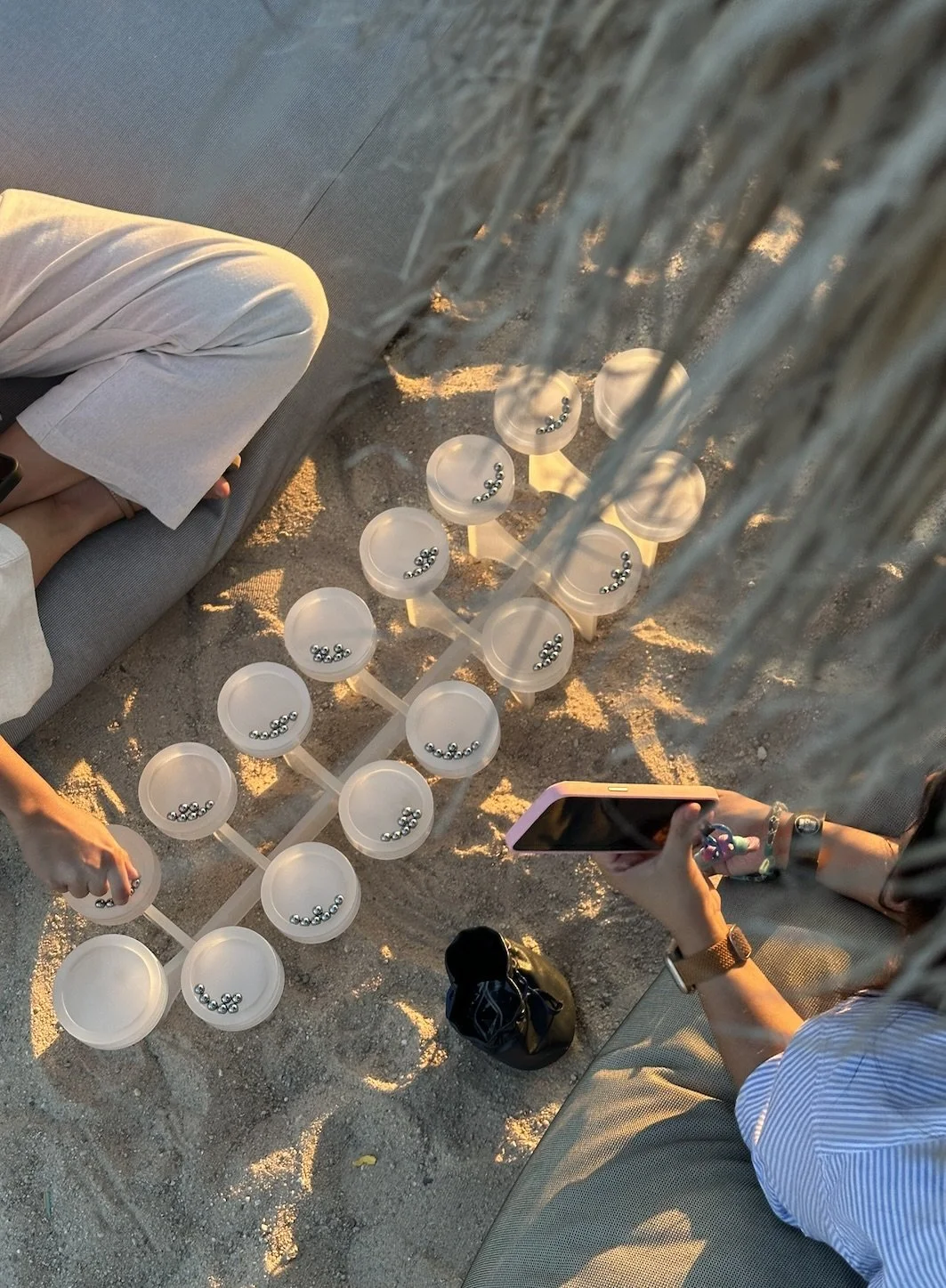
The object answers through silhouette and structure. Its geometry draws from multiple spatial grammars: the raised domestic logic of the bahay kubo, the arched and rhythmic language of Qatari architecture. These references do not resolve into synthesis so much as remain in productive adjacency, held together through proportion and restraint.
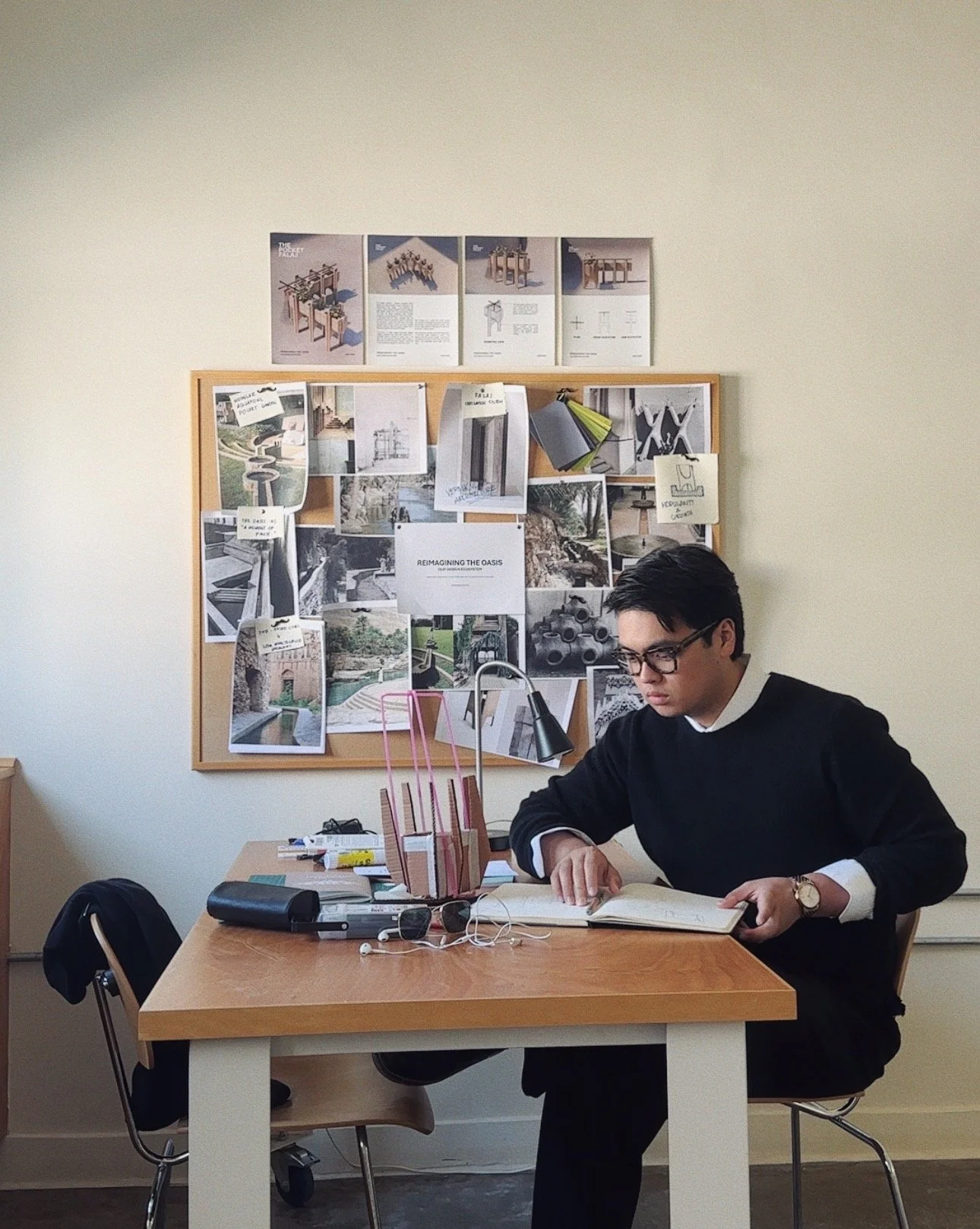
Architect Stephen Amoyo
The synthesis feels deliberate, though never heavy-handed.
As Amoyo describes it, “The board can be collapsed and transported — a nod to the nomadic nature of early traders and the modern transience of expat life in the Gulf.”
Mobility operates as a governing principle, materialized through modular construction that accommodates the realities of diasporic movement, from folded-suitcase existence to the provisional permanence of migration and the subtleties of in-between spaces.
Even in repose, the object resists singular definition.
At one scale, a board game; at another, domestic sculpture; elsewhere, a vessel for keepsakes, jewelry, and smaller accumulations of personal memory. Function spills over into multiple categories, while use folds into layered, shifting forms.
There is, too, a notable material restraint. Laser-cut opaque acrylic lends the work a translucent atmosphere, finely calibrated, almost weightless in appearance. Amoyo’s reference to the Barong Tagalog enters here with particular elegance, less quotation than one of abstraction on its traditional dress being translated into surface, light, and fabrication.

Minimal material, maximal resonance.
What emerges is a project attentive to how memory can be embedded in form without lapsing into sentimentality, memory itself becoming, in effect, material within the act of construction.
Building Heritage Beyond the Blueprint
As Amoyo frames it, “This work reinterprets heritage as a living, movable object — one that travels with us, adapts with us, and keeps us rooted even as we move.”
Embedded in that statement is the project’s deepest proposition.
Design, in Amoyo’s handling, becomes a mode of cultural continuation—one that carries inherited forms forward without arresting them into symbols. More so in a diasporic context, where identity is assembled through fragments, repetitions, and acts of translation, the gesture takes on added weight.
Even play acquires architectural consequence.
And through this process do Amoyo fold personal narrative into broader questions of migration, belonging, and form-making. The piece comes off as a love letter, yes, but it also opens out into a proposition—on what objects manage to hold, how design reaches across multiple geographies, and how identity, like architecture, gets built up in layers over time.
One might call it a bridge, but that feels too fixed.
This is something more fluid.
A vessel, perhaps.
Or better yet, a threshold.
Rooted in Transit, Carried in Form
In Amoyo’s hands, Sungka exceeds its status as a game passed down through generations, turning instead into a site where Filipino memory meets Gulf modernity, where trade histories echo through contemporary design, and where diaspora is taken up as fertile ground.
And maybe that is the quiet brilliance of the work: it understands that culture does not lose itself when it travels.
It gathers.
As Amoyo writes, “SUNGKA! Architecture and Play is a love letter to the in-between — to life in the Gulf, to the Philippines we carry with us, and to every Filipino finding their place across the Middle East and beyond.”
Rooted, yet in motion—a paradox Amoyo knows well.
And one this project carries beautifully.