Requiem for a Social Realist Artist
A tribute to Antipas Delotavo.
Words Benjamin Locsin Layug
Photos courtesy of Tin-aw Art Management Inc.
April 11, 2026
Last December 2, 2025, the Philippine art community mourned the passing of Antipas “Biboy” P. Delotavo, Jr., a popular Ilonggo visual artist whose name has long been etched in the history of Philippine social realism. One of the country’s most respected and influential contemporary painters, he created art of sociopolitical meaning for the purpose of articulating conflict and effecting social change, giving voice to the marginalized and laying bare the social realities of the Filipino people. Biboy’s vision helped shape the way generations understand truth and humanity.
Born on March 18, 1954, he first studied at the University of San Agustin in Iloilo City and, in the turbulent 1970s, moved to Manila, studying Fine Arts at the Philippine Women’s University (PWU). Here, he honed the visual sensitivity and critical clarity that would later define his practice. He also received a grant from the French Embassy and the British Council to travel to Paris and London, respectively.
In 1976, he was a key figure in the formation of KAISAHAN, a historic collective of young, idealistic artists committed to Social Realism during the Marcos period of political repression and dictatorship. Fellow artists Jess Abrera, Pablo “Adi” Baens-Santos, Orlando Castillo, Jose Cuaresma, Papo de Asis, Neil Doloricon, Edgar “Egai” Talusan Fernandez, Charles Funk, Renato Habulan, Albert Jimenez, Al Manrique, Jose Tence Ruiz, and Vin Toledo were also prominent members.
Since he started in 1977, Delotavo, an artist of quiet, self-effacing demeanor, has shaped the direction of Philippine Social Realism, influencing generations of artists, cultural workers, and viewers. His paintings have appeared in institutional collections, landmark publications, and dozens of major exhibitions, both in the Philippines and in Madrid in 2006; Singapore and Fukuoka (Japan), both in 2008; and New York in 2018.
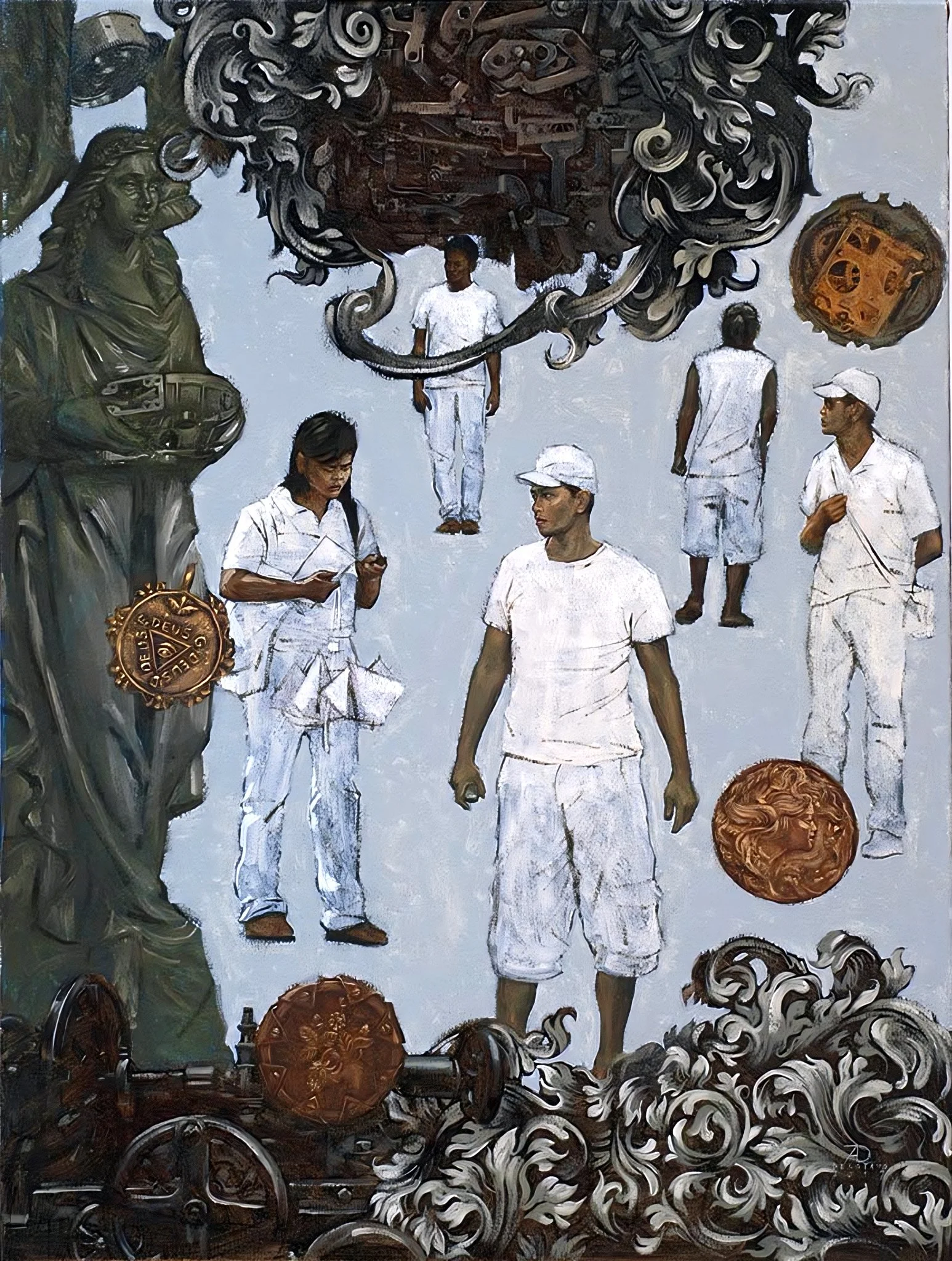
Lihis sa Kaligtasan
A multi-awarded painter, Biboy has won top awards (including prizes in photography and non-objective painting, showing his versatility) in the Art Association of the Philippines (AAP) competitions, a crucial platform for emerging Filipino artists, in 1978 and 1979. In 1987, newly installed president Corazon C. Aquino asked him to do her official Malacañang portrait. Later, he won a Thirteen Artists Award recognition from the Cultural Center of the Philippines in 1990; the Philippine Art Awards in 2000; a 100 Alumni of the Century recognition from Iloilo’s University of San Agustin in 2004; a Hall of Fame in the Gallery Genesis Kulay sa Tubig contest, also in 2004; an Araw ng Maynila Patnubay sa Sining Award in 2005; and a Garbo ng Bisaya Award from the Dumaguete City, hosting of the VIVA Excon, in 2012.
Whether working in watercolor or oils, Delotavo is one of the Philippines’ most respected portraitists, belonging to an elite and revered roster that might include Fernando Amorsolo, Romulo Galicano and Martino Abellana.
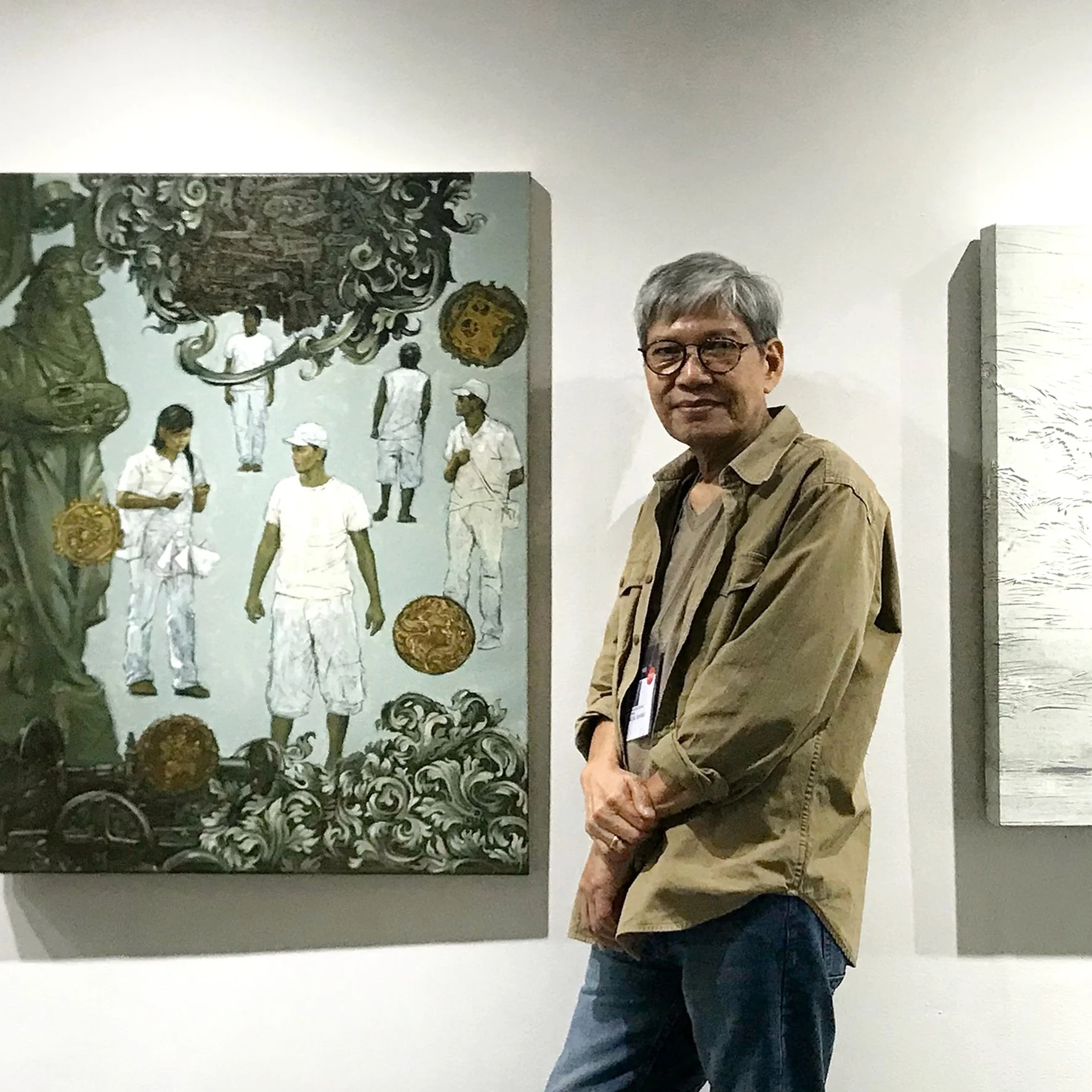
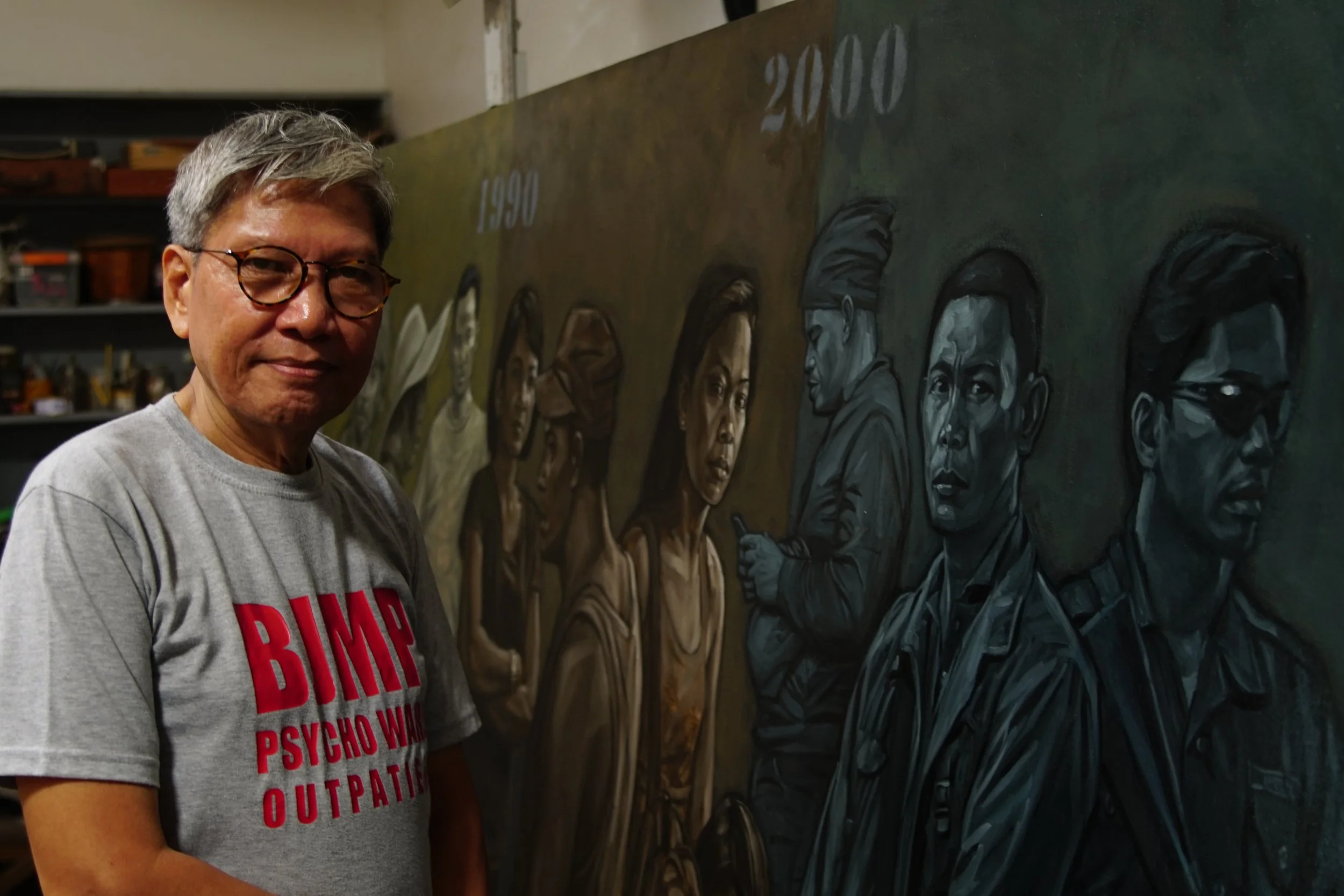
The artist at the Tin-aw booth during Art Fair PH 2018
Throughout his nearly five-decade long career, Delotavo committed his art to revealing some of the harsh realities of poverty, oppression, and injustice experienced by ordinary individuals in Philippine society; unmasking the struggles of workers, the urban poor, and the socially displaced, individuals whose stories are often overlooked, yet portraying the everyday Filipino with dignity, honesty, and emotional weight.
A large body of Biboy’s realist work consists of portraits of laborers and the urban poor, doing a series of construction workers engaged in building the Marcos Period edifices. One of his most famous works is Itak sa Puso ni Mang Juan(“Dagger at the Heart of Mang Juan”), a watercolor painting on paper (1978) which remains one of the most recognizable and courageous visual commentaries in Philippine art. A searing critique of multinational control, neocolonial influence, and the exploitation of Filipino labor, it features an old, humble laborer standing in front of an overpowering corporate symbol of a transnational company, which some critics described as “crucifixion of the proletariat by a harsh capitalist system.”
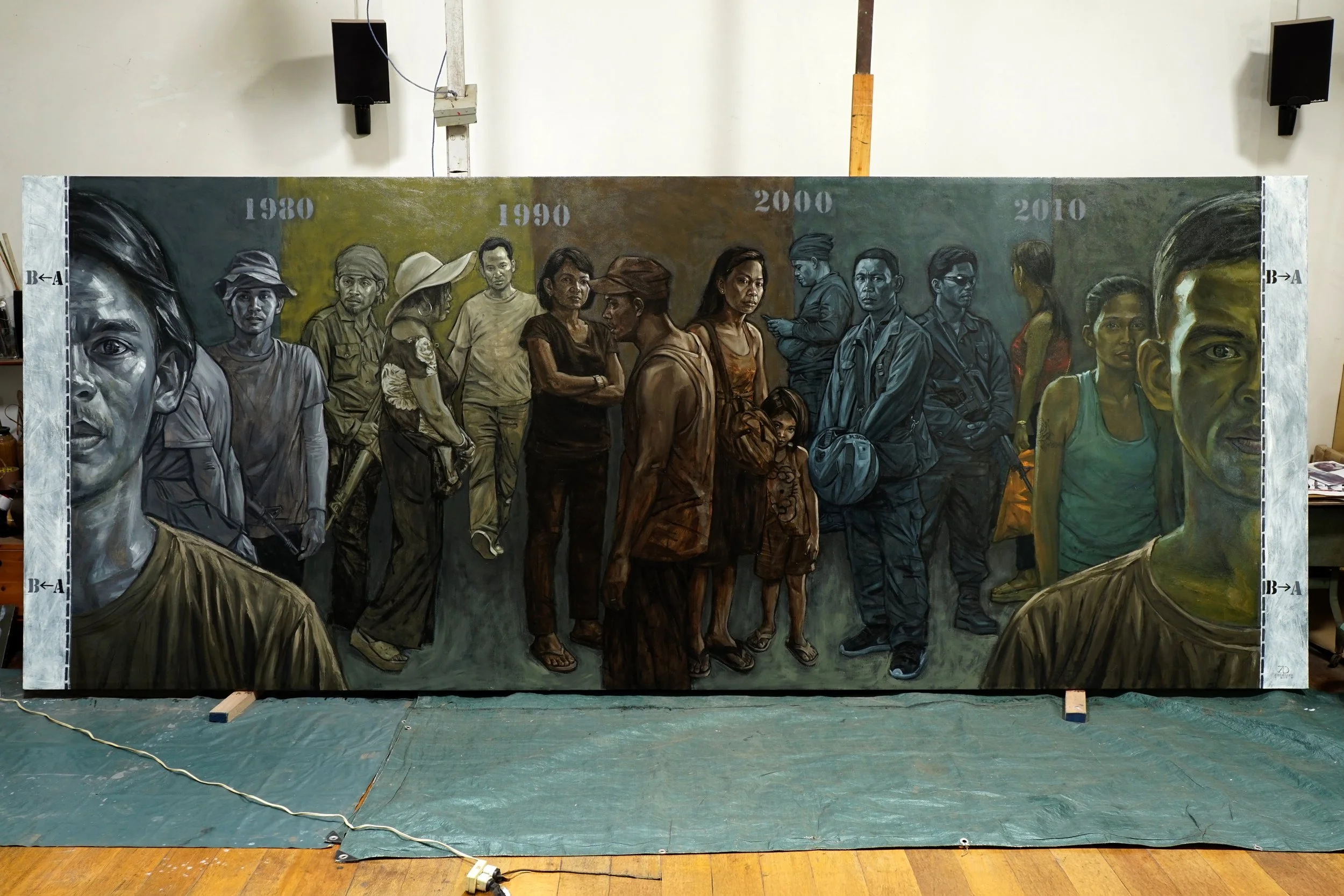
Antipas Delotavo, Kasaysayan, 2019, 6 × 15 feet, oil on canvas.
Struktura, another powerful Philippine social realist painting created in oil in 1990, during the Corazon C. Aquino administration, also depicts a lone, ordinary Filipino worker positioned against imposing corporate structures, symbolizing the alienation and exploitation of labor under modernization and capitalist oppression.
Providing courageous visual commentary on class struggle, Biboy revealed the harsh realities faced by ordinary Filipinos, and his visual language was marked by empathy, realism, and a calm yet piercing moral force. His art stands as a testament to the responsibility of artists to witness, confront, and reveal the truths of their time, speaking eloquently and, at times, starkly, like a dagger in the heart of a nation beset by poverty, plunder and state-sanctioned killings.
Delotavo’s philosophy was simple yet profound: “There is no high art or low art, for as long as an artwork touches your heart, it is the best art in the world.”