Pressures Beneath The Surface
Cracks, climate, and material shape Ardeña’s paintings as shifting, living surfaces
Words Marz Aglipay
Photos courtesy of Allain Dadivas
April 24, 2026
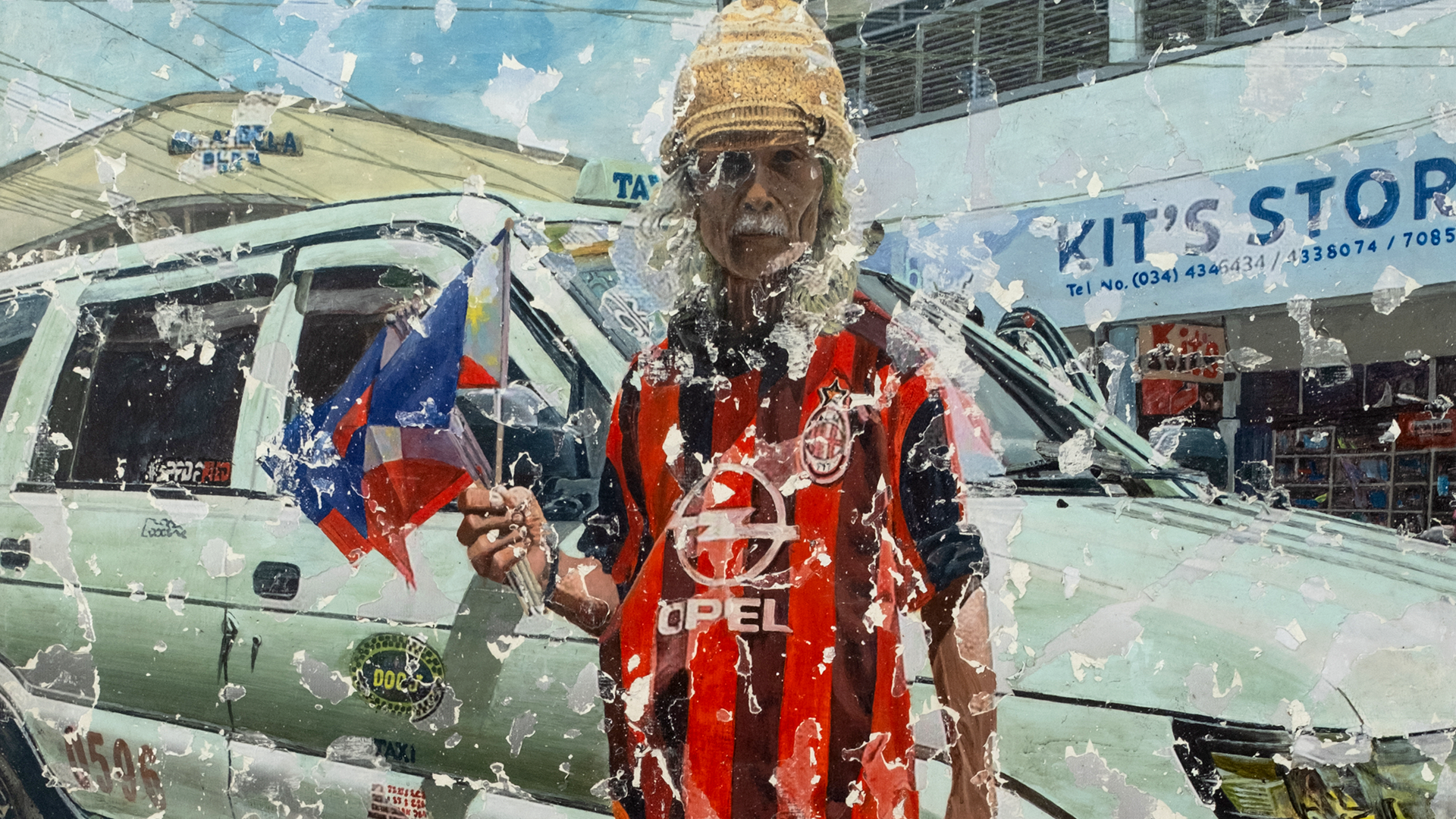
The paintings in Seiches look finished—until they don’t. The paintings conceal printed images beneath the paint, blurring the line between what’s painted by hand and what was already there. The cracks are intentional, but they don’t feel forced. They mirror a familiar reality in the tropics, where decay isn’t flaw—it’s nature. As these works persist, their changes feel endless, being exposed to time and climate.
Cracks are usually the first thing people notice in Kris Ardeña’s work, but it’s not a stylistic choice. They’re the way in. From painting retaso rug patterns to flora, Seiches leans into realism—not as nostalgia, but as homage. Since moving to Negros in 2015, where paint weathers fast and nothing stays smooth for long, Ardeña’s work has learned to move with its surroundings.
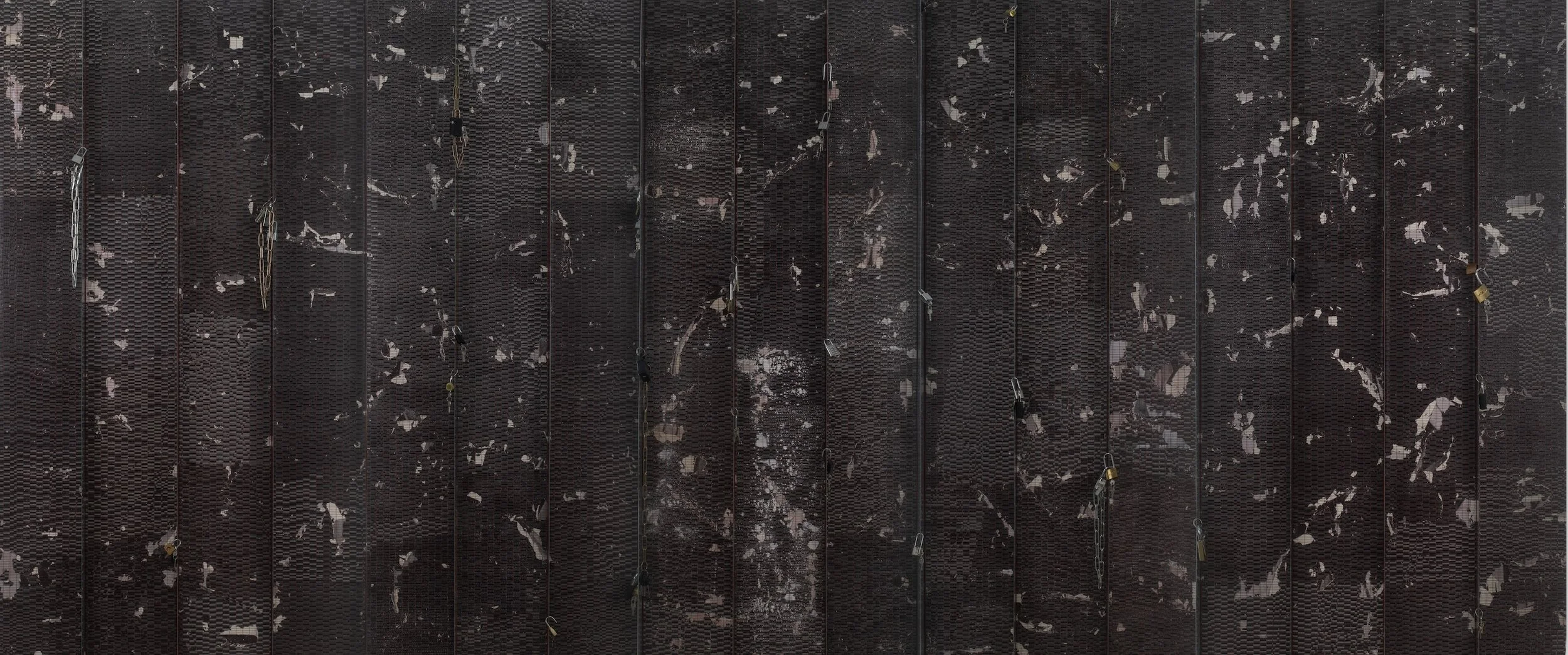
Ghost Painting (Cracked Category): Upholstery Series #3 / After Ang Kiukok’s 1979 Men at Work, 2024, 83.5 x 188 x 4.63 in / 212.09 x 477.52 x 11.76 cm, Elastomeric paint on woven PVC fiber (tarpaulin) with GI
“I like working with tropes,” Ardeña says. “Not clichés. Tropes last because they’ve been tested inside a system.” He compares it to overripe fruit—something that only gets there through time. The cracks are one of those things. “I like using [it] as a visual trope. It’s part of the language I use. It’s something you immediately associate with the tropics—especially when it comes to surfaces.”
That obviousness is exactly where he begins. But Ardeña is quick to point out that he isn’t chasing narrative. “I’m more concerned with the material, the technique, the process,” he says. What matters is how those elements push back against the medium itself—how painting can be reframed, questioned, or unsettled from within.
Medium is the message
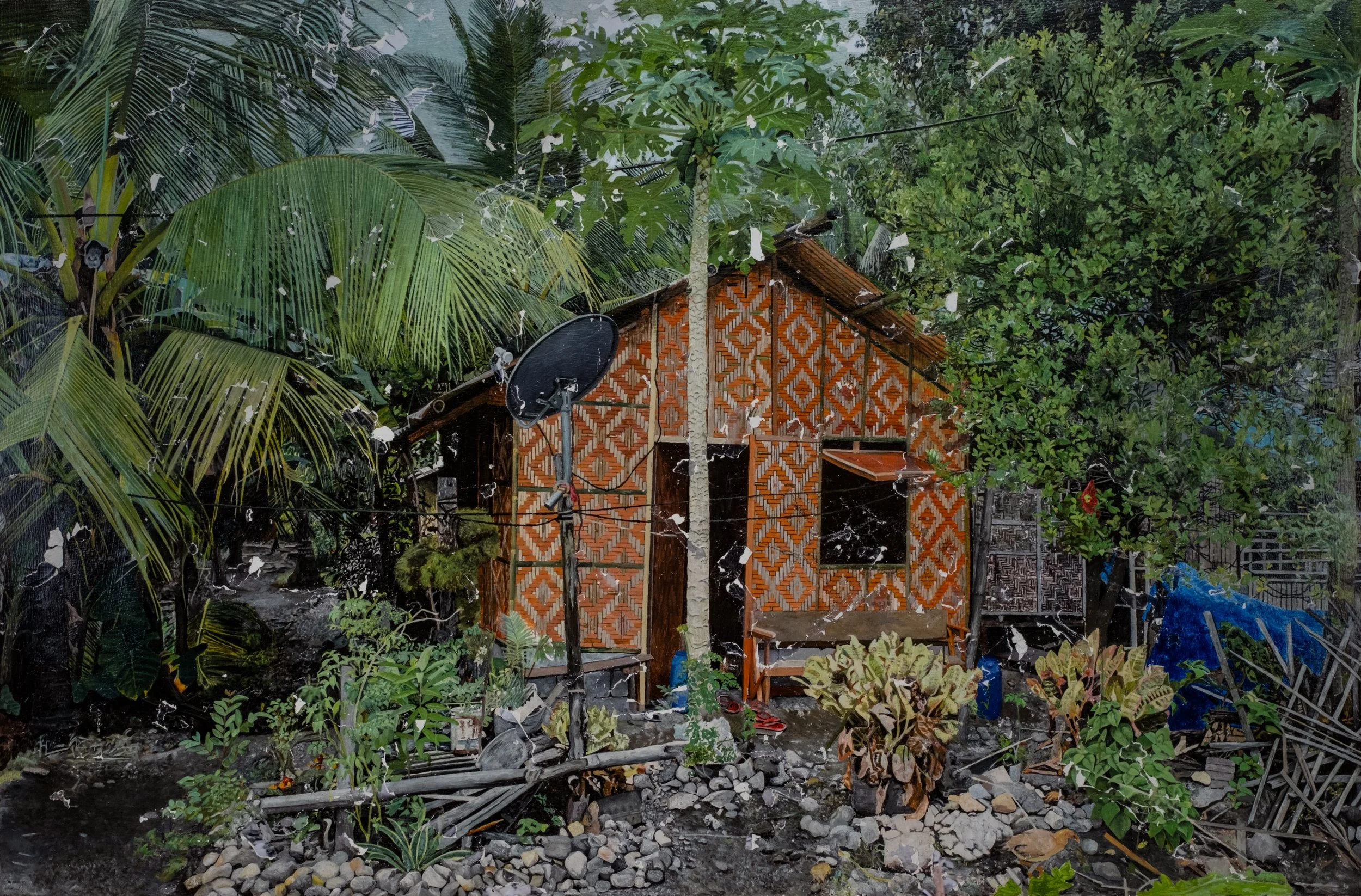
Ghost Painting (Cracked Category): Balay Tropikal #2, 2025, 75.13 x 107.13 in / 190.83 x 272.11 cm (framed), Elastomeric paint on woven PVC fiber (tarpaulin)
Ardeña’s Cracked paintings mimic the flaking paint of lived-in homes, walls weathered by humidity, and the constant swing between heat and rain. These are the marks of Philippine life. Ardeña wanted a painting medium that shared the visual language of traditional fine art, but remained rooted in everyday life in the Philippines.
Elastomeric paint offered that bridge—commonly used on building facades to withstand heat and humidity. “It behaves a lot like acrylic,” he explains, “but it wasn’t made for painting in the studio. It was made to protect buildings.” That distinction matters. Using elastomeric paint isn’t about finding a workaround or substitute—it’s a deliberate choice. Challenging the assumptions around what a painting should be made of, and where it should come from.
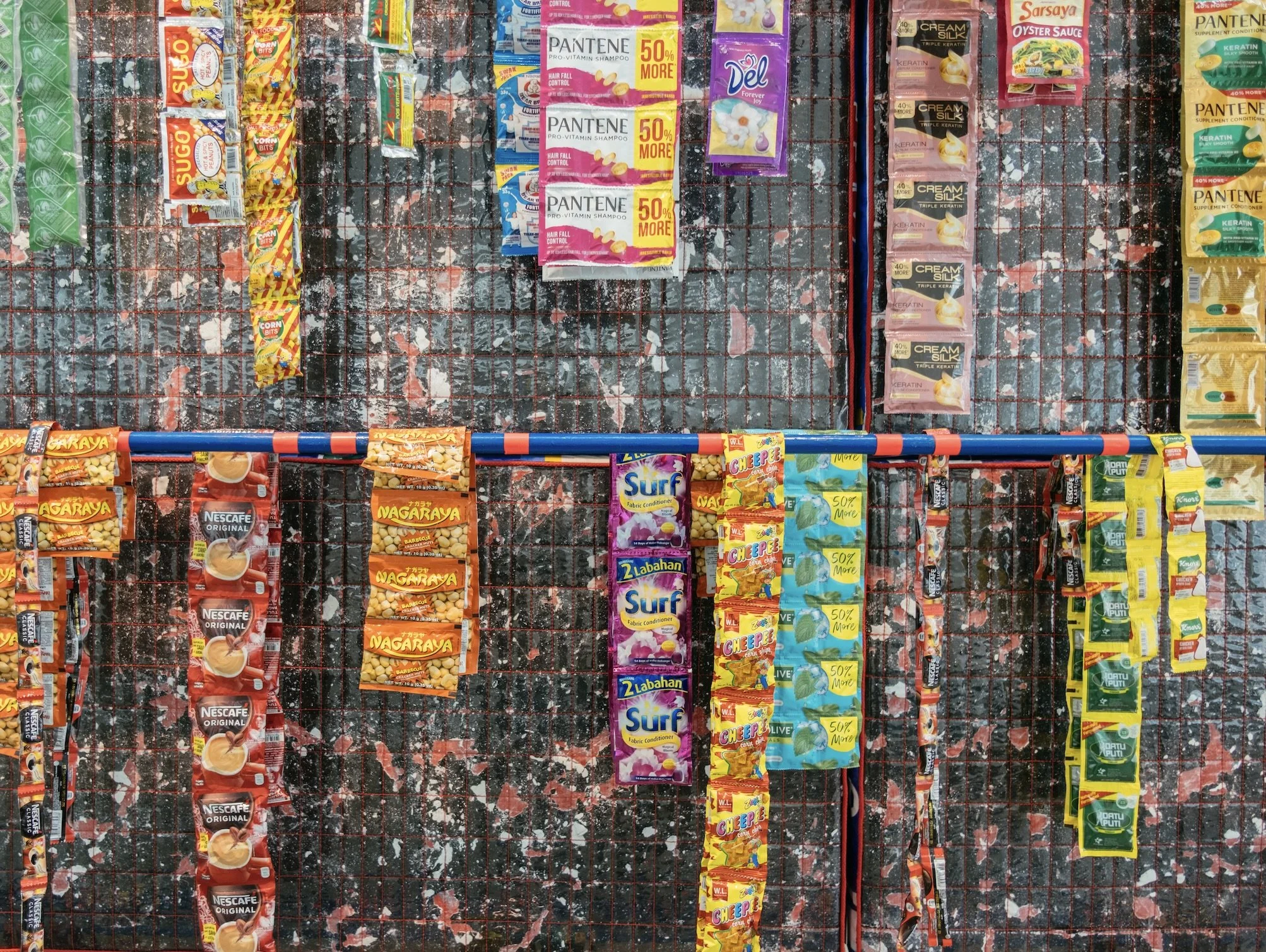
Close up of Ghost Painting (Cracked Category): Upholstery Series #1/Study after a Tricycle Sidecar and a Sari-sari Store, 2025, 74.75 x 97 x 13.5 in / 189.87 x 246.38 x 34.29 cm
Elastomeric paint on woven PVC fiber (tarpaulin) with GI metal tubular frames and sachets of Filipino products
Having seen how Filipinos repurposes tarpaulins, Ardeña’s relationship with the material remains broad and hands-on. “I still work with found tarpaulin,” he says. “If you look closely at one of the paintings in the show, the piece with the sachets, you’ll see parts are made from tarps collected from the streets. I still print images on tarpaulin and paint over them. I also make tarpaulin pieces meant for public spaces—not just as visual interventions, but as functional objects that age with use over time.”
Where the Surface Starts to Shift
Seiches is about pressure—the kind that builds quietly before it makes itself visible. For Ardeña, that pressure comes from working within “tropicality,” a framework that carries its own set of expectations. This exhibit shifts the idea from identity into condition.
“It’s a necessary reflection,” he says. “Western institutions do come with preconceived ideas of what ‘tropicality’ in contemporary art should look like.” He points to the term’s historical roots, particularly its association with Brazilian cultural movements like Hélio Oiticica’s Tropicália and the broader idea of tropicalismo. Beyond that, he notes how institutions—Western or otherwise—often extend these expectations through archipelagic theories, famously articulated by Édouard Glissant.
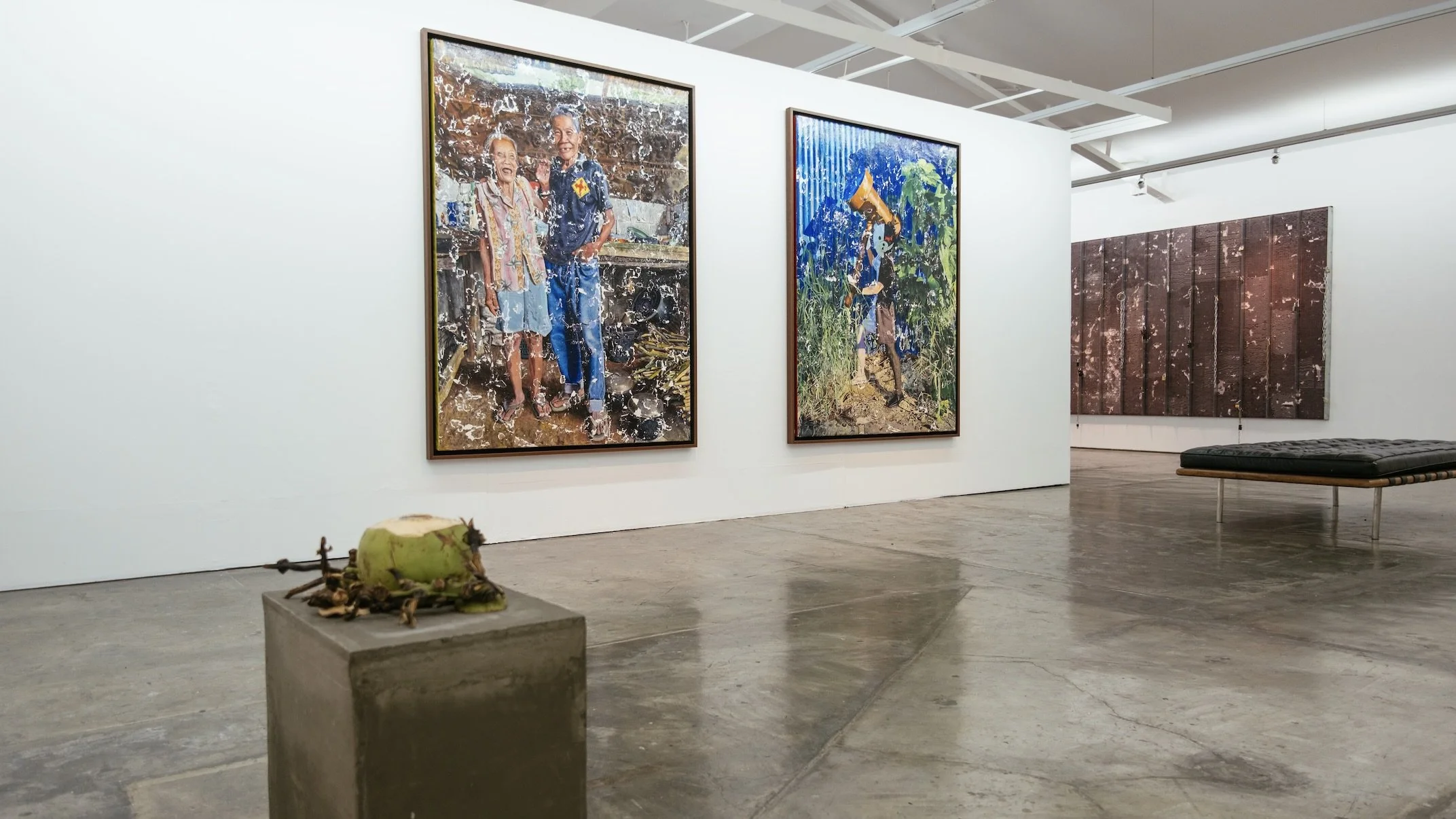
Installation shot of Seiches
“These ideas are present in my work,” Ardeña explains, “but they don’t operate in a straight line. It’s more fluid, more permeable.” He treats influence as something to be adjusted and likens it to the perennial debate around adobo—whether it was introduced by the Spanish or existed long before colonization. “That question doesn’t need to be about cultural ownership or historical purity,” he says. “It needs to be philosophical. Because the way we think is always shaped by others—past and present.”
Ghost Paintings Invisible Series
Ardeña’s Invisible Series pushes his painting practice beyond the surface and onto the object itself. In this series, the works are made with elastomeric paint applied to ready-made or found objects. This introduce a different kind of realism. Rather than describing reality through illusion, the works embody it. The painted image and the object it rests on are one and the same.
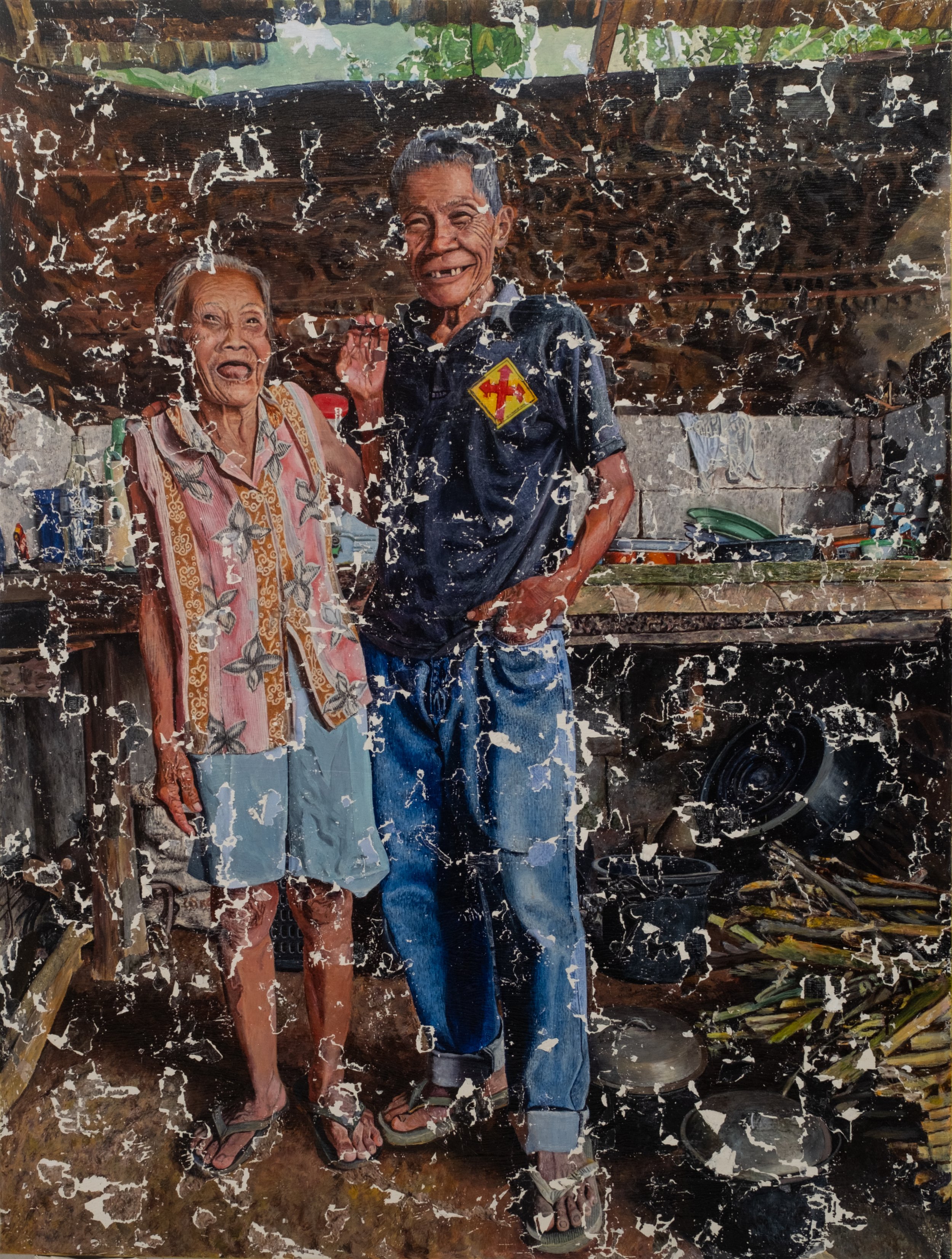
Ghost Painting (Cracked Category): The Tatay and Nanay Painting Elastomeric paint on woven PVC fiber (tarpaulin) 197x148 cm, 2024
The gesture is deceptively simple, it reframes painting as something that doesn’t merely depict the real world, but physically occupies it. “I’m playing with perception,” Ardeña explains. “The paint is already on the premise of the object itself. If you look at the object and the paint, they’re almost the same. So the realism isn’t descriptive—it’s embodied.” Christian Dominguez, who curated Seiches, describes this condition as a co-presence: the object and the painting exist simultaneously, neither dominating the other.
This approach challenges long-held assumptions about painting’s dependence on a neutral surface. “If painting always needs a substrate,” he says, “why can’t that substrate already be part of the world?” In a time where nearly anything can be considered art, his response is to fold context directly into material—allowing everyday objects to function not as symbols, but as structural elements of the work itself.
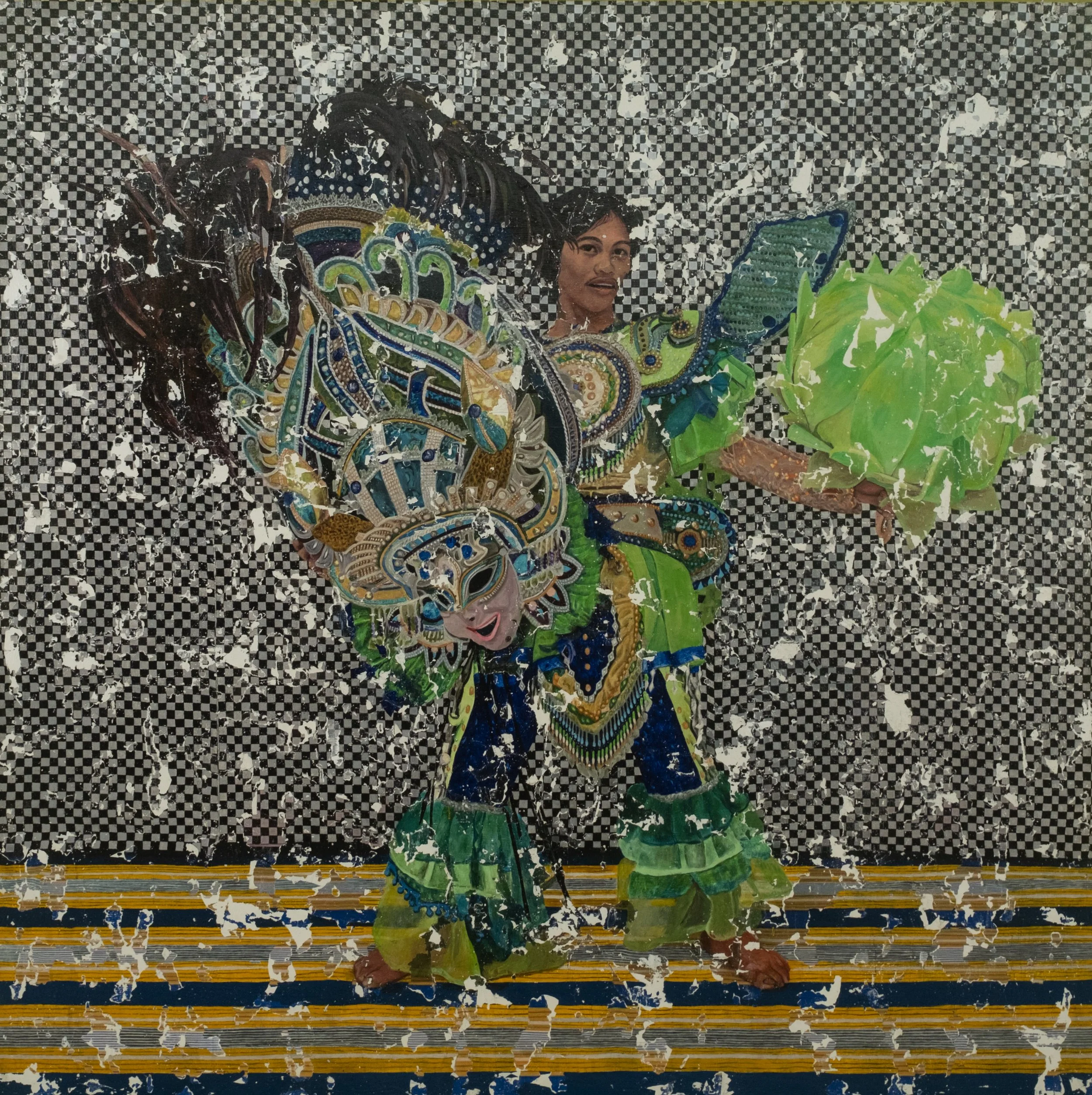
Ghost Painting (Cracked Category): The Masskara Dancer, 2025, 81 × 81.13 inches (framed), elastomeric paint on woven PVC fiber
The Invisible Series becomes a jump-off point for this shift. “The context isn’t ideological anymore,” Ardeña notes. “It’s not about following conceptual discourse. I take that context and turn it into material—it becomes an ingredient, just like paint or structure.” It’s a direction that signals where his practice is headed: less concerned with representation, and more invested in how painting can exist—fully and physically—within the world it comes from.
“In Western art history, there’s this urge to break everything down—to analyze it, strip it apart,” Ardeña says. He acknowledges that locally, it doesn’t work that way. “We tend to look at things as a whole. Everything stays connected.”
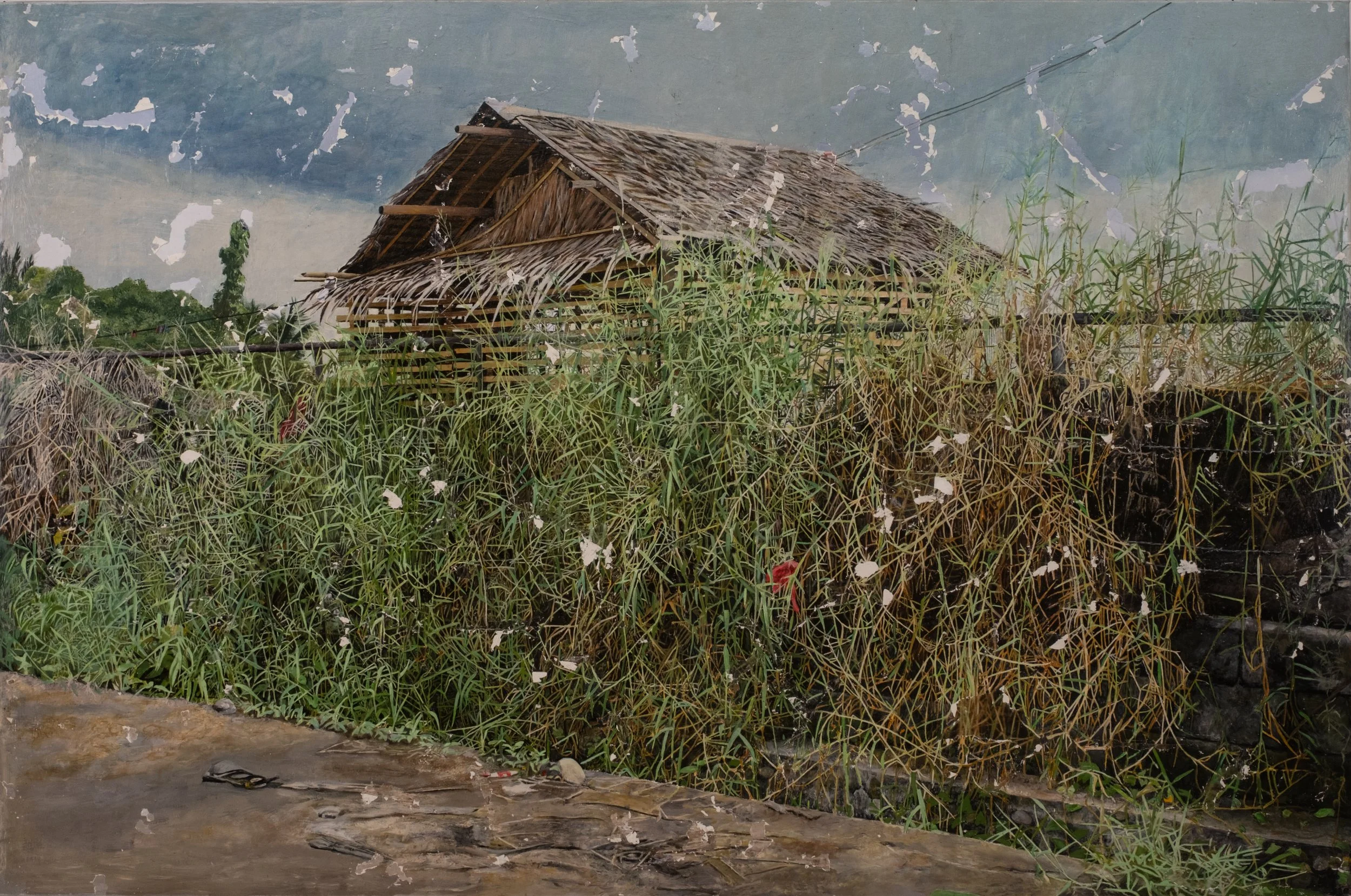
Ghost Painting (Cracked Category): Balay Tropikal #1, 2025, 75 x 107.13 in / 190.5 x 272.11 cm (framed), Elastomeric paint on woven PVC fiber (tarpaulin)
With the conclusion of Seiches, Ardeña's focus is about building a language—then creating the space where that language can live. “I’m trying to set up a system where the work can exist on its own terms,” he says. “That eventually becomes a way of thinking.” Art, he adds, doesn’t need to justify itself through logic. “It doesn’t always make rational sense—and that’s fine. It might not serve a clear purpose, but it’s essential. It’s part of what makes us human.”
Author’s note: Quotes have been edited for clarity and brevity