Combine and Subtract
Lou Lim’s works examine and appropriate the processes of different art forms to further investigate sculpture, exploring ideas of surface and touch.
Words Sean Carballo
Photos courtesy of Silverlens
February 26, 2026
In 1954, during the height of Cold War tensions—notably the year when representatives from all over the world, including Britain, the United States, Australia, France, and Pakistan assembled in Manila to form a regional defense treaty against Communist expansion—the American painter Robert Rauschenberg found himself tinkering with stray fabric, some newsprint, lightbulbs, and a mix of various oils, leading him to discover a strange, hybrid form. The finished output, if one could even call it that, turned out to be a vivid scatter of abstraction and found imagery, and a healthy streak of graffiti; the untitled piece from 1954 would end up becoming the first of Rauschenberg’s Combine series.

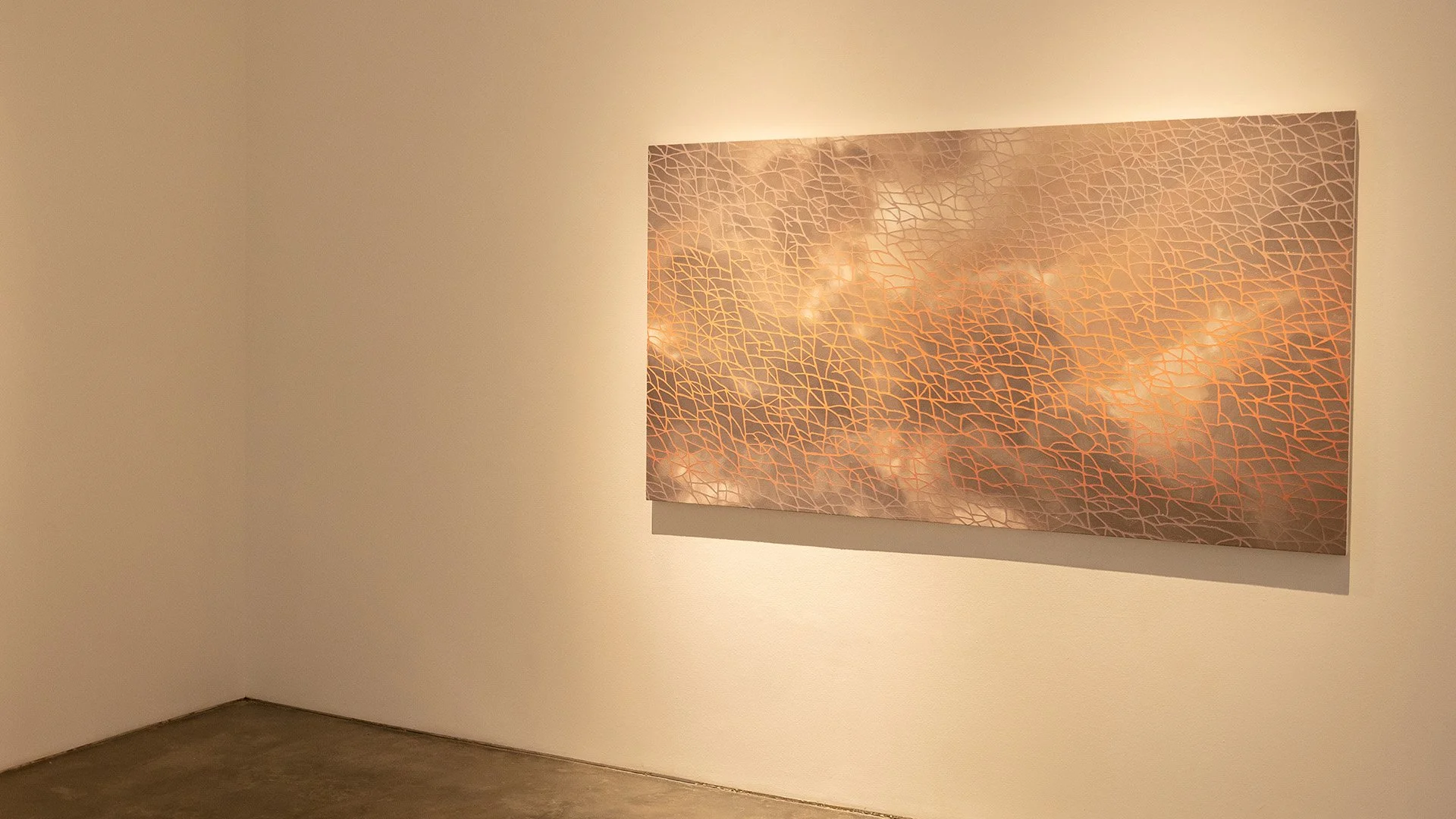
LOU LIM, Merging (Becoming Like), 2026, oil paint, thread, stainless steel jewelry pins on canvas
Rauschenberg’s then-partner, confidant, and artistic foil Jasper Johns described this series as “painting playing the game of sculpture,” a spectacularly compact description that cuts through the irreverence, freakishness, and encoded nature of Rauschenberg’s combines. Recall the unconventional relation the two artists shared within the homophobic context of American life at the time, who both laboured creatively “on a daily basis to the exclusion of most other society.” Here—in maze-like panels either free-standing or hanging—Rauschenberg seemed to explode the externalities of pressure and prejudice through an intuitive rhythm that relished in ordinary and collagist mess. The incorporation of everyday objects into the adornments of painting, the bringing together of two mediums’ forces without obscuring one over the other: these creative traits marked an embrace of the fleeting and the hybrid, the unsettled and tossed-aside.
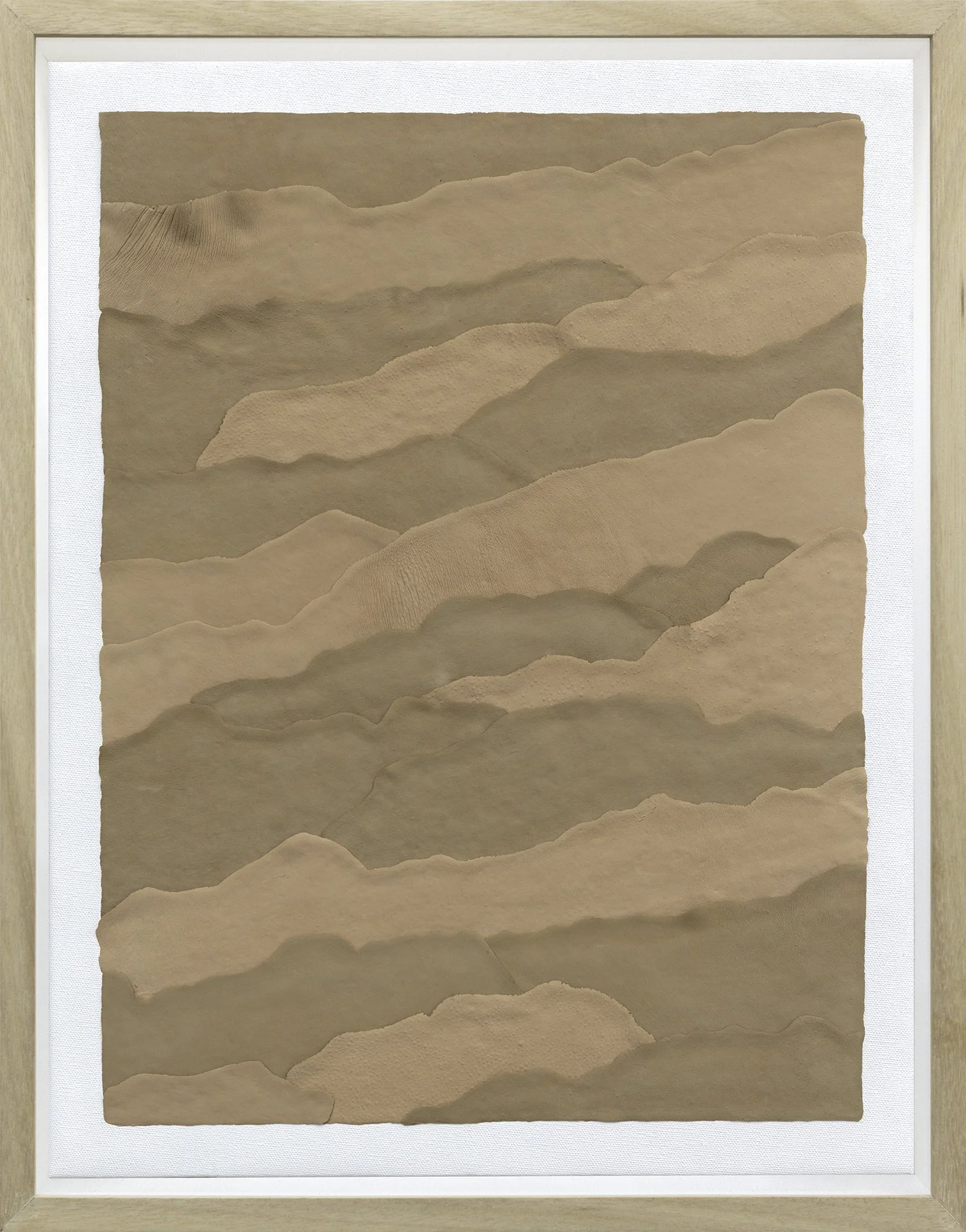
LOU LIM, Merging (Rendering Sky), 2026, acrylic paint, tulle on canvas
Lou Lim’s work, showcased in her latest exhibition titled Merging at Silverlens Manila, plays into a similar energy as the Combines—its untethered approach to material, blistering with latent meaning—but filtered through a much more existentialist light. Merging consists of a series of expansive canvas upon canvas, toggling between sculpture and painting. Beginning with a painting of sunlit sky, Lim applies vinyl stencil, a network of lines meant to resemble traces of human, onto each canvas and threads them onto the canvas. An additional surface layer, a painting of a dark sky, is then rendered across the canvas.
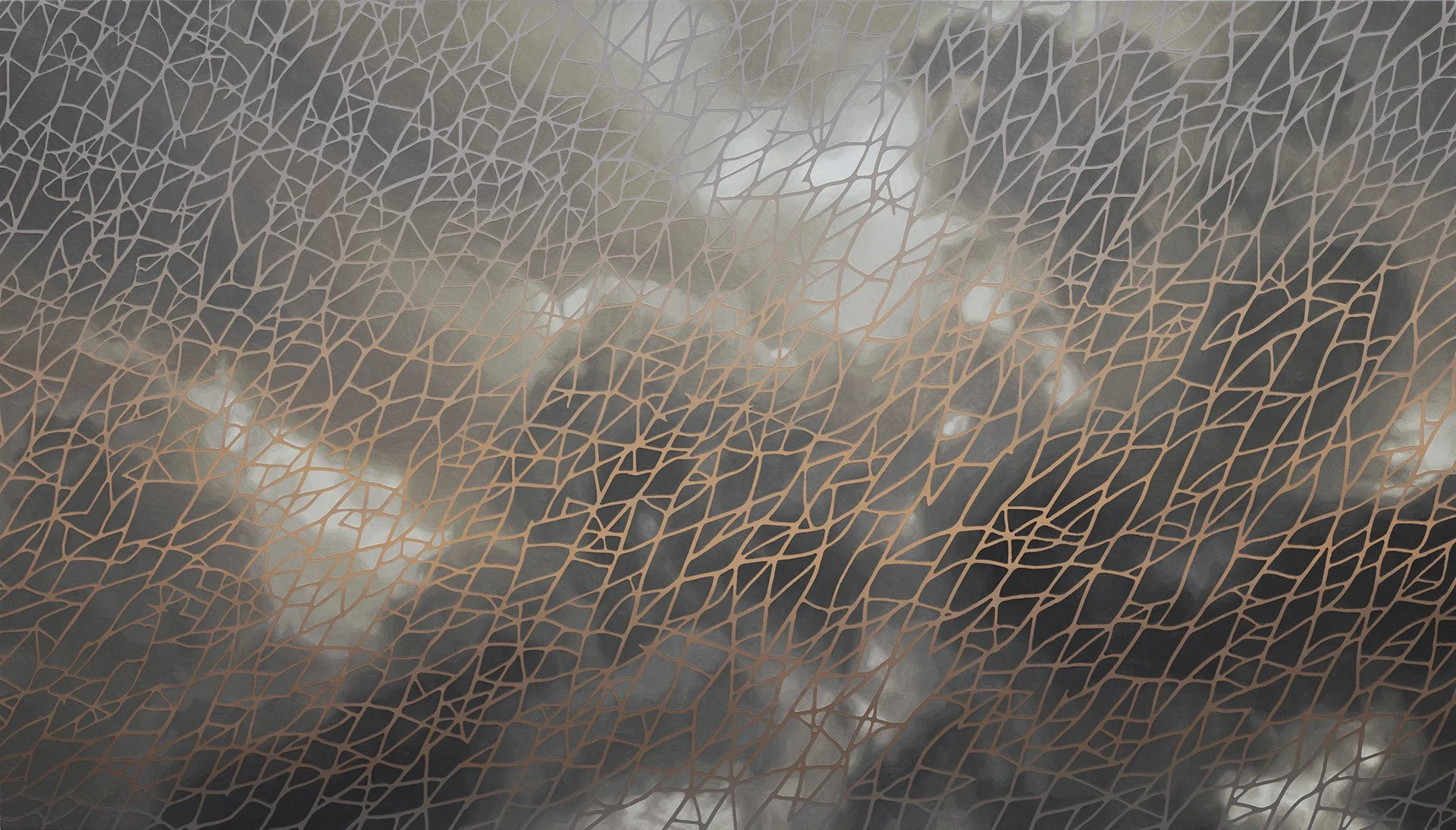
LOU LIM, Mergingₐ, 2025, oil and acrylic on canvas
This description is a simplification of Lim’s process: there is so much more going on in these seemingly serene and cool canvases. But the foundation of these pieces goes back to the title: merging of medium, merging of skin and sky, merging of the background and foreground, the far and near. “What draws me to the body and the landscape is that they share the same condition of temporariness and fragility,” Lim said of the exhibition. “Both are surfaces that receive time, damage, and care, and both retain traces of what has passed through them. In my work, the body and the land often stand in for one another, just as the spirit, the divine, and the sky can reflect one another.”
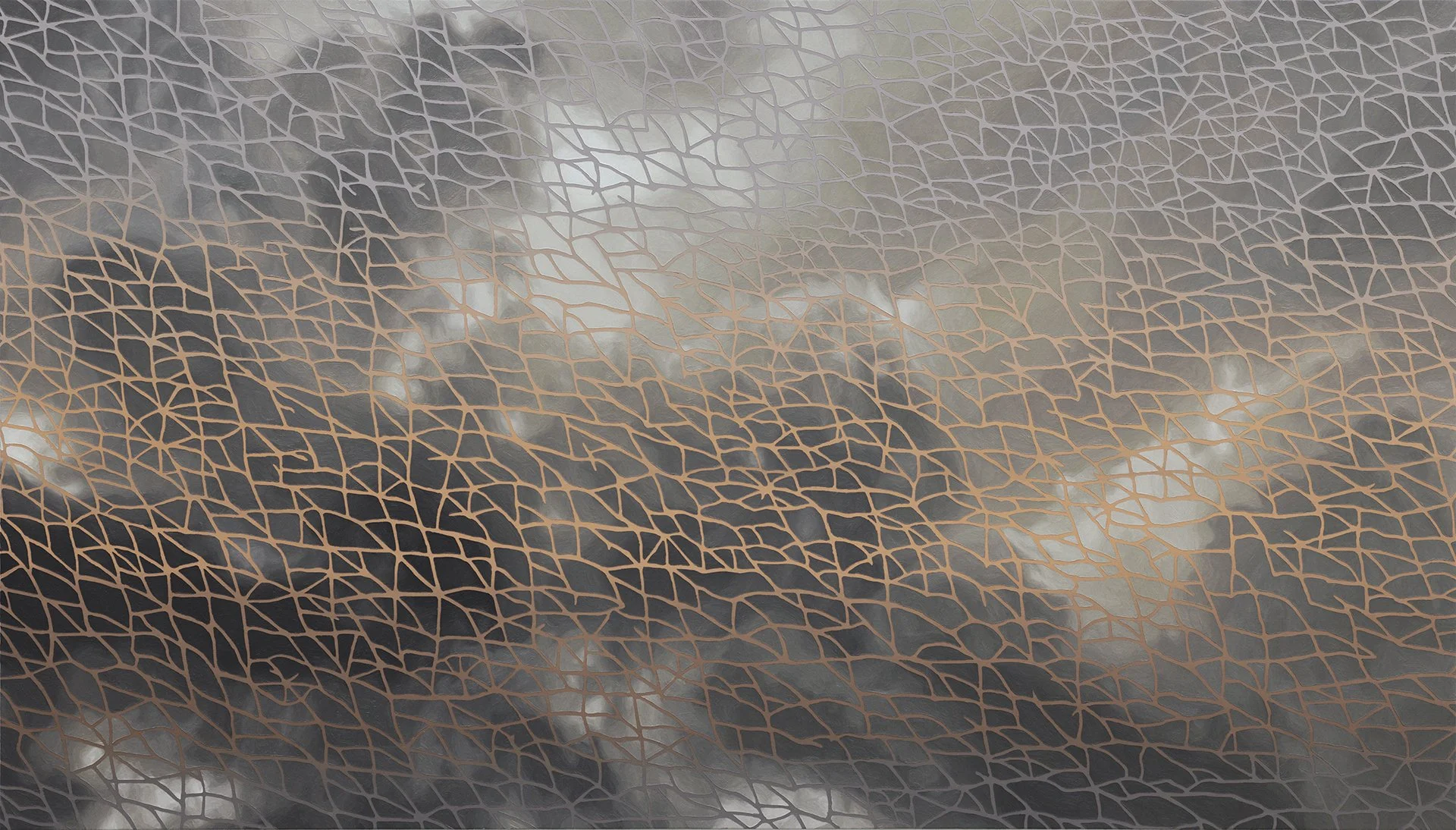
LOU LIM, Mergingᵦ, 2025, oil and acrylic on canvas
The geometry of sculpture provides the artist’s painterly abstractions structure and stature, and in Merging, the abstract and concrete meld into a wired, hazy mindscape. Enter these pieces through different angles and you find light unraveling something new, eerie, uncertain every time. Like Rauschenberg, Lim is a tinkerer of process, and revels in the changeable nature of art. After peeling the final layer, Lim says that “the work commits to change and can no longer return to its previous state. There is a real risk of failure after a long and labor-intensive process and its resolution is only known as the process unfolds.”
In its irresolution, these pieces unspool like accumulated layers of time, collapsing the great effort of its production and the wide-open serenity it brings about. They bring into these folds the artist’s drive to capture the indeterminacies of earth and skin, the tactile forces of our becoming.