
Bob Mackie’s Icons, In Their Most Iconic Looks
From Carol Burnett to Cher, Diana Ross to Liza Minnelli, Bob Mackie turned costume into character and glamour into cultural memory.
Words Randolf Maala-Resueño
Art by Tristan Talon
September 18, 2026
Art by Tristan Talon
There is perhaps no better way to understand Bob Mackie than through a contradiction: the clothes could be outrageous, but the artistry could never be careless.
For more than five decades, Mackie transformed fabric into fantasy and performers into icons, understanding that a costume could be a punchline, a provocation, a memory, or an entire persona stitched into sequins. He knew glamour was most glamorous when it was about something impossible to forget.
Mackie’s death at 87 leaves behind a dazzling cultural archive, populated by women who became larger than life in his clothes.
Carol Burnett, Cher, Judy Garland, Diana Ross, Liza Minnelli, Mitzi Gaynor, and the many other performers he dressed were unapologetically inhabiting Mackie’s imagination, one silhouette at a time.
Below is not a definitive ranking, but a small procession through that extraordinary world: ten moments where costume became character, fashion became performance, and excess became an art form.
Mackie helps sketch the Marilyn Monroe myth into existence
Art by Tristan Talon
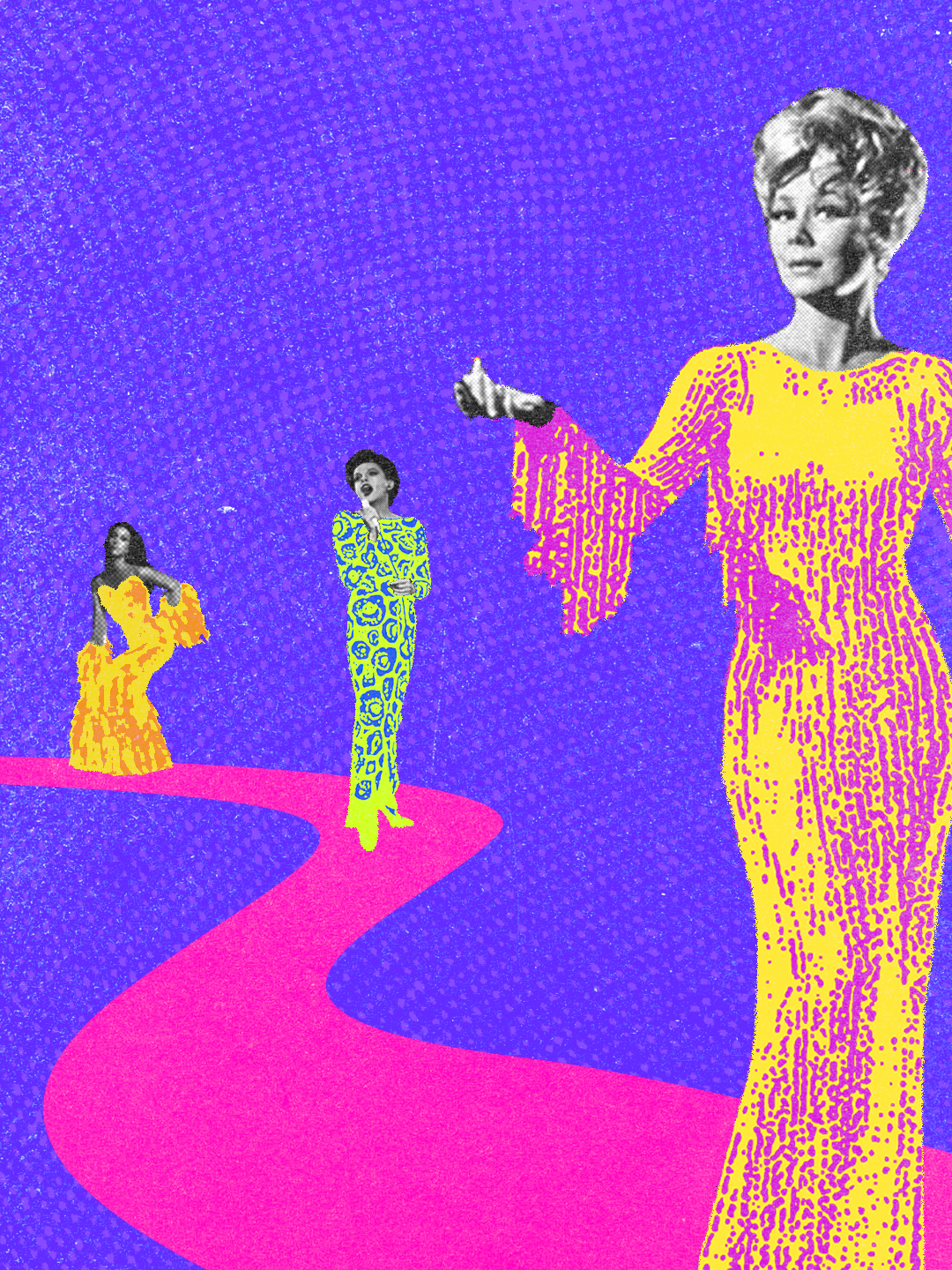
Few fashion images have become as inseparable from American celebrity as Marilyn Monroe singing “Happy Birthday, Mr. President” in 1962.
Mackie, then a young designer, sketched the dress for Jean Louis, who created the finished garment: a sheer, rhinestone-studded second skin that turned Monroe’s body into something closer to light than fabric. This, inarguably, is what launched Mackie’s stamp on the fashion zeitgeist.
Camp exudes with Carol Burnett’s “Went With the Wind!” costume
Perhaps no Mackie creation understood the joke better than Carol Burnett’s curtain-rod dress from The Carol Burnett Show. Playing “Starlett O’Hara,” Burnett famously emerges in a gown made from the curtains, complete with its brass rod and valance hat.
Decades later, it remains proof that Mackie could turn theatrical absurdity into an object of genuine beauty.
Cher turns rebellion into rhinestone architecture
Cher’s 1986 Academy Awards ensemble remains one of Mackie’s great acts of defiance: black, barely there, aggressively glamorous, topped by that enormous feathered Mohawk.
Mackie understood that Cher needed clothes that made her impossible to ignore.
RuPaul finds her superstar silhouette
Before drag became an omnipresent force in mainstream fashion, Mackie understood its fundamental language: exaggeration, transformation, and entrance. When RuPaul became famous, one of her first calls was to Mackie, who designed costumes for her first Las Vegas revue.
It was an almost perfect artistic handoff between generations of television spectacle, where audiences recognized a superstar through sequins now dressed as one of drag’s future architects.
Later on, RuPaul would recognize Mackie’s contribution with the “Giving Us LifeTime Achievement Award” on his reality-competition show RuPaul’s Drag Race as its first recipient in 2023.
Judy Garland’s television wardrobe carries a legacy
Mackie’s early work on The Judy Garland Show, alongside Ray Aghayan, placed him beside one of entertainment’s most complicated icons.
Garland’s clothes had to accommodate not only a performer but a mythology: Hollywood nostalgia, vulnerability, comedy, and enormous stage presence.
Raquel Welch borrows from Tina, and Tina notices
Art by Tristan Talon
One of Mackie’s loveliest stories is almost accidentally circular: Raquel Welch once asked him for something “a little bit Tina Turner,” with a cave-woman quality. Turner later saw Welch wearing the resulting look and loved it so much she called Mackie, unaware that the original inspiration had been her.
Few stories better capture how Mackie’s designs moved between women, bodies, performances, and cultural fantasies. His clothes’ iconography began borrowing from one another through him.
Whoopi Goldberg cages royalty in couture camp
For the 1999 Academy Awards, Mackie transformed Whoopi Goldberg into Queen Elizabeth I in a wonderfully ridiculous cage-like costume.
The joke was enormous, but so was the craftsmanship: an evening gown hidden underneath, a structured cage surrounding the body, and a matching architectural headdress. It was history filtered through Hollywood camp.
Mitzi Gaynor makes television sparkle
Mackie’s long creative partnership with Mitzi Gaynor deserves its own place in the glittering canon.
For her television specials, he produced costumes that treated the performer almost like a moving sculpture, including the dazzling “Egyptian Discotheque” fantasy. The clothes were designed to catch light, movement, and attention simultaneously.
Mackie turns fashion fantasy into a collectible object
Art by Tristan Talon
Beginning in 1982, Bob Mackie brought his extravagant visual language to Barbie, creating a fantastical universe of glittering gowns, sculptural silhouettes, feathers, sequins, and unapologetic excess.
His designs compressed the spectacle of his celebrity costumes into something that could be held, displayed, collected, and reproduced. Fashion became commodity, then collectible, then something approaching sculpture.
Diana Ross becomes Billie Holiday in Lady Sings the Blues
For Diana Ross’s portrayal of Billie Holiday in Lady Sings the Blues, Mackie helped construct a wardrobe that did something his flashier costumes rarely get credit for: it restrained itself. A teal wool dress, pale green vest, and hat shaped Ross into a historical figure rather than simply another glamorous star.
The Smithsonian preserves the ensemble today, a reminder that Mackie’s artistry was never dependent on sequins. Sometimes his greatest magic was knowing exactly when not to use them.
The glamour remains
To call Bob Mackie the “Sultan of Sequins” is accurate, but ultimately incomplete.
His real medium was transformation: the instant a performer stepped into a costume and became larger, stranger, funnier, more vulnerable, or more themselves.
From Burnett’s curtain rod to Cher’s bare midriff, from Garland’s television stage to Ross’s Billie Holiday, Mackie understood that fashion could preserve a feeling long after the performance ended.
And perhaps that is why his clothes continue to glitter beyond the fashion zeitgeist. Mackie made icons look iconic, and made image-making something the most glamorous of today still aspires to be.