
As Mahjong Maven Club introduces the traditional Chinese game to a new generation, its tiles become a way for young Filipinos to reconnect with heritage and discover how an old tradition continues to endure.
Words Nanzi Sofia Sernadilla
Art by Kirk Bertrand
November 19, 2026
Art by Kirk Bertrand
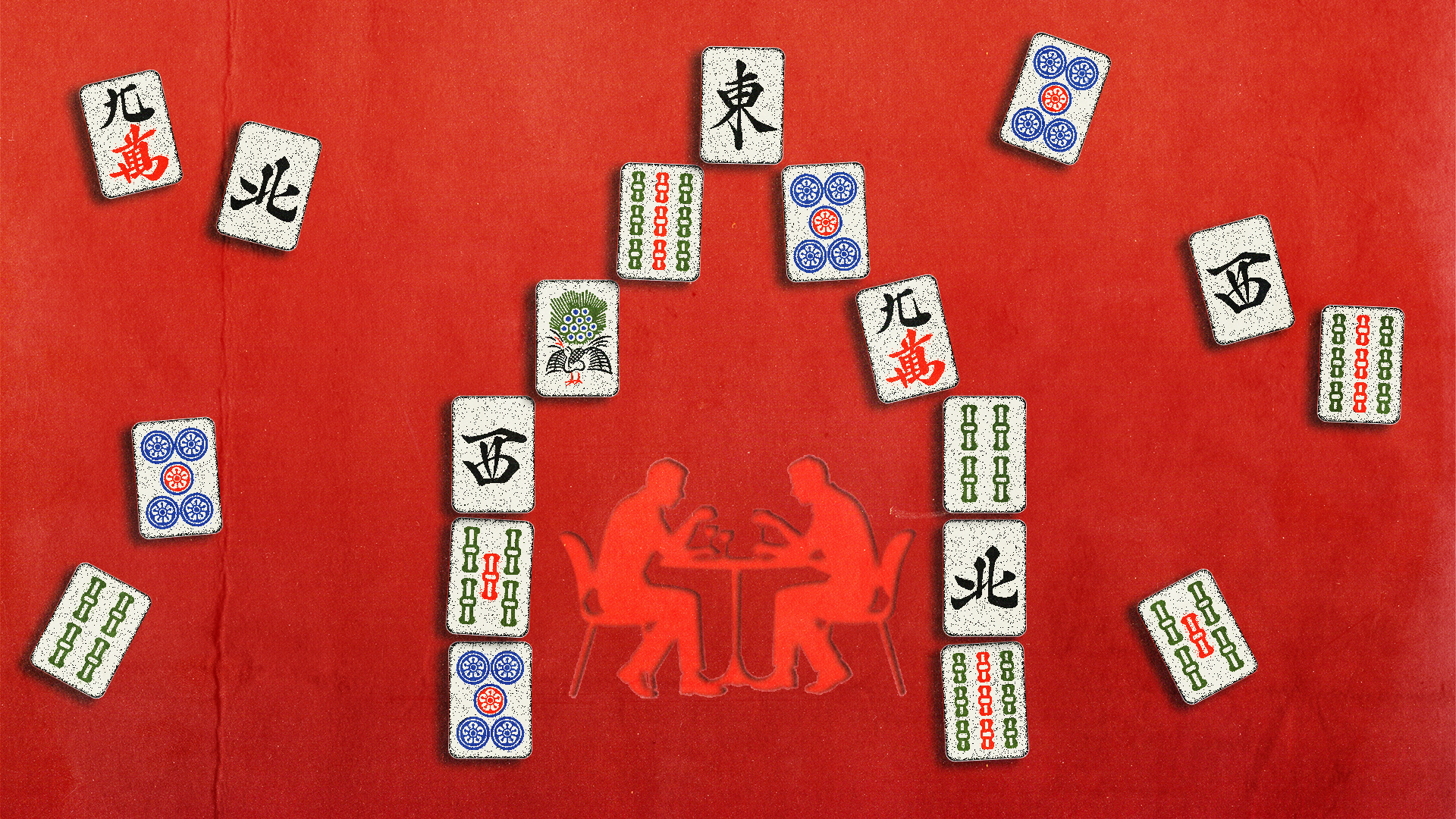
Turn a Mahjong tile over and, at first, it can feel like looking at a language you have not yet learned. Circles, bamboo, Chinese characters, flowers, and directions sit against one another in patterns that seem almost impossible to understand.
But these symbols are more than pieces of a game. They carry fragments of a history that has moved across generations, borders, and changing cultures.
History Etched in Tiles
During the exclusive interview to Ang Chak Chi, managing director of Bahay Tsinoy, there is no single, definitive story of where Mahjong really originated. While stories trace the game to much earlier periods, the earliest documented version closest to the game played today dates to the mid-19th-century Qing Dynasty, particularly in places such as Shanghai, Ningbo, Fujian, and Guangdong.
“It was not until the mid-19th century Qing Dynasty,” Ang explains. “The earliest documented version appeared in Shanghai, Ningbo and eastern coastal areas like Fujian and Guangdong.”
Even before the familiar tiles emerged, Mahjong existed in other forms. Ang notes that earlier versions used cards, bamboo, bone, and even ivory. The game did not arrive in its present form fully formed; it evolved with the people who played it.
That history of change is visible in the tiles themselves.
The numbered suits, for instance, have interpretations tied to older Chinese systems of money. The circles can be understood as coins, while sticks or strings refer to the way coins were once carried on strings. The character suit represents ten thousand. Flowers can symbolize the four seasons and the four flowers–plum, orchid, chrysanthemum, and bamboo–while the honor tiles include the four directions.
Ang is careful to point out that these interpretations are only among several versions of the symbols’ meaning.
That multiplicity is part of what makes Mahjong culturally revealing. The game changes depending on where it is played, who plays it, and what traditions they bring to the table.
More Than a Game of Chance
In the Philippines, Mahjong developed its own character. Ang recalls the game’s place in Chinese-Filipino households in the 1950s, '60s, and ‘70s, when a Mahjong table became a gathering place at home. Not every game was about gambling. Families could simply play to pass the time, talk, tease one another, or spend a weekend together.
“Siyempre, it started talaga as just a friendly game. Just to kill time,” Ang says.
For him, that distinction remains important. While gambling became associated with Mahjong, its social function existed independently of money.
He remembers playing with the same group of friends for years, “Nandoon ‘yung chikahan, nandoon ‘yung chismisan, nandoon ‘yung asaran,” adding that it was also “pang-camaraderie.”
Learning to Read the Tiles Anew
Now, another generation is learning to read the tiles.
In an exclusive interview with the Mahjong Maven Club founders Sheena, Sharlene, and Siegfried Lim, Mahjong was already familiar with the family.
Their interest in bringing it to younger players grew from that personal history, but their experiences also revealed how intimidating the game can appear to someone seeing the tiles for the first time.
“The most intimidating aspect is really the tiles,” Siegfried says. “Especially if you’re not coming from a heavily Chinese background, you would be intimidated at first glance by the Chinese characters written on the Mahjong tiles.”
The solution is not necessarily to translate every character immediately, but to learn how to see the tiles as part of a visual system. Beginners, Siegfried explains, are encouraged to “treat them as images” rather than become overwhelmed by their unfamiliarity.
In that sense, learning Mahjong becomes more than learning the rules. It becomes an encounter with symbols that once belonged to another generation.
The founders have also witnessed different generations gathering around the same table, while players bring different versions of Mahjong into the room. Chinese, Filipino, Malaysian, Japanese, Taiwanese, and other variations remind players that there is no single way the game has survived.
Lessons in Every Hand
For Siegfried, that survival can be summed up in one work: Endurance.
“Mahjong is a very strong representation of endurance,” he says. Games can last until one or two in the morning, but the endurance he means extends beyond the length of a match. “It endures so long of a time to be passed down from generation to generation.”
Mahjong, in other words, has survived because it has been allowed to change.
For Sheena, the game represents something even broader: life itself.
“In Mahjong, you actually need both luck and strategy to win,” she says. “And that’s the same thing in how we live or go about our daily lives or when we experience challenges as we live.”
Every hand begins with what is given. What follows depends on the decisions made afterward.
Siegfried remembers a beginner who once asked him which tile she should discard. Rather than deciding for her, he offered his perspective and allowed her to choose. She opted for what seemed like the safer choice, only to discover later that it had been the wrong move.
For Siegfried, that is precisely where the game begins to resemble life. “It teaches you so much about life, about how the tiles are being dealt to you,” he says. “And it’s really up to you how you want to play this game.”
Sharlene gives the game another meaning: memories.
“During the game, you make conversations at the same time you play,” she says. “You get to learn about each other’s character and you get to meet new people.”
For her, Mahjong becomes “a bunch of memories put in one game.”
Passed from Hand to Hand
Perhaps this is why cultural preservation does not always look like preserving something exactly as it was.
Culture survives through use. It survives when someone teaches another person a game, explains a symbol, tells a story about a grandparent, or sits across from a stranger and begins to play.
For Mahjong Maven Club, that social exchange is part of what preservation means.
The tiles, then, become more than objects with rules attached to them. They become vessels for memory.
A circle may be a coin. A bamboo may recall an older way of carrying wealth. A flower may hold a season, a virtue, or an interpretation passed down through generations. A direction can become part of a system that changes depending on the community around the table.
And now, those same symbols are being encountered by young players who may not have grown up knowing what every character means.
That does not necessarily mark the end of the tradition. It may be another chapter in its endurance.
Mahjong has survived precisely because it has been allowed to move: from cards to carved tiles, from China to the Philippines, from family tables to new communities, from one generation’s understanding to another.
The tiles remain small enough to fit in the palm of a hand. But they carry what culture often does—fragments of where people came from, what they valued, what they remembered, and what they chose to pass forward.
Eventually, the tiles are turned face down again.
They are mixed.
No one knows which one will come next.
And perhaps that is the enduring story of Mahjong: not that we are given control over what is dealt to us, but that, generation after generation, we continue to turn the tiles over and learn how to play.
And perhaps that is the enduring beauty of Mahjong—not that the game gives us control over what we are dealt, but that it teaches us to keep playing with it.