
John Frank Sabado and Leonardo Aguinaldo move mountains in two-man show at Silverlens Manila.
Words Madeleine O. Teh
Photos courtesy of Silverlens
June 27, 2026
If you drive further north—on roads winding through Bulacan, Pampanga, Tarlac, Pangasinan, and La Union—you'll eventually reach the Cordillera region.
Cordillera is the only landlocked region in the Philippines. Its largest city, Baguio, sits atop a mountain, accessible through Marcos Highway and Kennon Road, which is notorious for landslides during the rainy season. It’s also one of the few places in the Philippines where strawberries can grow. Baguio housed a US military base—and, more importantly, is a home to indigenous communities, such as the Ibaloi and Kankana-ey people, who have been there for centuries.
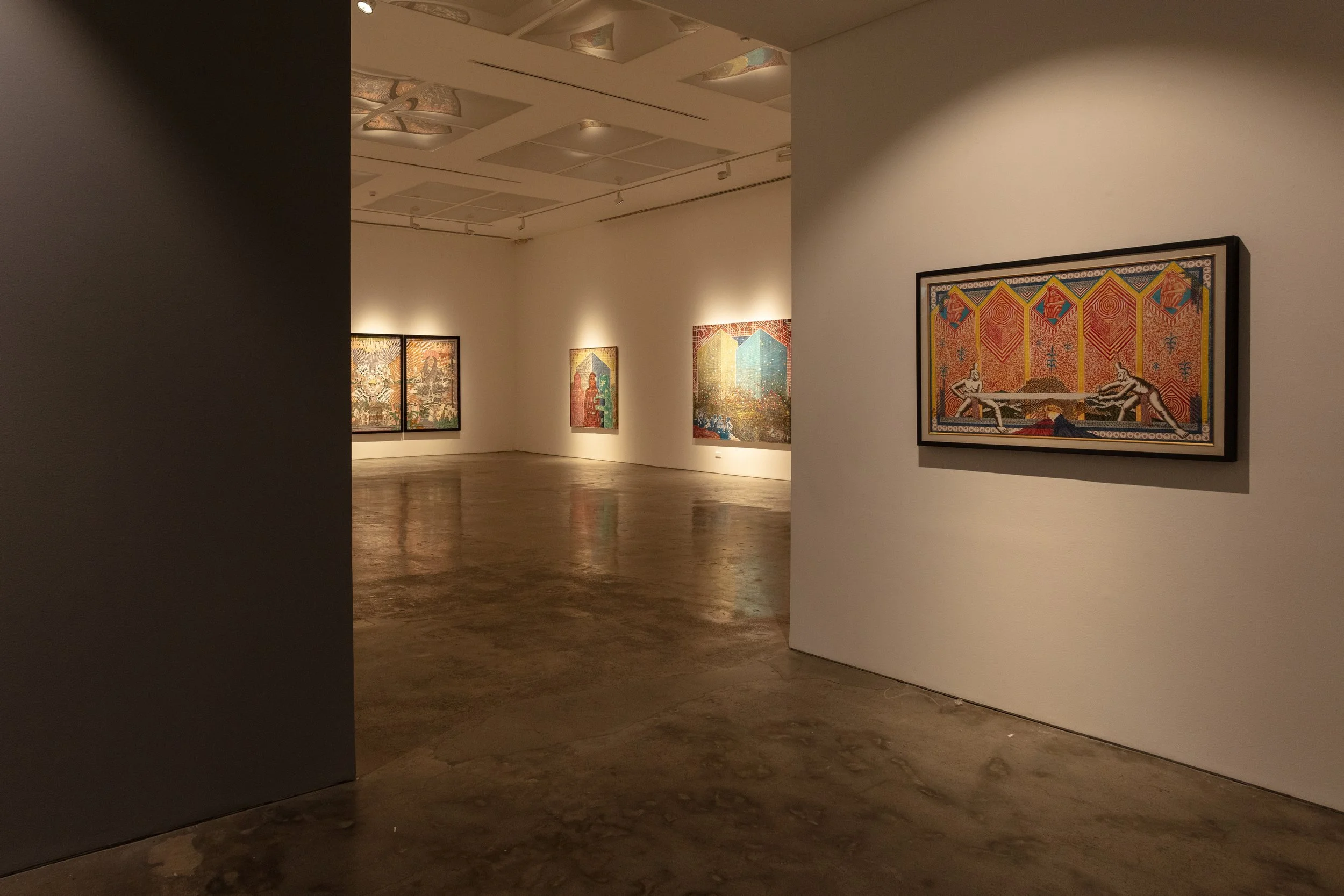
The entrance of the exhibition | Photo from Silverlens Galleries
Baguio and Benguet-based artists John Frank Sabado and Leonardo Aguinaldo pay homage to the communities and customs that characterize this region in their exhibition, Raised by Mountains. Picking up from the region’s landscape and social tapestry, the two-man show was on view at Silverlens Galleries Manila from February 24 to March 28, 2026, and features works from each individual artist and one artwork made by both artists.
Instead of focusing on one aspect of life in Cordillera, Sabado and Aguinaldo embrace the sprawling intricacies that inhabitants grapple with every day: migration, preservation, the environment, and, most importantly for Sabado and Aguinaldo, the people.
Portraits in Pointilism
Sabado was born in Benguet to Ilocano parents and grew up in a Kankana-ey community in Lepanto, Mankayan, Benguet. A self-taught artist, Sabado joined his father’s road construction project at sixteen and was exposed to the traditional practices of those communities. In 2000, he earned the Thirteen Artists Award and has exhibited across Asia.
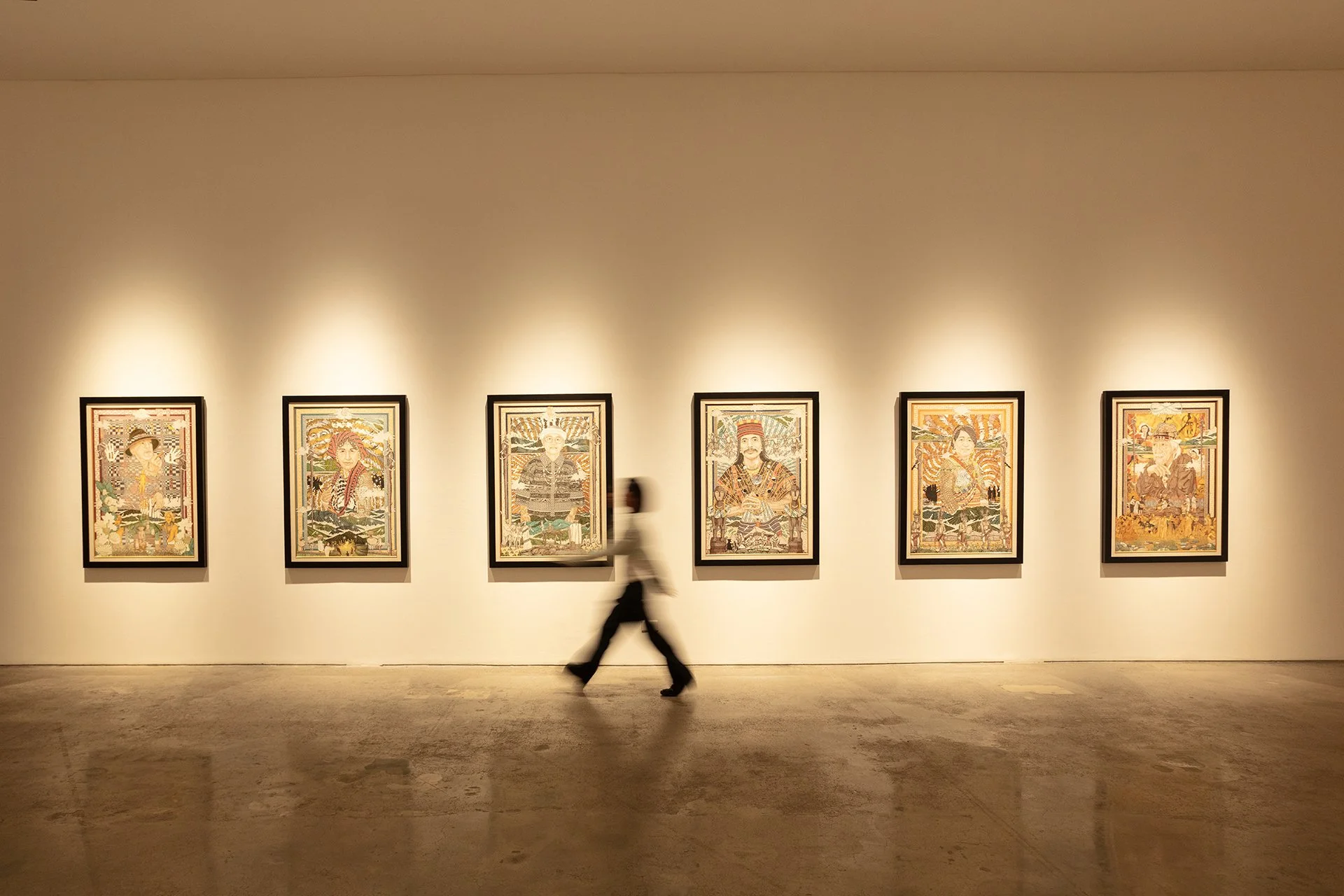
Sabado’s portraits | Photo from Silverlens Galleries
Sabado’s showing at Art Fair Philippines 2024 with Altro Mondo featured mixed media artworks focused on pattern, color, and texture. He rendered human figures as silhouettes or integrated with patterns to the point of being indistinguishable.
In Raised by Mountains, Sabado places humans at the forefront through a series of six individual portraits of community members. Each portrait has the subject at the center, surrounded by vignettes and objects from these communities. Sabado incorporates patterns from these communities through textiles, borders, and backgrounds. He renders these lush compositions through pointillism, which nods to the nature of patterns themselves. These portraits are reminiscent of Kehinde Wiley’s paintings of Black subjects in the lineage of portraitists such as Reynolds, Gainsborough, Titian, and Ingres.
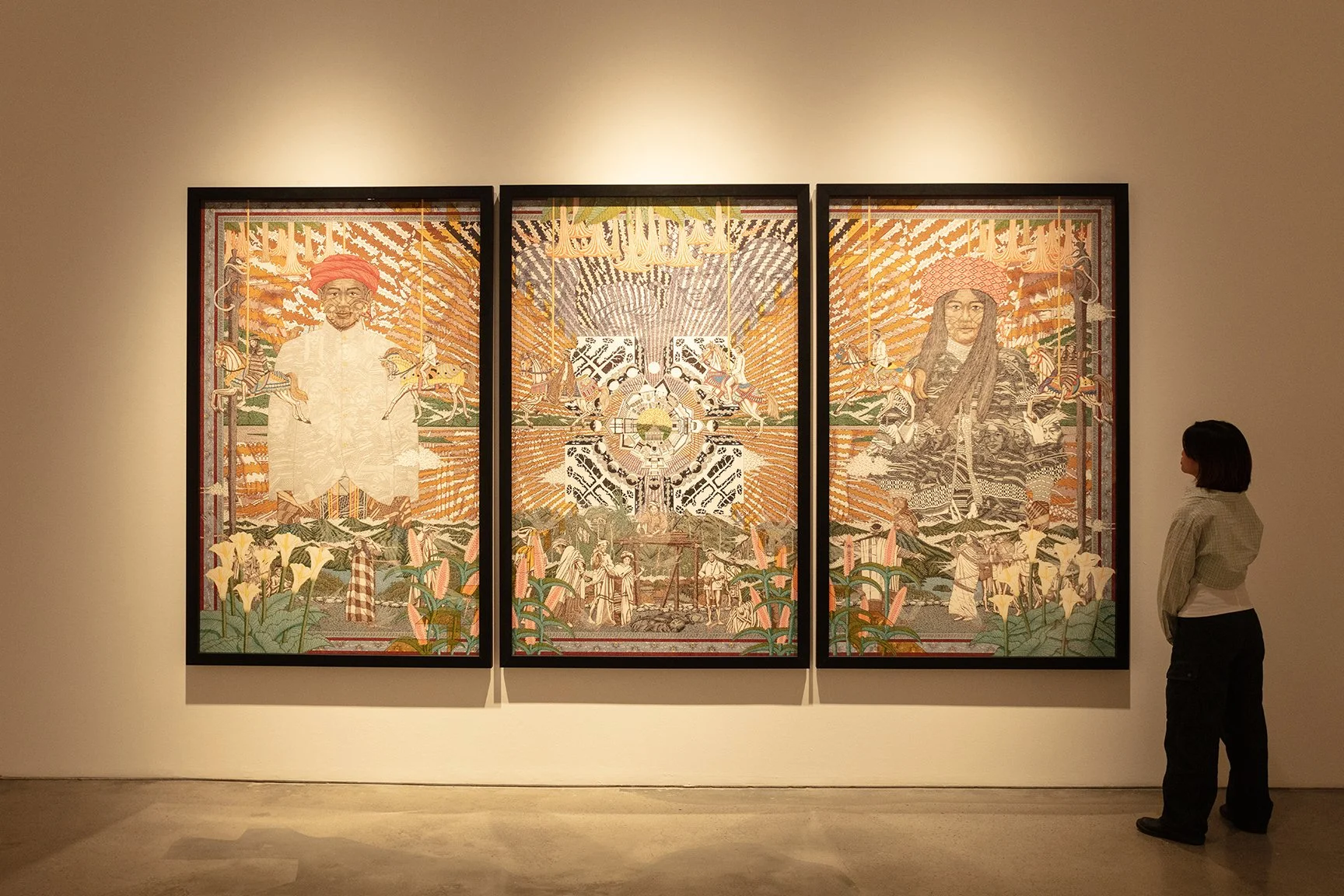
“PREMORADIAL ANCESTORS” by John Frank Sabado | Photo from Silverlens Galleries
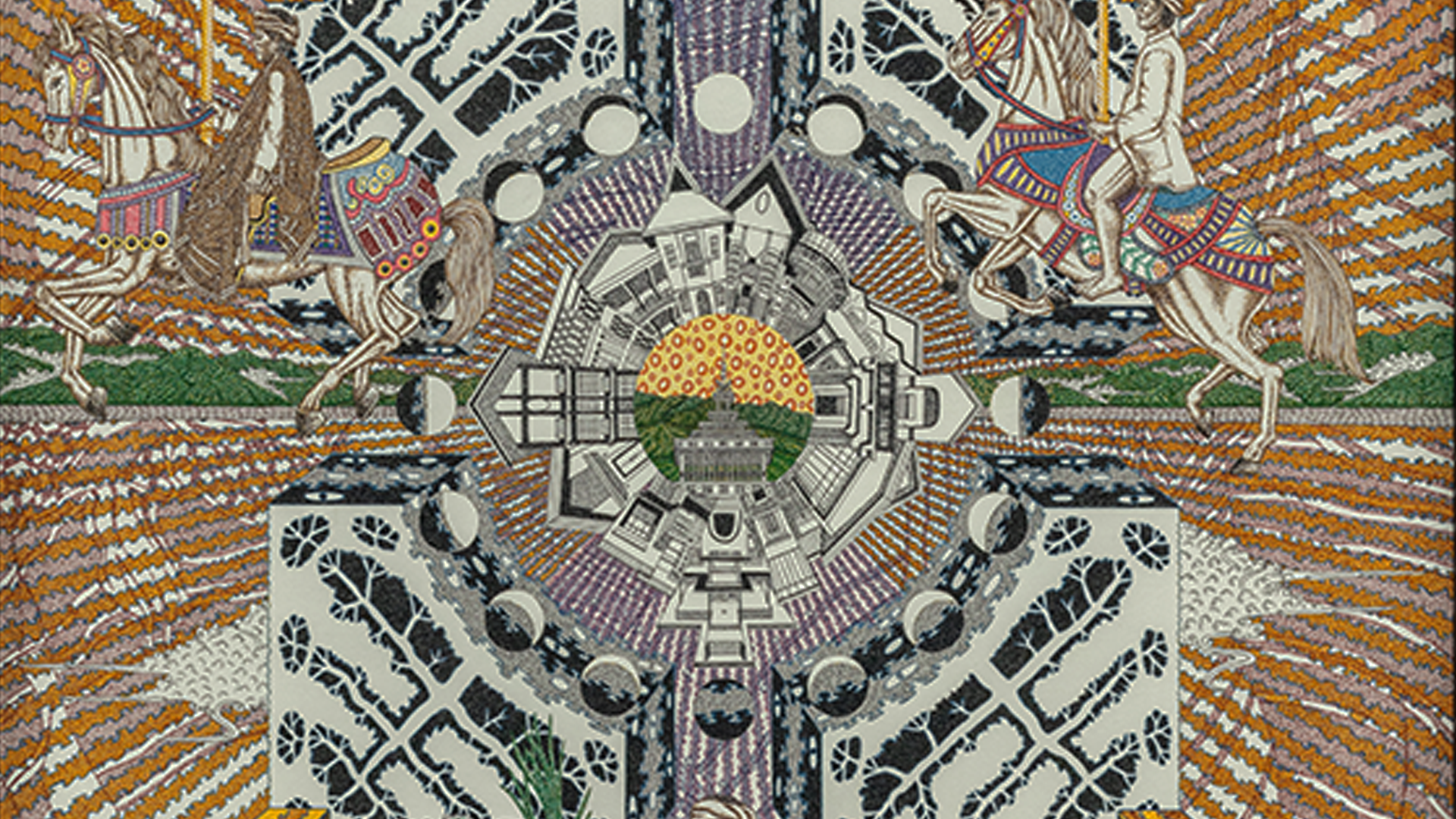
The artist’s most ambitious work in Raised by Mountains—and even in his body of work—is a large-scale triptych entitled PREMORADIAL ANCESTORS. On the triptych’s left-hand panel stands a man in traditional attire behind mountains and among calla lilies, celosias, and angel trumpets. The center panel has a moon phase wrapping around buildings, referencing interpretations of time outside the Gregorian calendar, yet followed by numerous cultures around the world. The right-hand panel has a woman in traditional clothing standing like the man. Across all three panels are scenes of people dancing and building, and people riding carousel horses, showing the passage of time.
Re-mapping Home
Like Sabado, Aguinaldo was born and raised in the region and earned a Thirteen Artists Award in 2003. He creates intricate patterns and compositions through woodcut and mixed media. The painterly application of such materials echoes the practice of Santiago Bose, co-founder of the Baguio Arts Guild, of which Sabado and Aguinaldo participated during their early career.
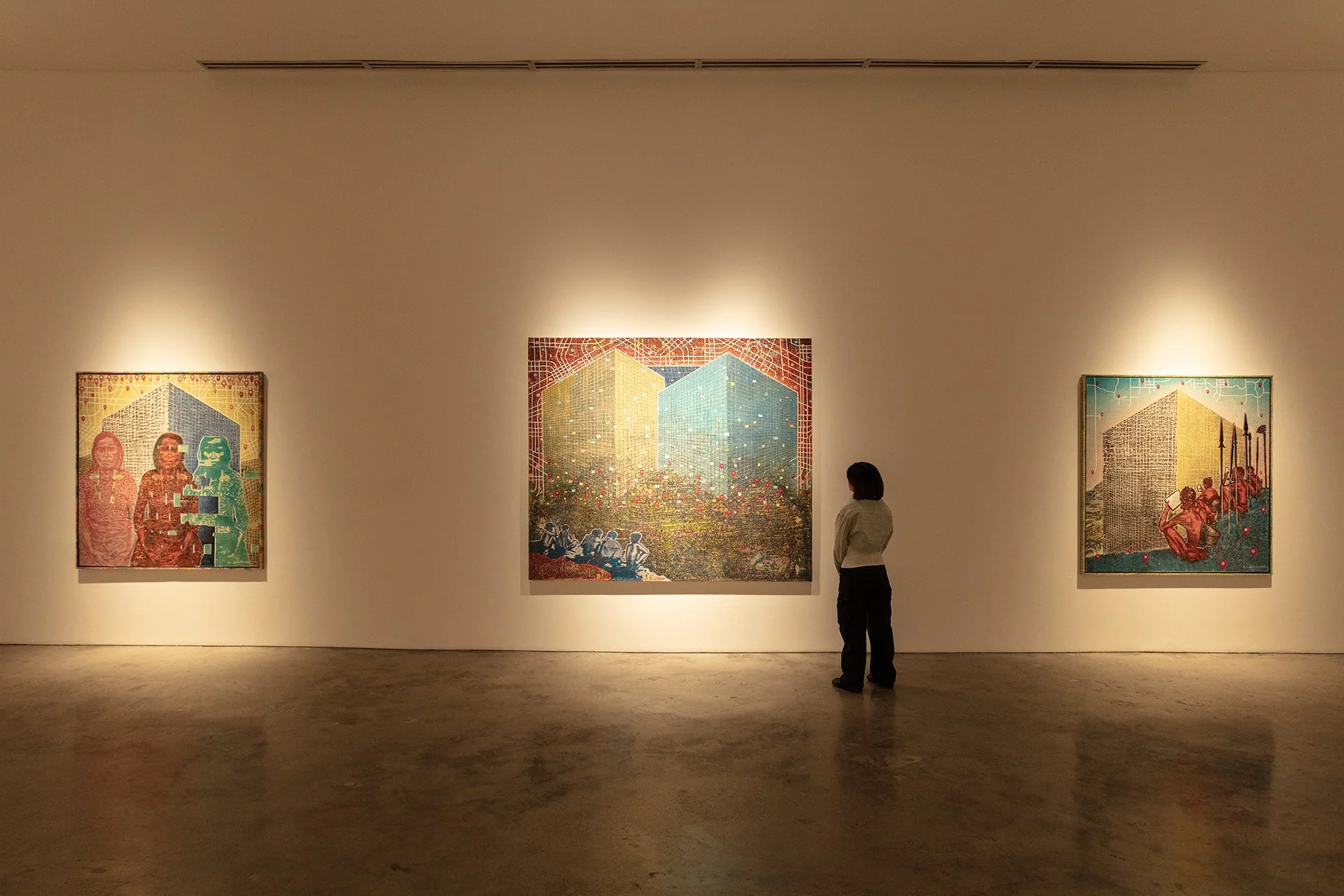
Aguinaldo’s paintings | Photo from Silverlens Galleries
While Sabado celebrates the heritage and history of these indigenous communities in Raised by Mountains, Leonardo Aguinaldo explores how past, present, and future intersect in Cordillera. On view are a series of mixed media artworks that show the contrast between past and present in Cordillera. Symbolizing technological progress are large cubic structures that resemble glass buildings, lines on online maps, and location pins; representing the past are flora and fauna. Humans are caught between these two worlds: sitting on the rice terraces, scrolling on smartphones and tablets, and disappearing into pixelation.
It would be all too easy for Aguinaldo to depict the march of time in strict, moral binaries: technology is evil, and nature is good. Yet, the artist takes the more nuanced and skillful path by presenting technology as embedded in these cultures by having the human subjects interact with it, for better or for worse.
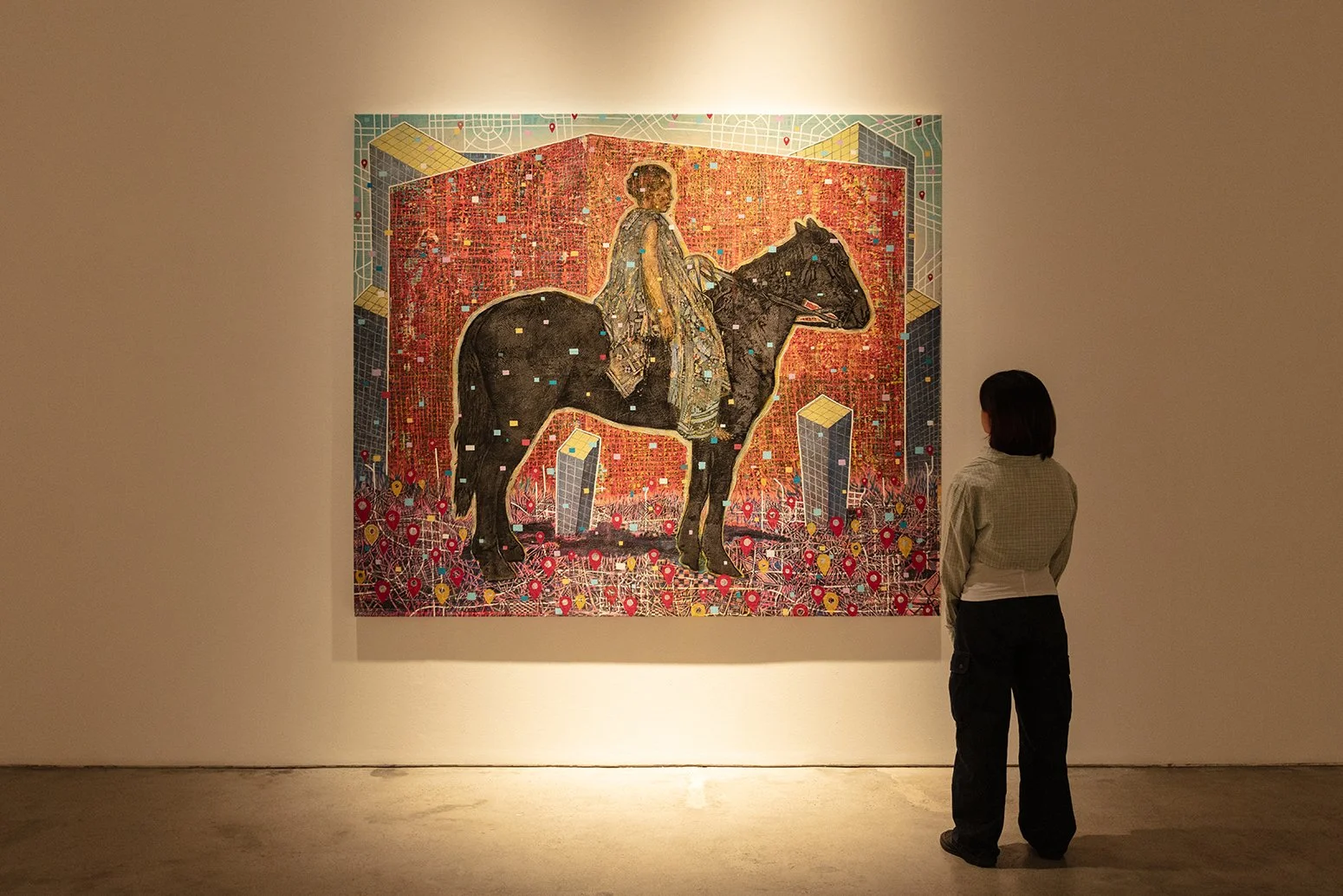
“This Place Meant Nothing” by Leonardo Aguinaldo | Photo from Silverlens Galleries
The artwork This Place Meant Nothing embodies this complex approach the most. A woman sits atop a horse amid location pins, map lines, and the aforementioned cubic structures. There is not a patch of greenery in sight, implying that technology has taken over the land. The woman on the horse could represent the mass movement and displacement of indigenous peoples in the Philippines. However, the colorful blocks scattered around the painting mirror the geometric designs found on the woman's garments. Through this detail and the beauty of these digital patterns, Aguinaldo hints that these digital artifacts have become part of the fabric of life in Cordillera.
Weaving Together
Raised by Mountains gives two masterful peers the space to showcase the best of what Northern Luzon has to offer. The exhibition’s layout is simple: Sabado’s portraits are on one wall, his triptych hangs on a wall perpendicular to the portraits, Aguinaldo’s paintings hang on one wall, and This Place Meant Nothing hangs on the wall opposite the triptych. Although the choice to clearly allocate respective walls to each artist makes this exhibition feel like two separate shows, especially for viewers who want to spend time with each artwork.
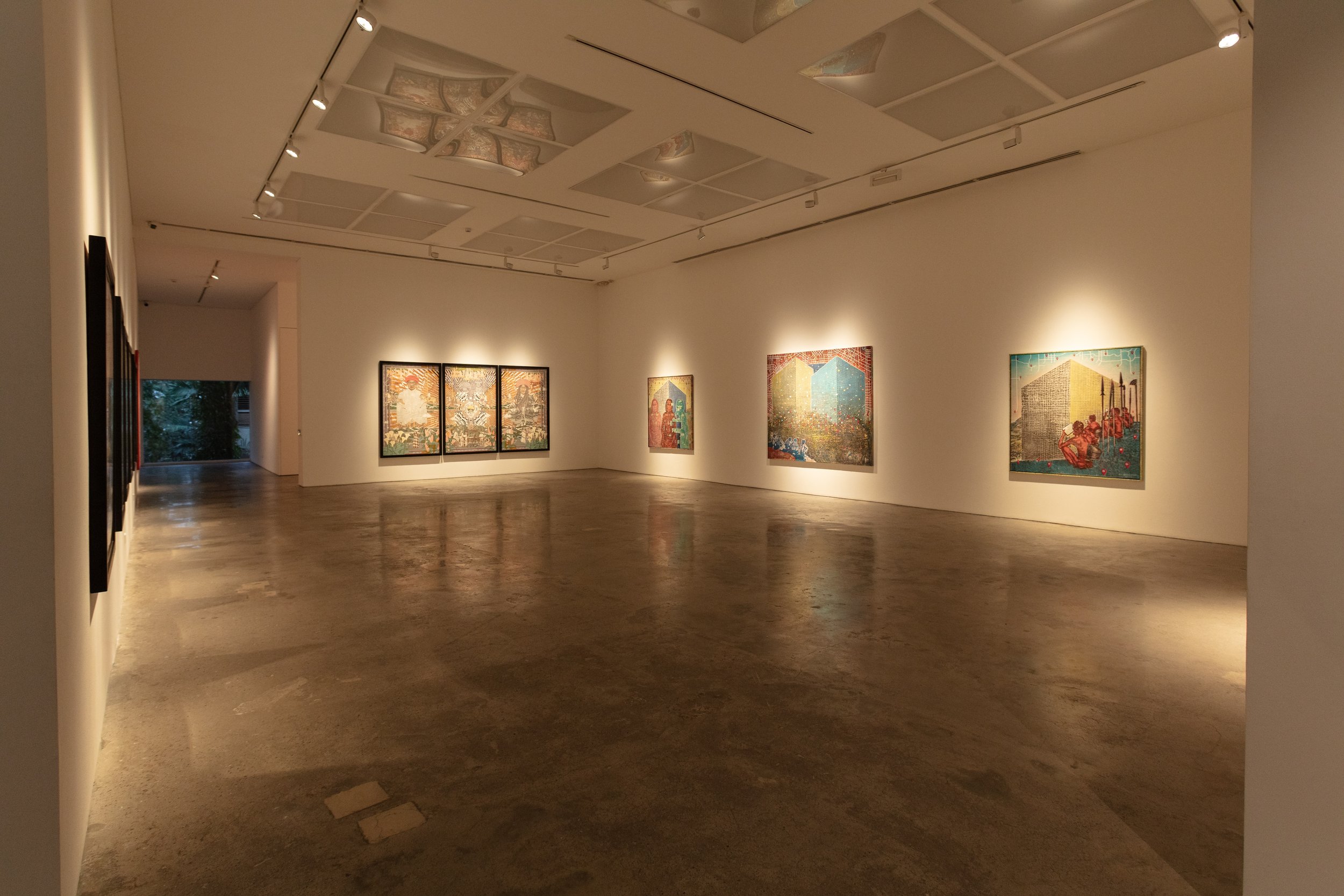
Exhibition layout | Photo from Silverlens Galleries
One point where both artists intersect is in the artwork TWOMANSAW. Seeing two established artists collaborate on a single artwork is a rarity. TWOMANSAW shows that Sabado and Aguinaldo could integrate their approaches seamlessly. The work features intricate and vibrant geometric patterns in the background, and two men sawing the head off of a crocodile with a Philippine flag spilling from its jaws.
Filipinos today use the term ‘buwaya,’ which means ‘crocodile’ in Filipino, to refer to corrupt politicians. Given the Philippine flag in the crocodile’s mouth, it’s clear that Sabado and Aguinaldo are making a political statement.

“TWOMANSAW” by John Frank Sabado and Leonardo Aguinaldo | Photo from Silverlens Galleries
The shock factor here eclipses the more intriguing and important statement made by the two men sawing. Each man has a head that resembles that of a bulul, carved ancestor figures used to guard rice crops. These figures are used by the Ifugao people of Cordillera. Bulul are usually seated, but TWOMANSAW has them livid.
One bold—and even controversial—interpretation of the bulul in TWOMANSAW is that it’s a subversion and critique of appropriation of indigenous art by Western artists, specifically Pablo Picasso’s Les Demoiselles d'Avignon, a landmark painting in Cubism. Picasso takes masks from Africa and Iberia and puts them on the naked bodies of two women, which some scholars believe to be in a brothel. Art critic Hal Foster calls this the “abstraction of the tribal,” and art historian Anna C. Chave states that “Picasso caricatured sacred African masks and employed them in a brazenly disrespectful way.”

LAKAY MAGTIBAY by John Frank Sabado | Photo from Silverlens Galleries
By having the bulul use the saw against the symbolic buwaya, Sabado and Aguinaldo position the representation of indigenous Filipino culture as a sort of moral authority and protector. This is underscored by the orderly patterns and textures that surround the composition. Picasso may have twisted the meaning of sacred objects, yet Sabado and Aguinaldo position their community’s sacred objects in their rightful place, with one foot in the past and another in the present.
How to Move Mountains
Raised by Mountains immerses viewers in the highlands, even if only for half an hour. Sabado and Aguinaldo capture what it means to be part of these communities and what it means to be human: to sit in nature, to dance with the seasons, and to scroll online.

INA PATTIKIW by John Frank Sabado | Photo from Silverlens Galleries
Waxing poetic about the past is tempting when talking about heritage. In celebrating and capturing different facets of Cordillera, Raised by Mountains also shows how indigenous values thrive in the present and could prepare us for the future.
On January 31, 2025, Baguio launched Pansa-nopen Tayo, an initiative for the city's circular economy portfolio. Pansa-nopen Tayo is rooted in practices of the Ibaloi community, such as crop rotation in traditional farming and waste reduction.
“Circular economy has long been practiced by the indigenous Ibaloi people, though it wasn’t called that way in the past,” says Vicky Mackay, Ibaloi elder, for the United Nations Development Program.
So, on your next road trip to Cordillera, take your eyes off the mountains, rice terraces, and strawberries for a second to see who these mountains embrace.
Sources and Citations
Altro Mondo. (2025, March 22). John Frank Sabado | Altro mondo · Creative Space. Altro Mondo · Creative Space — Contemporary Art Gallery. Retrieved March 24, 2026, from https://altromondo.com.ph/artists/john-frank-sabado/Anglin Burgard, T. (1991). Picasso and Appropriation. The Art Bulletin, 73(3), 479–494. https://www.jstor.org/stable/3045817?read-now=1&seq=1#page_scan_tab_contentsC. Chave, A. (1994). New Encounters with Les Demoiselles d’Avignon: Gender, Race, and the Origins of Cubism. The Art Bulletin, 76(4), 596–611. https://www.jstor.org/stable/3046058?read-now=1&seq=1#page_scan_tab_contentsCajigan, R. A. (2026, February 26). “Raised by Mountains” Exhibition Description [Press release]. Retrieved March 24, 2026, from https://www.silverlensgalleries.com/exhibitions/2026-02-24/raised-by-mountainsFast Facts: Indigenous Peoples in the Philippines. (2013). In UNDP.org. United Nations Development Program. https://www.undp.org/philippines/publications/fast-facts-indigenous-peoples-philippinesFoster, H. (1985). Foster, H. (1985). The “Primitive” Unconscious of Modern Art. October, 34, 45–70. https://doi.org/10.2307/778488. October, 34, 45–70. https://www.jstor.org/stable/778488?read-now=1&seq=1#page_scan_tab_contentsHiraya Gallery Deutschland | Leonard Aguinaldo. (n.d.). http://hiraya.de/portfolio_page/leonard-aguinaldo/#:~:text=Born%20in%20November%206%2C%201967,of%20the%20Philippines%20in%202003.Ifugao artist - Bulul (male rice deity figure) - Ifugao people. (n.d.). The Metropolitan Museum of Art. Retrieved March 24, 2026, from https://www.metmuseum.org/art/collection/search/626371John Frank Sabado. (n.d.). Silverlens Galleries. Retrieved March 24, 2026, from https://www.silverlensgalleries.com/artists/john-frank-sabadoKehinde Wiley Studio | Brooklyn, NY. (n.d.). https://kehindewiley.com/Leonard Aguinaldo – Gajah Gallery. (n.d.). https://gajahgallery.com/artist/leonard-aguinaldo/Leonardo Aguinaldo. (n.d.). Silverlens Galleries. Retrieved March 24, 2026, from https://www.silverlensgalleries.com/artists/leonardo-aguinaldoRillera-Tabangin, D., Balay-as, M., & Diaz, E. P. (2025, June 5). Re-embracing Indigenous Values with Baguio City’s Transition Towards Circularity. UNDP.org. Retrieved March 24, 2026, from https://www.undp.org/philippines/blog/re-embracing-indigenous-values-baguio-citys-transition-towards-circularitySantiago Bose. (n.d.). Silverlens Galleries. Retrieved March 24, 2026, from https://www.silverlensgalleries.com/artists/santiago-boseSilverlens. (2026, February 24). https://www.silverlensgalleries.com/exhibitions/2026-02-24/raised-by-mountainsThe Future of Indigenous Peoples in the Philippines: Sources of Cohesion, Forms of Difference. (2012). Philippine Quarterly of Culture and Society, 41(3/4), 273–294. https://www.jstor.org/stable/43854732?seq=1