Receipts, Recipes, and Recollection
Pam Yan Santos’ When Grey Turns Blue explores the bursts and tolls of aging.
Words & Photos Madeleine O. Teh
September 12, 2025
Comfort Food
According to a study conducted by Stanford University, we age in two bursts. The first burst happens at 44 and the second burst at 60. While we age in microscopic increments every day, dramatic changes during these ages primarily affect age-related diseases such as Alzheimer’s and cardiovascular illnesses. The findings also redefine our concept of growing old, that it doesn’t happen slowly, but all at once, and often blindsides us.
A head full of gray hair signals not only physical changes, but also psychological ones as well. Artist Pam Yan Santos meditates on the fraught and fragile process of growing old in her solo show, When Grey Turns Blue. The show takes place at Makati-based gallery The Drawing Room and runs from July 12 to August 9, 2025.

Left, Right, Inwards
Here, Yan Santos exhibits a collection of paintings, assemblages, and installations that focus on the artist’s memories of raising her family, overcoming personal challenges, and watching her mother age. “Not one to keep the personal under wraps, Pam has left traces of the continuing journey strewn across the walls and gallery floors here in ‘When Grey Turns Blue,’” writes Eileen Legaspi-Ramirez in the show notes, “On Edge, On Point.”
Yan Santos shows the iridescence of aging. She marks the mixed emotions that come with seeing the first gray strands and reflects on the promise of so-called blue zones, where residents often live to be a hundred years old, thanks to a mix of fresh food and lifestyle. While Yan Santos ponders what aging would bring her, she also sifts through the rubble of life with an artist’s hand.
Safeguarding ephemera
The artwork that most directly embodies the ethos of “When Grey Turns Blue” is the series “Blue Notes.”
Blue Notes
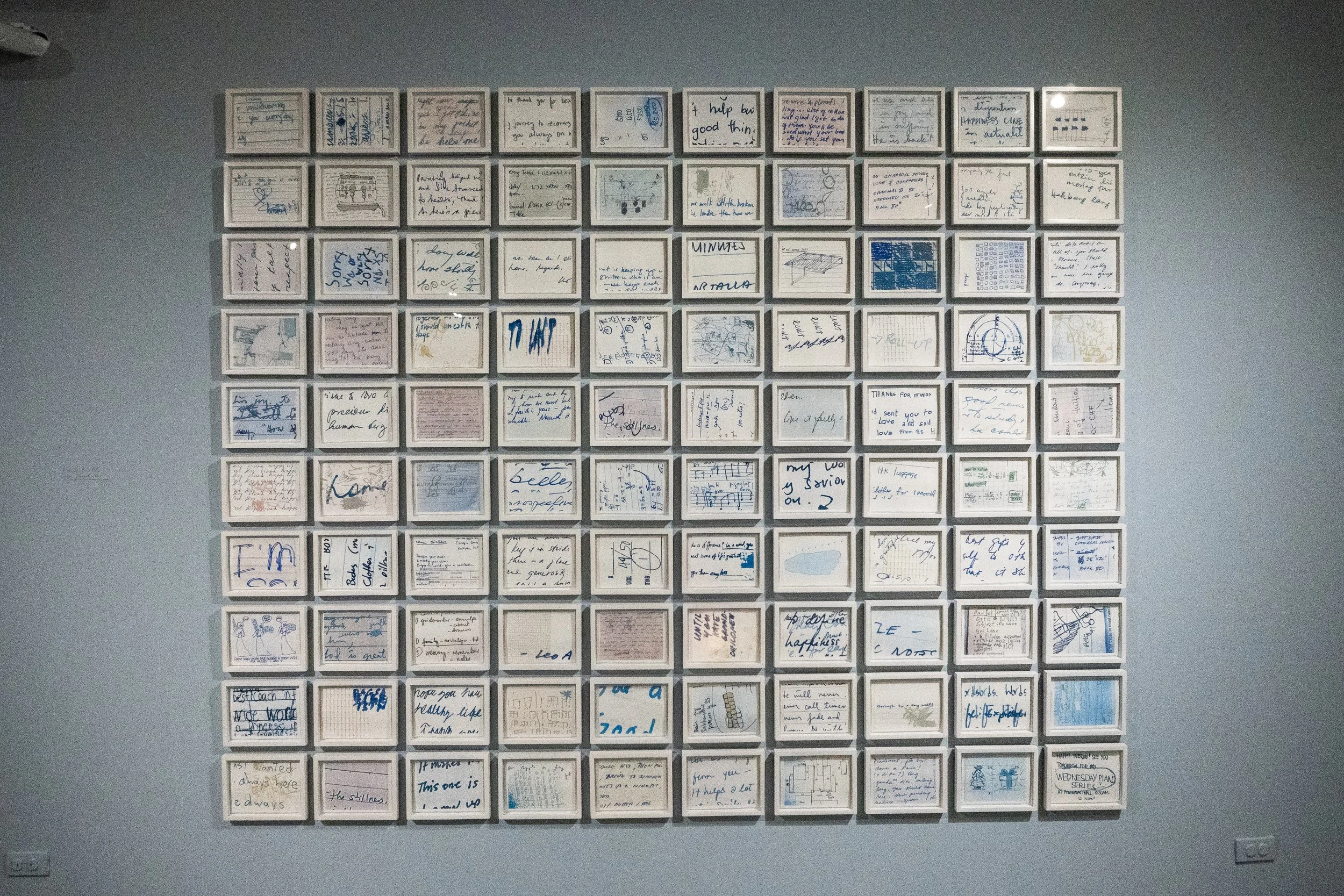
“Blue Notes” features a hundred bond paper-sized prints, mostly handwritten notes and drawings, all in the vibrant blue of ballpoint ink. The notes are shown cropped and enlarged, thus bringing them to a realm of significance. Here, Yan Santos creates tension through everyday, generally inconsequential notes and a larger scale that demands attention.
Perhaps, the artist cautions us that these scraps of paper containing grocery lists, children’s drawings, and diary entries could become the culmination of one’s life. Through this, she ponders the question of what we leave behind.
Uncovering memory through collage
Yan Santos’ use of collage and printmaking techniques permeates throughout her practice. She uses collage in her 2009 work, “Making a living room: Color inside the line,” at the Pintô International. Since then, Yan Santos’ collage work evolved to focus on abstraction and evocation, rather than straightforward representation. This rings especially true in When Grey Turns Blue.
Time Deposit Series
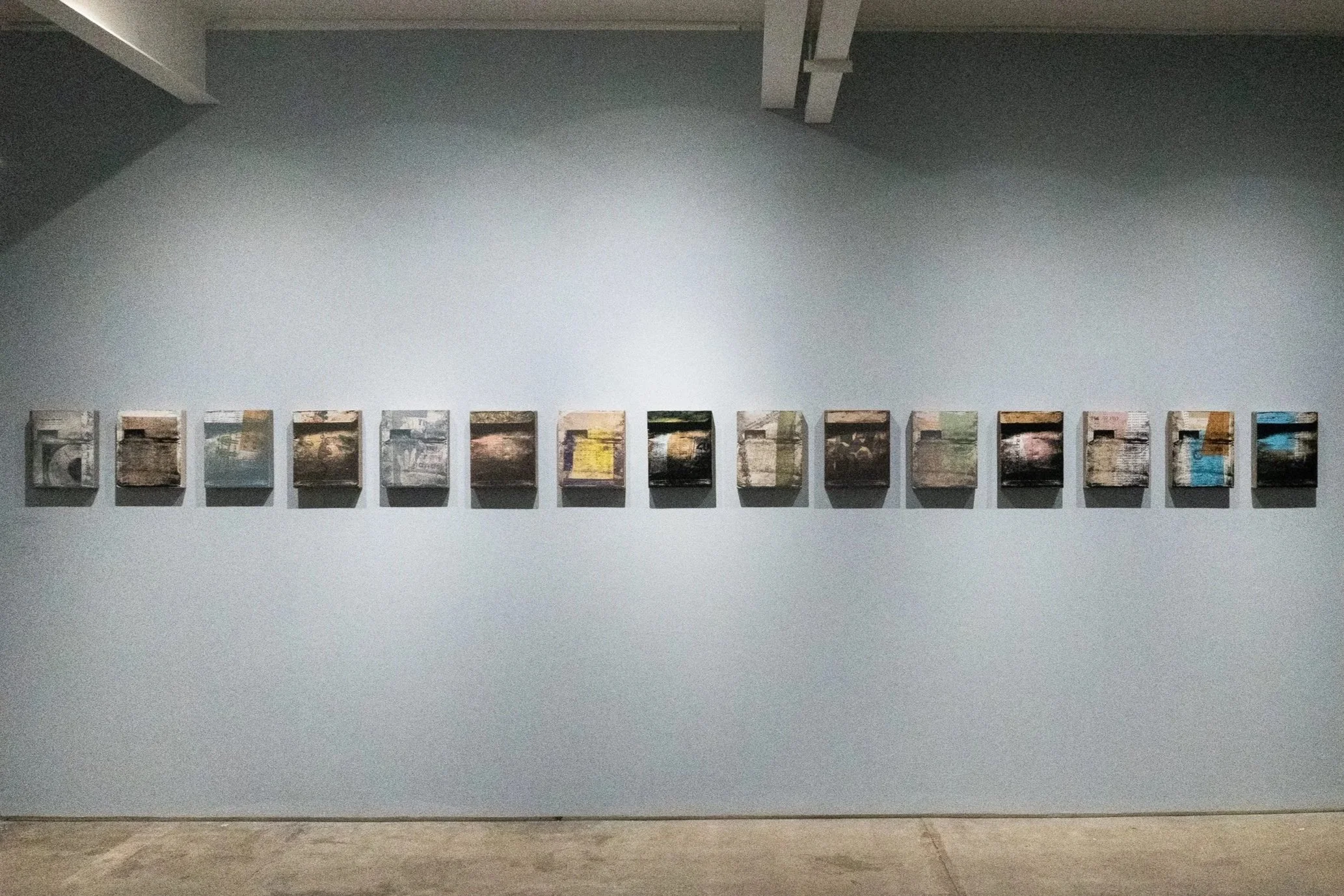
“Time Deposit Series” is a set of fifteen collages on canvas. Yan Santos combines pages from notebooks, receipts, and other printed matter with acrylic and serigraph. The printed matter peek from behind a blur of what seems like acrylic markings. By altering legibility through collage, Yan Santos employs the strengths of the medium. Curator Margaret Miller says, “Collage has been the means through which the artist incorporates reality into the image without imitating it.”
The process of deciphering the blurred text reflects the difficulty of remembering and rewards the viewers through the hunt. “Time Deposit Series” eschews a Proustian version of recollection that’s often instant and vivid. For Yan Santos, memory is earned.
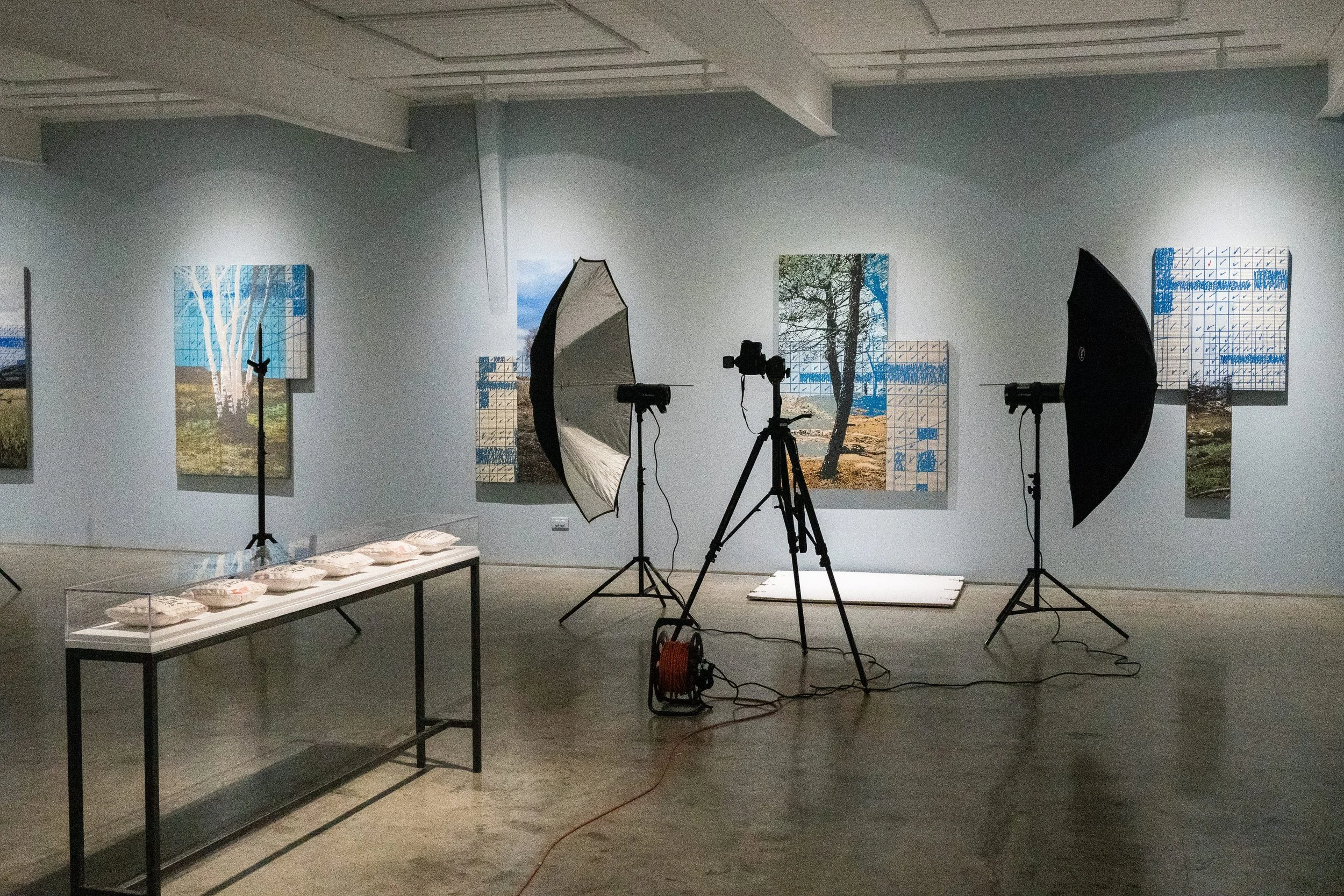
On the largest wall in the space are four large-scale works where checkboxes intersect with scenes of rocky terrain. For these works, Yan Santos uses a combination of acrylic, collage, and transfer on intersecting canvases. They deviate from the conventional rectangular format employed across the visual arts. Again, these large-scale collages reinforce the show’s themes of memory and transience.
Stirred in Memory
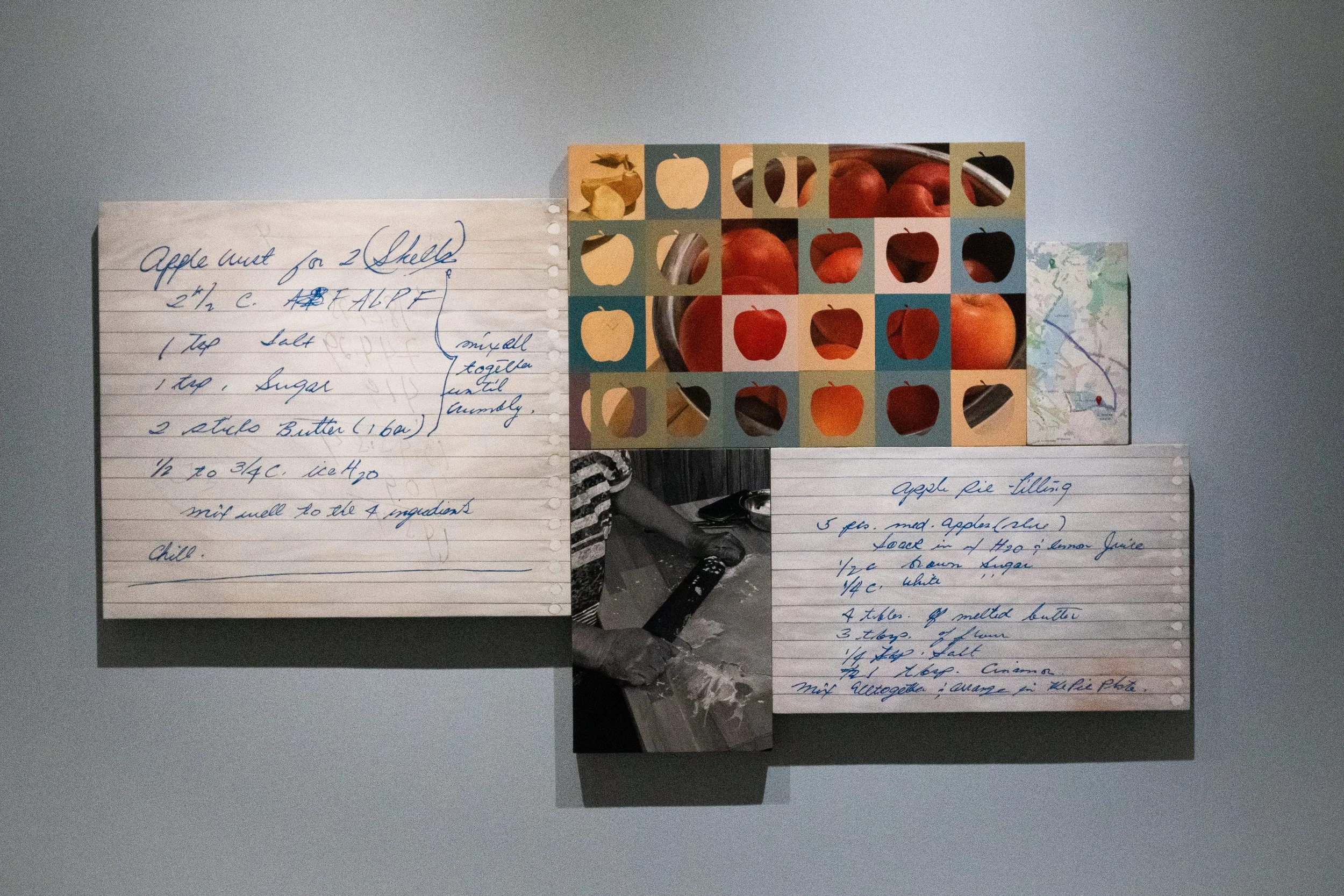
Lastly, Yan Santos employs the visual language of collage in the painting “Stirred Memory.” Much like the large-scale collages, this painting has a group of canvases showing different parts of the cooking process, such as handwritten recipes, apples, and a vignette of preparing the dish.
According to Legaspi-Ramirez’s text, the inclusion of these scenes in “Stirred Memory” recalls Yan Santos’ mother, especially as the artist navigates caring for her. “Homing her locked-down mother and witnessing her revisit baking skills that had seen Pam and siblings through their childhood comes marked by an apple pie recipe blown up and painted.” “Stirred Memory” functions much like the aforementioned collages in the show, and Yan Santos explores these experiences further in her assemblages.
Revisiting assemblages
Assemblages constitute a significant portion of Yan Santos’ practice. The artist showcased assemblages in previous shows, such as the 2023 solo show Contain in MO_Space and the 2025 group show Big Bang: A Myth of Origins in Gajah Gallery. Each assemblage from Yan Santos crystallizes numerous themes of motherhood, domesticity, and everyday life.
Pioneering curator at the Museum of Modern Art, William C. Seitz, says the term “assemblage” refers to the combination of materials and “a complex of attitudes and ideas.” Through these assemblages, Yan Santos ruminates on the weight of everyday objects. She employs assemblages similarly in When Grey Turns Blue, which has three notable objects.
Peace of Cake
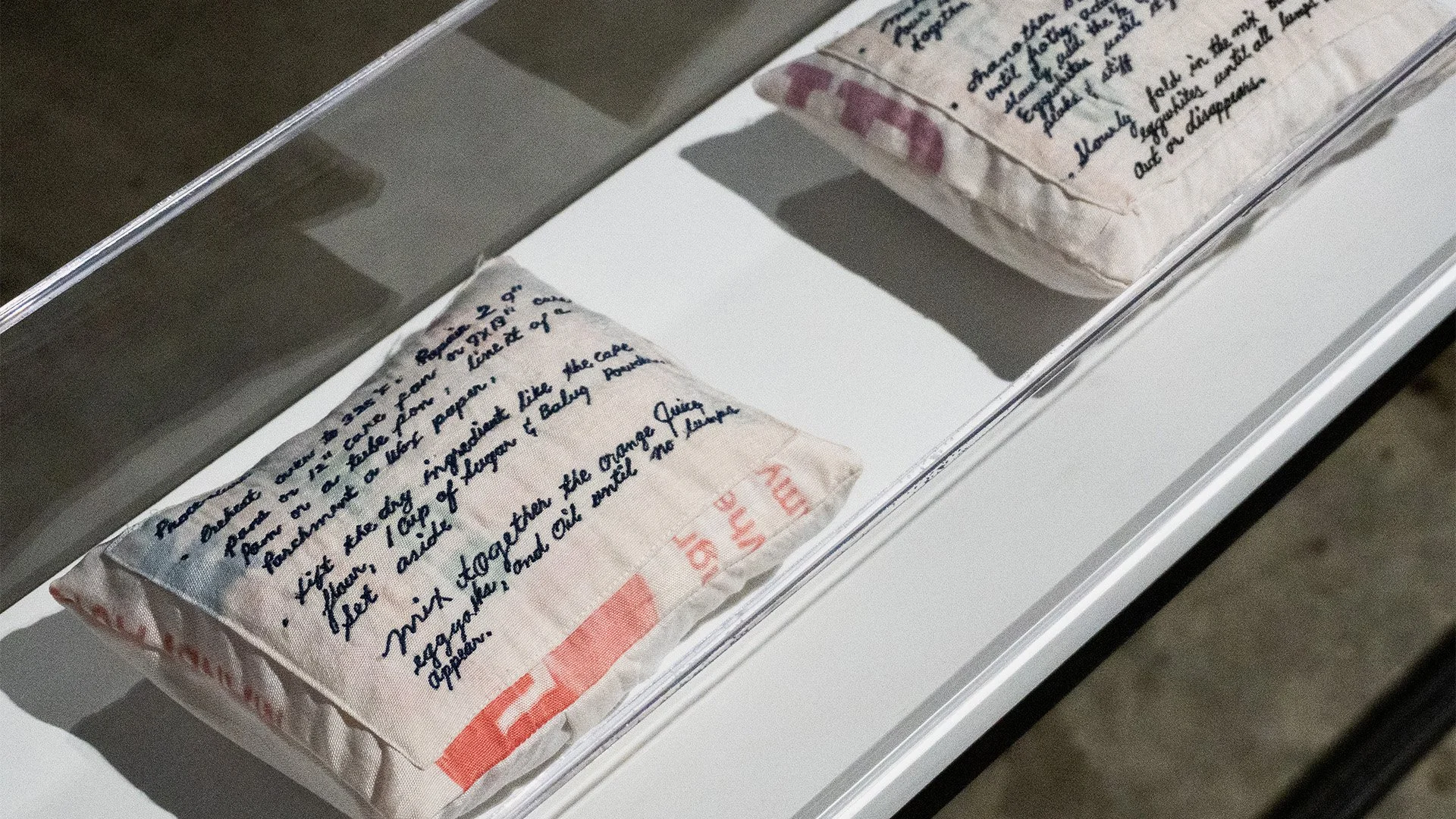
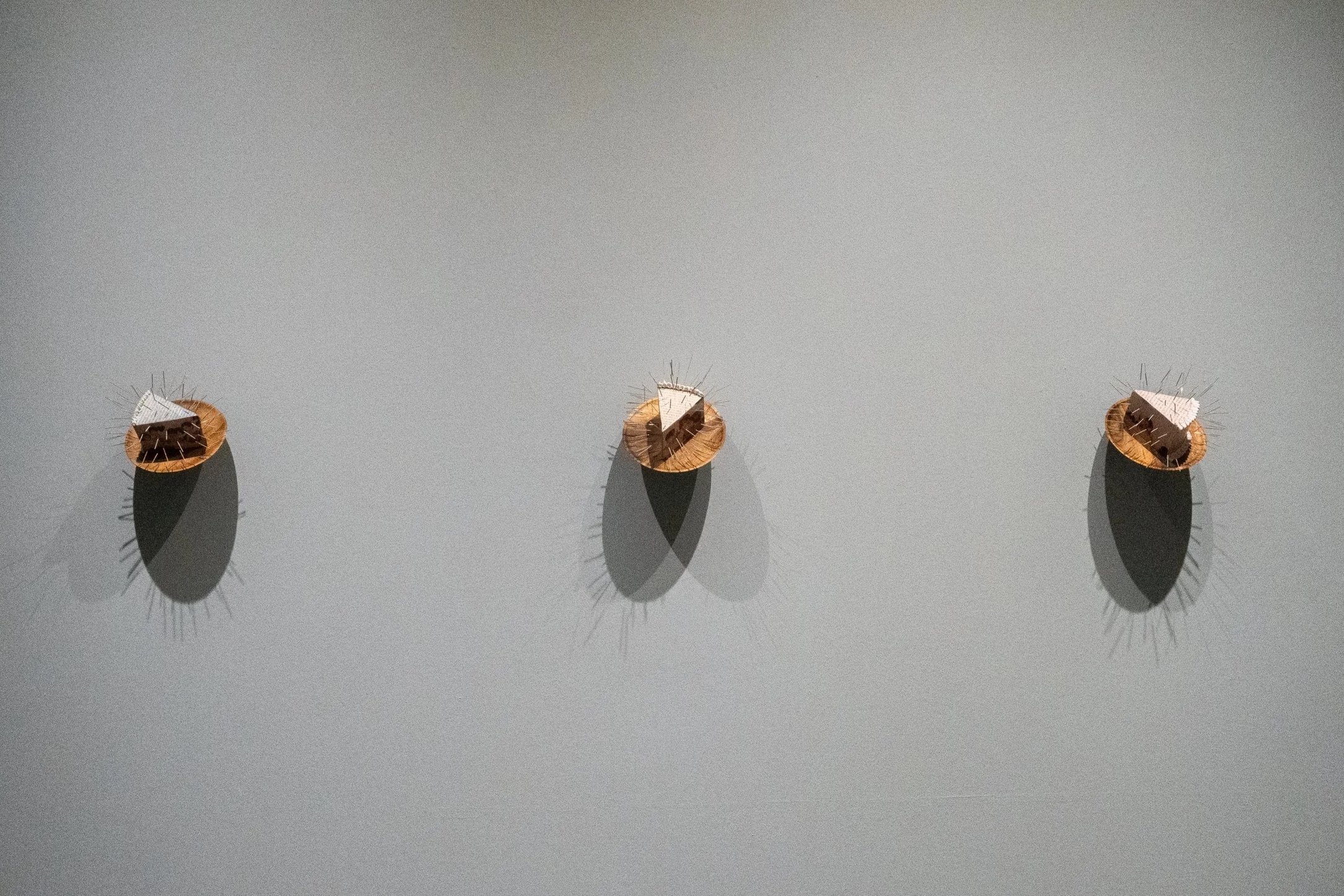
The first of the assemblages, “Peace of Cake,” is a series of three sculptures constructed out of resin and found objects. Each object appears to be a slice of cake with acupuncture needles sticking out. On the surface of the cakes are cut-outs of childhood photos and long text. The second, “Comfort Food,” is pillows crafted out of sacks with recipes in delicate cursive embroidered on top. Simple in execution, “Comfort Food” captures the nostalgia and safety of a home-cooked meal.
Both these objects pay homage to Yan Santos’ mother by highlighting childhood memories, experiences during the COVID-19 lockdowns, and challenges from caring for her mother during her illness. Legaspi-Ramirez notes, “Pam relates how she stopped in her tracks, asking how her mom kept undeterred by all that had been flung at her.” The assemblages memorialize her mother’s experiences and acknowledge how the artist could repeat these as she ages.
Yan Santos’ choice of cursive for “Comfort Food” subtly hints at the writing of previous generations, given how much cursive has fallen out of use in recent years. This gesture is similar to the one in artist Danh Võ’s “2.2.1861.” Võ asked his father to transcribe the last communication from French Catholic Saint Théopane Vénard to his father before his execution. Much like “2.2.1861,” “Comfort Food” pays homage to parents while also showing the transience of time left with them.
Yan Santos’ last assemblage, “Red Letter Days,” is an installation of votive candles arranged to resemble church offerings, tucked away on the other side of The Drawing Room’s main space. Legaspi-Ramirez notes, “Votives encased in resin apples get lit to send up intentions exhibition visitors care to share and slip into the drawers for safekeeping.”
Votive candles nod to what happens after one ages and create a liminal space between the earthly and the divine. Yet their presence among Yan Santos’ paper-based works appears tonally and formally disconnected. The votives are somber while the assemblages and collages are expressive and painterly. “Red Letter Days” shows no signs of the human hand, while everything else does.
The disparity between “Red Letter Days” and the rest of When Grey Turns Blue could be an artistic decision to distinguish between life and the afterlife. However, the exhibition’s thrill lies in seeing Yan Santos labor over a glut of ephemera, rather than sending a prayer to the sky.
Scraps of life
When Grey Turns Blue is a visceral reflection on facing mortality, one scrap of paper at a time. Yan Santos takes time to pause before the evidence of her life and those of her loved ones before trying to make sense of it all. The artist uses collage and assemblages to find meaning, yet with the occasional awkward fit.

Comfort Food
Much like how we dramatically age in two spurts, this exhibition at The Drawing Room feels like a reckoning for Yan Santos. To see how much one’s life amounted to is jarring. Where does Yan Santos go from here?
“We remember in spurts and broken up sequences,” Legaspi-Ramirez writes. “Perhaps because that is all we can bear as we try to keep moving as parts of us insist on stasis.”
When Grey Turns Blue is a reminder that past the first few strands of grey lies the culmination of a life well-lived and the start of another marked by reflection and, ideally, peace.
Sources (Chicago):
“Big Bang: A Myth of Origins – Gajah Gallery.” n.d. https://gajahgallery.com/exhibition/big-bang-a-myth-of-origins/.
“Contain: Pam Yan Santos | MO_Space.” n.d. https://www.mo-space.net/exhibitions/2023-contain.
“Danh Vo | 2.2.1861 | the Guggenheim Museums and Foundation.” n.d. The Guggenheim Museums and Foundation. https://www.guggenheim.org/artwork/28837.
Devlin, Hannah. 2025. “Scientists Find Humans Age Dramatically in Two Bursts – at 44, Then 60.” The Guardian, April 2, 2025. https://www.theguardian.com/science/article/2024/aug/14/scientists-find-humans-age-dramatically-in-two-bursts-at-44-then-60-aging-not-slow-and-steady.
Legaspi-Ramirez, Eileen. 2025. “On Edge, On Point.” The Drawing Room, July 16, 2025.
“Pintô | Your Door to Philippine Contemporary Art.” n.d. Pintô | Your Door to Philippine Contemporary Art. https://www.pintoart.org/pam-yan-santos.
Seitz, William C. 1961. The Art of Assemblage. The Museum of Modern Art: Distributed by Doubleday.