
Okada Manila Maps Responsible Luxury with Bold ESG Strides in 2025
Okada Manila’s 2025 ESG report shows how a sprawling integrated resort quietly rewires luxury into something far more accountable, one system at a time.
Words Bernadette Soriano
Photos Courtesy of Okada Manila
April 30, 2026
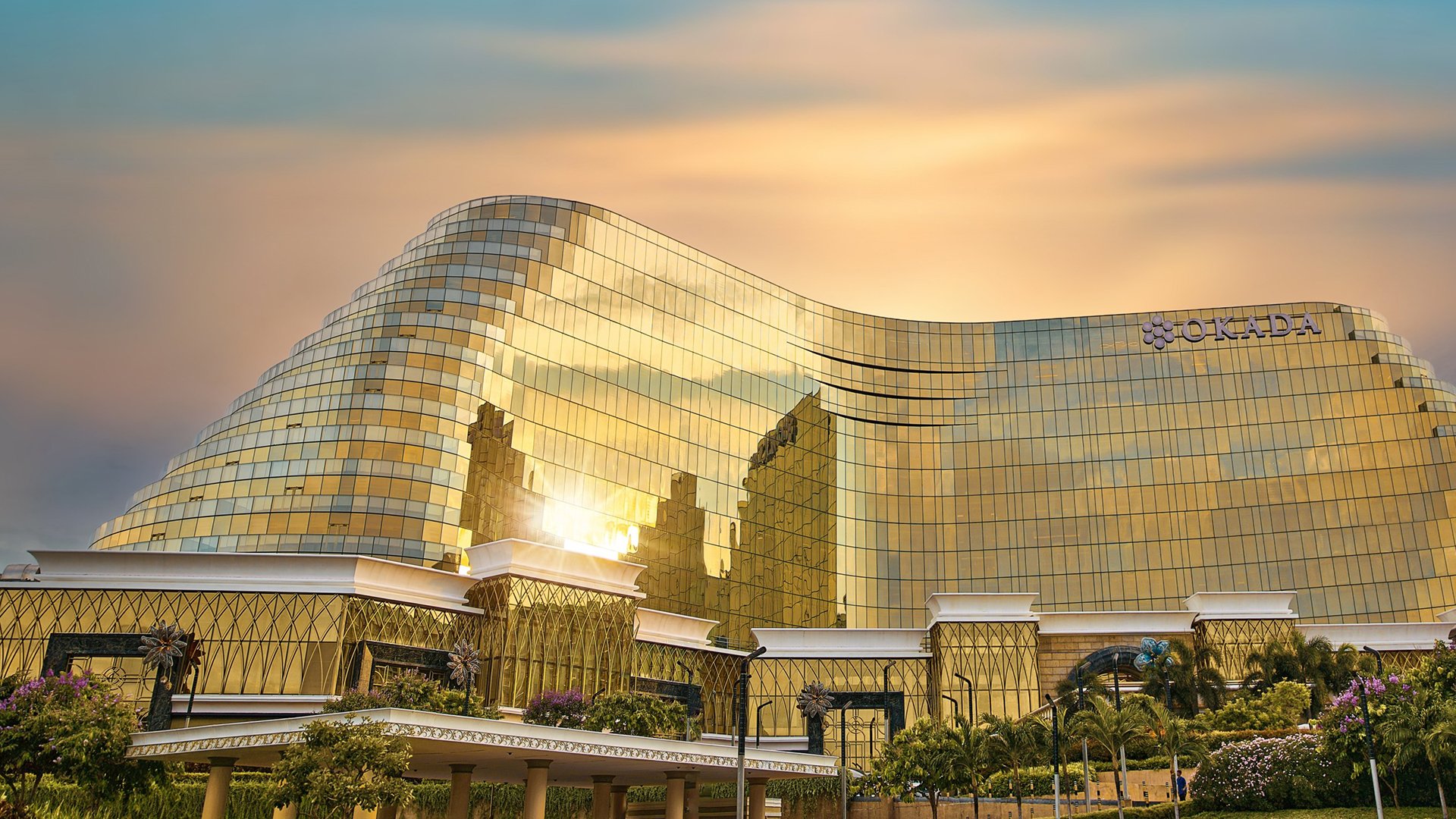
At Okada Manila, scale has never been quiet. It arrives in sweep and shimmer—the arc of fountains mid-air, the steady hum of gaming floors, the skyline imprint that lingers like a signature after the page has been turned.
Yet in its 2025 Environmental, Social, and Governance (ESG) Report, scale learns a different register: less about spectacle held in place, more about systems tightening their grip on long-term development.
The Okada Green Heart program threads through this recalibration with a kind of deliberate ease, as if sustainability has finally settled into its own architecture within the resort.

Okada Manila installed Entertainment City’s first electric vehicle (EV) charging station in a move towards sustainable innovation.
Numbers surface with intent—up to two million plastic bottles kept out of circulation each year, more than 9,000 meals redirected into communities that often sit just outside the glow of Entertainment City. These are not isolated gestures; they read like pulses in a larger operating rhythm, each one feeding into a system learning how to close its own loops.
Energy moves first, as it often does in large estates—half invisible, half orchestrated. LED lighting now runs across the property, an overhaul that trims consumption while keeping the luminous edge of its visuals intact.
Systems are tuned, then returned, as if the entire complex is learning to breathe at a lower cost. The introduction of an electric vehicle charging station within Entertainment City slips into this landscape almost unobtrusively, yet it signals a shift that carries weight: mobility now enters the conversation on sustainability, not as a concept, but as infrastructure.

Okada Manila has been honored with the Corporate Social Responsibility of the Year award at the 2025 Global Gaming Awards.
Water follows with a different lane of precision. Through the Nordaq system, filtration and bottling are handled on-site, drawing the process inward and stripping away excess along the way. Supply chains shorten. Single-use plastics fall away in increments too steady to dramatize but too significant to ignore, as what remains is an accounting of millions of bottles prevented from ever needing disposal.
Waste, in turn, is no longer treated as an endpoint. It circulates, recirculates, and moves back in altered form. Food rescue initiatives recover over 2,800 kilograms of surplus food, redirected into more than 9,000 meals that find their way into communities beyond the resort’s immediate frame. Emissions fall alongside it, around 5,500 kilograms of CO₂ avoided, though the more telling shift is structural: waste no longer exits the system as easily as it once did.
Still, the ESG story here is not confined to environmental engineering. It moves outward, into people, into practice, into the less visible textures of daily operation. Employee well-being is supported through medical and wellness programs that sit alongside a culture of preparedness: drills, training cycles, safety systems that return again and again until readiness becomes reflex.

Okada Manila brought together 110 employee volunteers, who planted 200 seedlings in support of long-term reforestation efforts.
Coastal cleanups and tree-planting activities extend that rhythm outward, placing staff in direct contact with the landscapes the resort inevitably shapes. In one such effort, 110 volunteers planted 200 seedlings for reforestation at the La Mesa Watershed.
Responsible gaming, too, is folded into this architecture of care. Digital training modules and strengthened reporting systems reinforce oversight, ensuring that accountability does not sit above operations but moves through them, embedded in how decisions are made and monitored.
Beyond the property’s perimeter, the Okada Foundation, Inc. extends the same logic of reach. Its programs move across education, healthcare, food security, arts, and sport—fields that rarely intersect but here are drawn into a shared current of access and support.

Across the broader Okada Food Rescue Program for the year, the initiative successfully recovered more than 2,000 kilograms of food.
In 2025, this includes expanded digital learning partnerships, nutrition initiatives, and sustained investment in Filipino artists and athletes, including long-horizon preparation toward the 2028 Olympic Games.
“Through the Okada Green Heart program, we are strengthening how responsible practices are embedded across our operations while creating value beyond business performance,” says President and COO Nobuki Sato, framing what the report itself keeps circling back to: that sustainability is not a separate pursuit, but a way of keeping the whole structure aligned as it grows.
As the pioneer in the Philippines to receive the Forbes VERIFIED Responsible Hospitality badge, Okada Manila is charting new territory in sustainable tourism, demonstrating how luxury and responsibility can evolve in tandem.