
Memories of Mr. Sansó
From a chance encounter to countless lessons in art and life, a glimpse into the warmth and wit of the man who painted beauty from memory and emotion.
Words Ricky Francisco
Photo courtesy of Fundacion Sansó
October 13, 2025
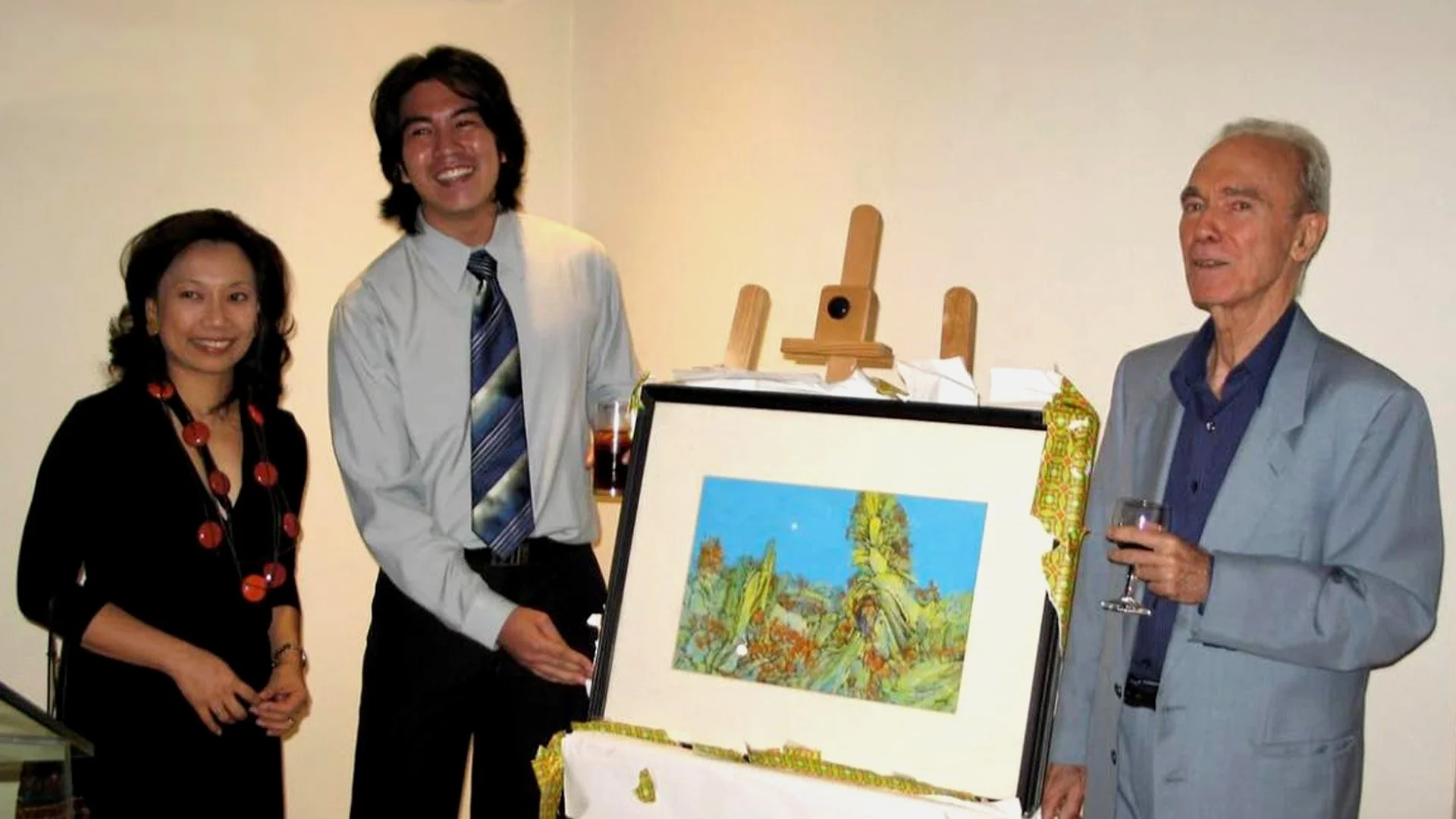
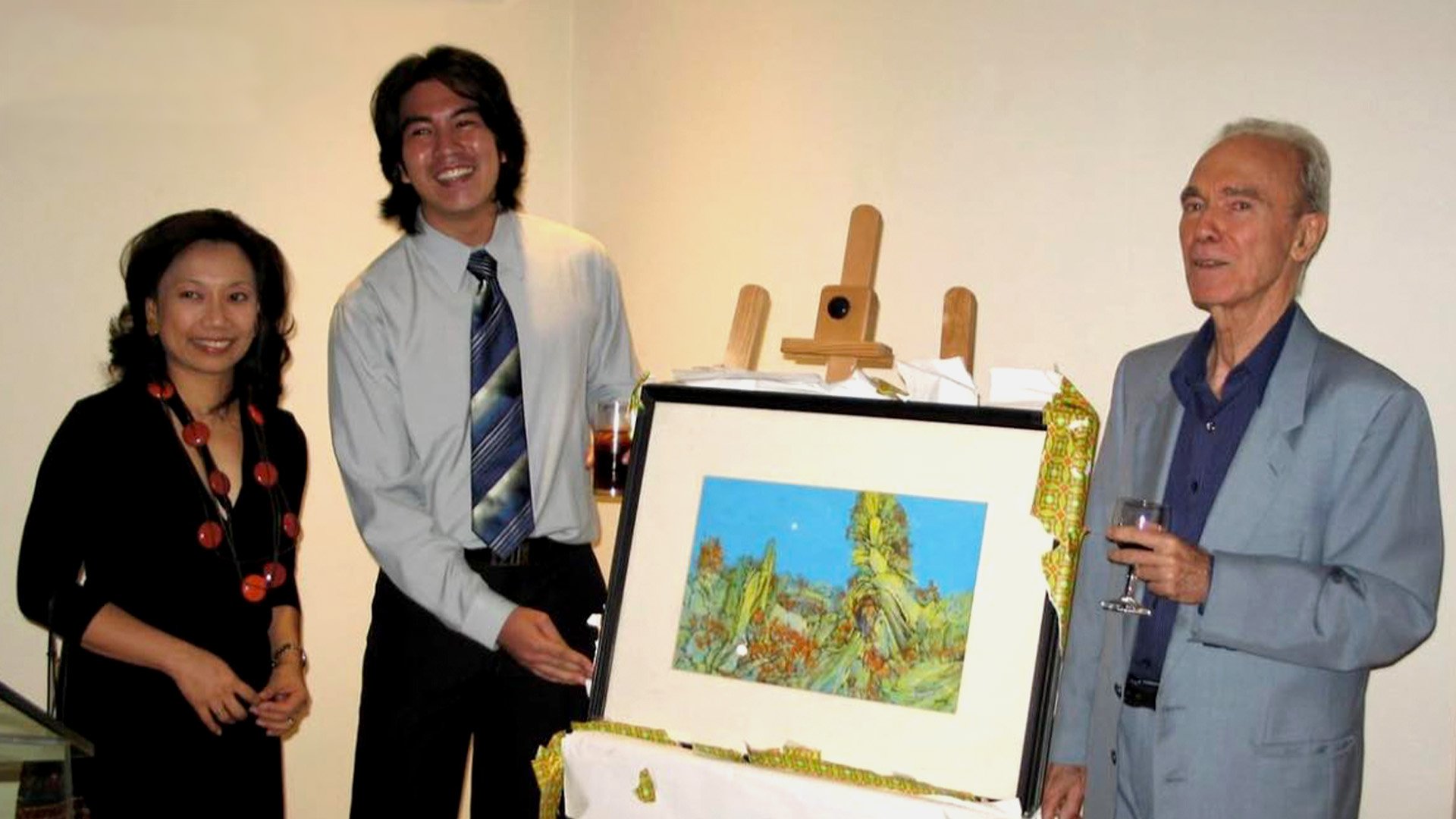
I have known of Mr. Sansó since I was a museum registrar at the Ayala Museum collection, in the early 2000’s. But I only got to meet Mr. Sansó in 2007, when I was already working for another museum, the Lopez Museum and Library, and I attended the opening of his exhibition, Black Bouquet, at the Ayala Museum. There was a raffle at the exhibition opening, and I was the lucky grand prize winner of his framed acrylic on paper painting, which, he told me when I claimed it, used to hang in his room. I was a proud owner of a Sansó artwork at age 29 by sheer good luck. It seemed, in a way, like a foreshadowing of what was to come for me with regards to being connected with Mr. Sansó.
When I started a new phase in my museum career as an exhibition organizer (as I still had great qualms with using the term ‘curator’ then) in 2014 at the Lopez Museum, I wanted to find new ways of making the Lopez Museum and Library’s collections more timely and relevant. One of the focal collections I wanted to touch on was the over 40 copperplate etchings of Mr. Sansó in the Lopez Museum and Library’s Collection, which were gifts of Mr. Sansó to the Eugenio Lopez Foundation, in gratitude for Robby Lopez’s generosity in publishing the Rod. Paraz-Perez book on Sansó (which would be the start of the series of publications on Philippine Artists by RPP and the Eugenio Lopez Foundation) and helping to fund the six-museum exhibition cycle of Sansó in 1988.
Though the copperplate etchings of Mr. Sansó were mostly made in the 1950’s and 60’s, they were so contemporary as they spoke of solitude, angst, and anomie, which many of his contemporaries only briefly touched on despite their trauma from war, and yet established young artists like Ronald Ventura, Andres Barrioquinto, and Leslie de Chavez interestingly focused on around that time. So I attempted to juxtapose Mr. Sansó’s early works with the works of Leslie de Chavez, Mike Adrao, and contemporary dancer/choreographer Ea Torrado in Complicated, which I co-curated with my good friend and colleague, Dr. Ethel Villafranca.
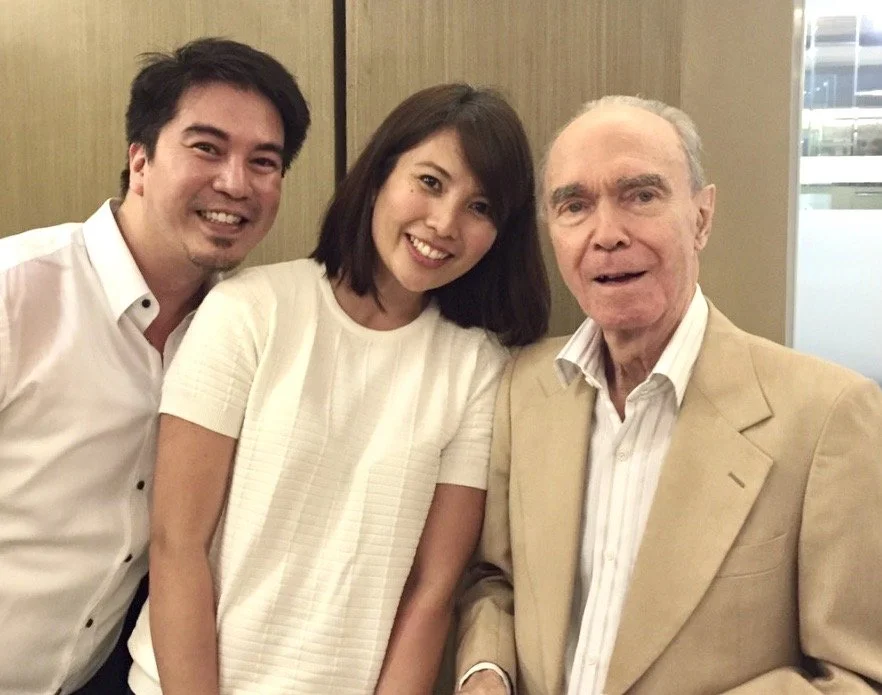
Sanso with Ricky and Misty Francisco, PKL Center 2016
I got to interview Mr. Sansó about his works at his home for this exhibition, and I showed him the fan I designed using the “Black Bouquet,” which for me was so iconic. He expressed appreciation for the fan, allowed us to use the image to develop the product, and even asked me if he could keep the fan that I brought. I felt so honored. He told me how he made the copperplate etchings, and how tedious and technically difficult they are to produce. When I was about to go, he told me a memory about how he suffered during the war as a teen. And his eyes became teary. I did not know how to respond appropriately, but I expressed my admiration for him, and sympathy for the ordeal he had to go through. As I was about to go the second time, he asked me again if I was leaving, and told me the exact memories of war again. It left me quite sad, intuiting then that Mr. Sansó, in his advanced age, could possibly be starting to lose his memory. This was in January 2014, if I remember correctly. And as he finished his story, he came to, and told me he still had a meeting to go to, and bade me goodbye.
Two of the key Sansó works for the Lopez Museum exhibit were a skull wreathed with flowers and the bouquet of grotesque faces that I learned were both in the collection of Mr. Sansó’s gallerist, Mr. Jack Teotico. Preparing for the show, I tried to borrow it several times over a period of several months. I got to talk to Mr. Teotico and he told me that he was willing to lend it, but as Mr. Teotico was really busy, I was left hanging with a promise until two days before the opening. By then, I wanted to do a last-ditch effort and I made up my Plan B just in case. Luckily, Mr. Teotico told me to pick it up at his gallery in San Juan, and we had the opening with the exhibit as I intended it to be.
Complicated, the exhibit ran for six months, but it was not until two weeks before closing that Mr. Sansó visited. If I remember right, it was around February 2014. He came with Mrs. Gilda Salita, the director of what was soon going to be the Museo Sansó, and its librarian Mrs. Olive Baldomar. All three of them were all quite happy with the exhibition. Mr. Sansó was quite jolly, and was happy to see his older works being exhibited together in a dramatic all-black gallery. Most of us in the museum were in awe of him—he was so debonair, and we were so thrilled that he spoke with everyone. For someone of his stature, he was still approachable and down-to-earth. He was not haughty. He was approachable and friendly. He made us feel it was okay to talk to him. He would even throw in a few jokes from time to time. He was a real gentleman, and we all felt we were in the presence of someone special. After they left, we had a few moments to decompress from our “kilig,” and the next day, we got a call that they planned to visit again.
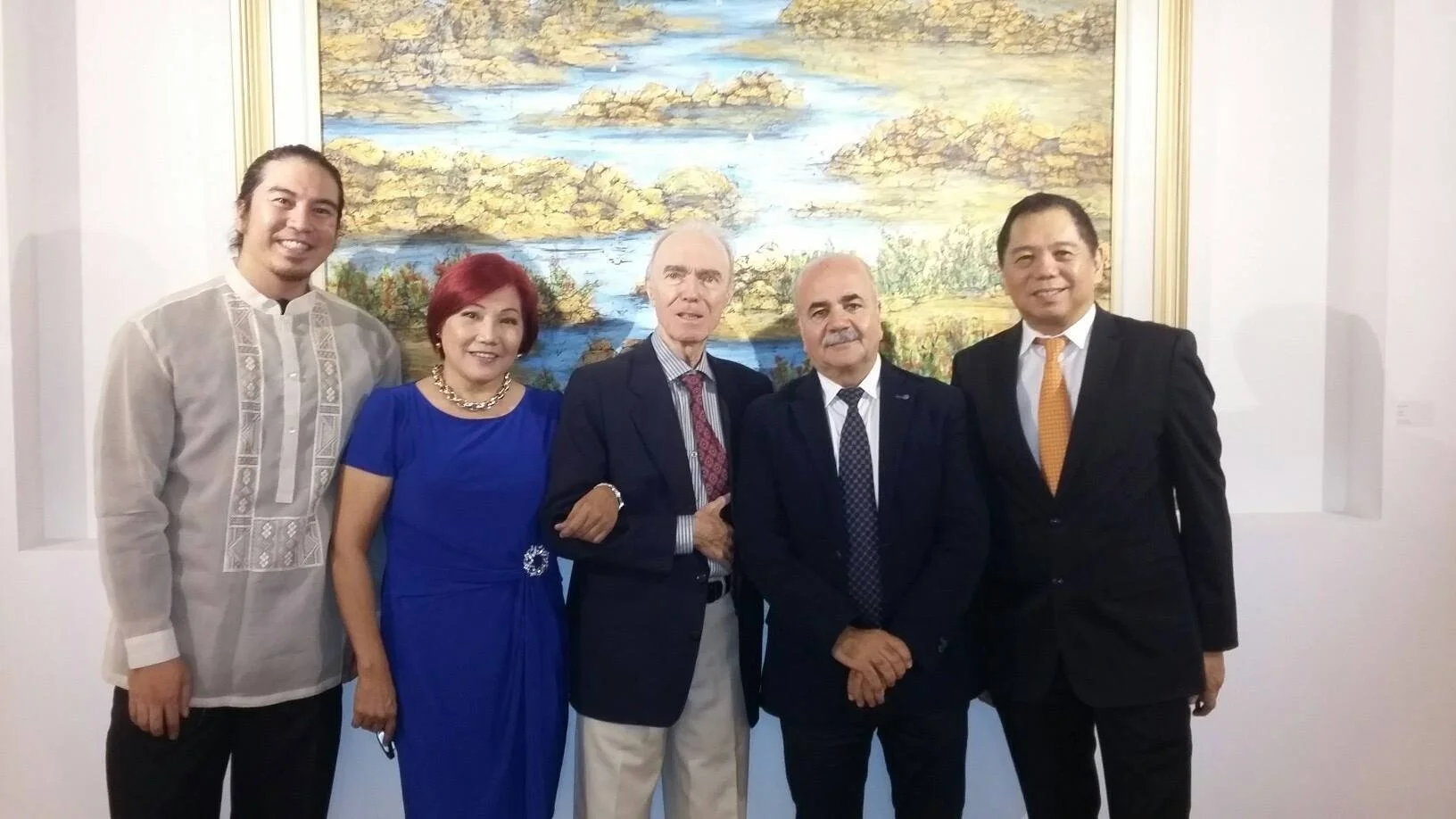
2014 Fundacion Sanso Opening
On the last day of the exhibit, they came back, this time, with Mr. Teotico who also expressed surprise and happiness that Mr. Sansó’s works were being seen in a new light. He said that it was quite refreshing to see Mr. Sansó’s works against the works of younger artists, and that, despite the decades that have passed, Mr. Sansó’s works still were relevant and on point. He made me feel like it was a revelation. At that time, I felt like I gave some justice to the works of Mr. Sansó, and I was so grateful to have been given the opportunity.
When I returned the works I borrowed from Mr. Teotico three days after their visit at his gallery in San Juan, he asked me what I thought of Mr. Sansó’s works. In the privacy of his office, I said, since I saw his earlier works a few years ago, I have always loved his works. However, at least for me, I felt like Mr. Sansó seemed to be a victim of his own success as most art enthusiasts only know him for his colorful floral works and his beautiful Brittany seascapes. They did not know of his masterful early works that were so full of soul and angst, and quite the opposite of his cheerful flowers or his peaceful Brittanys.
To my surprise, Mr. Teotico agreed with me, and asked me if I could “help Mr. Sansó” by introducing his other works to more people, particularly the younger artists and collectors. He was inviting me to help Mr. Sansó and him with the inaugural exhibit of Museo Sansó. This was around late February or early March 2014. By March 15, I was reporting at the museum, spending two to three days a week at Museo Sansó, going through the art and archive collections, preparing for the museum’s inauguration on November, supposedly to coincide with his 85th birthday.
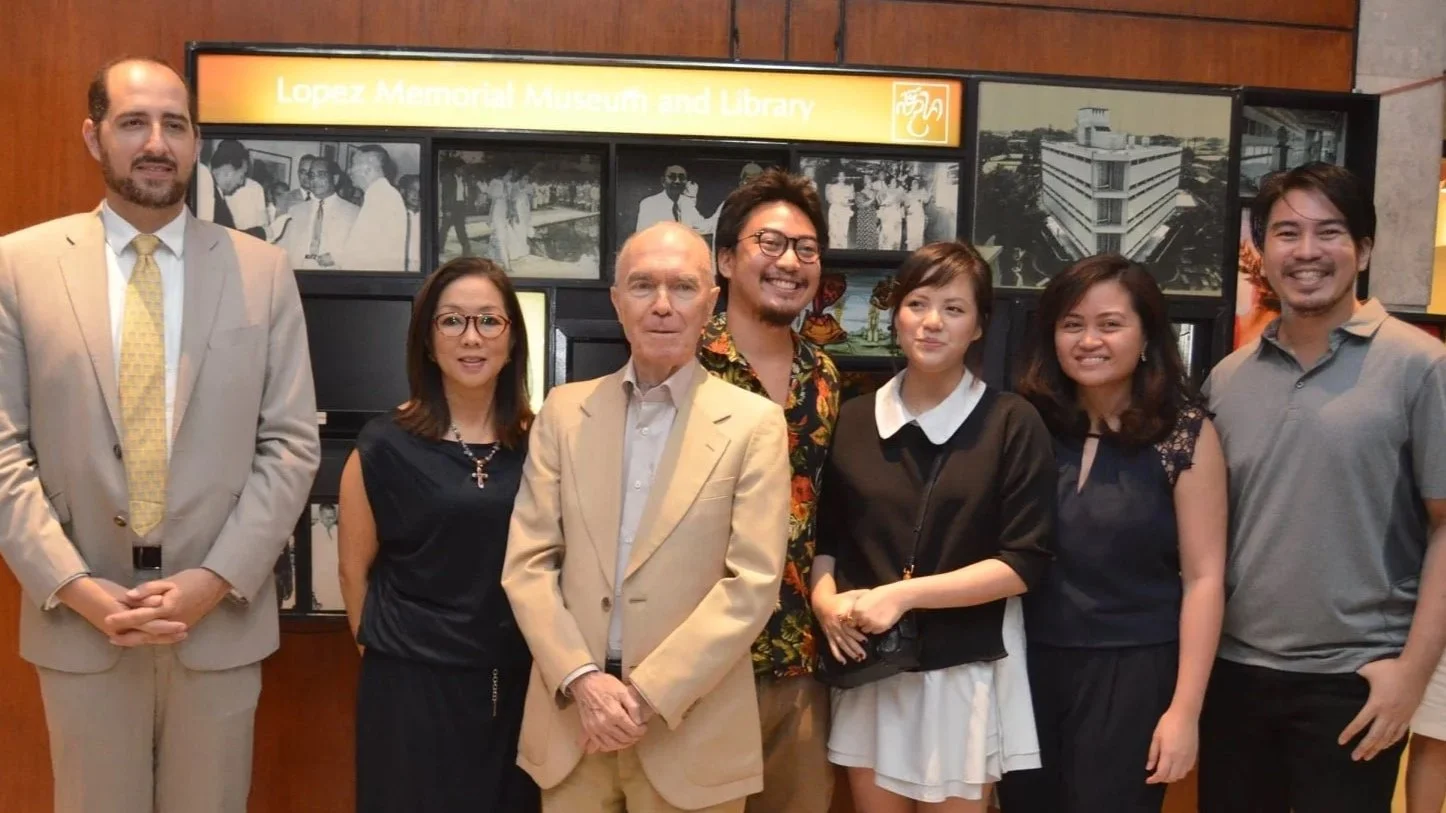
Two Halves Of A Whole Opening
Having the time to go through his archive and his personal collection opened my eyes to so many things. Seeing the works, I saw some connections between the different things he was doing, over a period of over seven decades. Going through his letters, I had the privilege of understanding in some way how he thought and what kind of man he was, and who his family and friends were. He seemed to know from an early age that he was destined for greatness as he kept his letters from the early 1950’s to his friends Larry Alcala, Rodolfo Ragodon, Cesar Legaspi, among others, and stapled carbon copies and drafts of these letters. He also did this to a great number of professional contacts: collectors from Manila, Paris, New York, and other places; important gallerists which included Arturo Luz, Agra Gallery, Weyhe Gallery, Galerie Lucie Weill, Trafford Gallery, among many other important galleries from Europe, America, and the Philippines. And associating with important people like avant-garde fashion designer Elsa Schiaparelli, composer and playwright Gian Carlo Menotti, and if earlier writings about him are to be trusted, the Spanish fashion designer Balenciaga. I felt so lucky to be privy to so many things and learn about him, his art, and his thinking. Please allow me to share a few of them, so I may, in my own way, honor Mr. Juvenal Sansó.
First, I would like to exclaim that Mr. Sansó is a genius, and I do not say this lightly.
Mr. Sansó was adept and proficient in so many things. Though he is known by most for his painting, his robust and multifaceted body of work includes printmaking, scenography, experimental photography, dry brush, drawing, mosaic, fresco, and even textile design! And his curiosity led him to other things like painted 35mm slides which he printed using photographic printing, which I later learned was called cliché verre. His creativity seemed boundless, and he had the drive and the work ethic to make his ideas into artworks.
As a painter, Mr. Sansó has been known for his colorful flowers, and peaceful Brittanys. Numbering in the thousands, these works are appreciated by the beginning collector, as well as the serious collectors. He worked on paper as well as on canvas. On paper, he was able to create brilliant colors and wonderful details. On canvas, he was able to create the enormous “Tides of Fortune,” which hangs on the walls of his good friend, Henry Sy’s Mall of Asia and measures 2.5 x 6.5 meters!
Young Ricky, Photo courtesy of Ayala Museum
His floral series, which started appearing in the 1950s, have transformed into a variety of sub-series over the decades. From dark floating bouquets which evolved from bouquets of grotesque faces and flowering shrubs that grew from the ground, growing over cadavers, they would morph into coralline foliar shrubs that were more monochromatic with bright solid backgrounds, to colorful flowering shrubs that grew from the ground, to flowers in vases, flowers framed and painted inside a bigger floral painting, to black and whites, and reverse series flowers that had black as the base color, to oriental-inspired flowers, and then to floating colorful bouquets with bright backgrounds. He kept critics and collectors interested by evolving his style almost every decade.
There were similar transitions in his Brittany series that not only changed in palette but also in the distance with which he painted them, as 70’s works were mostly zoomed in on the sea spray created when waves crashed on to rocks, and the 80’s were more focused on the field of vision or what a camera view finder would see if one looked at the shore, to the view of the horizon from the shore in the 90’s, and later, reexamining his very colorful and cartoon-like 1972 series of Breton houses done in lithographs. He would paint these on canvas in the 2000’s, departing from his Brittany series and creating some controversy, although they come from the same inspiration.
Although less in number and lesser known than his Brittany and Floral series, the earlier, darker works of Sansó are equally or even more moving. His works that focused on people, expressed the angst, brutality, and trauma brought about by the barbarity of war. Works like “The Sorcerer” and “The Incubus” won him early critical acclaim as both won him grand prizes in the Art Association of the Philippines Annual Art competition in 1951, when he was just 22 years old. This series would give birth to works like “Man with a Hoe,” which is in the National Museum collection; “Joy Ride” and “Neon Madonna,” both from the Lopez Museum and Library collection; and “Nocturnalia” and “Family Portrait” from the Hans Sy collection. These were all technically adept, dramatic, and emotionally moving works which showed Sansó’s mastery of oil and revealed his emotional state. Though truly memorable, Sansó would focus on works with people only up to the 60’s, when he would transition more into desolate landscapes inspired by the lowly barong-barong and the bamboo baklad of Manila, fused with the shores of Brittany and the rocks of Montalban that expressed more creatively the same emotional themes and allowed viewers not to sympathize with the subject, as his works with people allowed, but rather to situate themselves and resonate his solitude with their own.
Louise Richards, a former curator of the Cleveland Museum of Art, would describe Sansó’s desolate landscapes this way:
Manila happens to be one of the most thoroughly destroyed cities during World War II and what was left of the inhabitants picked up the charred remains and started to build shanties upon shanties of ghost-town, horrible beauty. Disregarding the human side of these apocalyptical domains, one cannot help be moved by the strange beauty of rust and rot, the galvanized iron slowly disintegrating into ochres, siennas ,and earth greens, and wood and bamboo decaying into fibers and sponginess. Swampy, dark, muddy, garbage-strewn waters may reflect the most dazzling skies in sunset flare ups. As if these dwellings are innumerable scales tied together on a gargantuan carcass, they catch the light with the hypnotic vibrations of sequins, like dangling elements in the breeze… Sansó shows the world as a limbo hovering between day and night where living creatures do not exist but inanimate objects become prime actors…and shadowy rocks and bushes have a watchful presence neither evil nor beneficent but alien to our everyday experience of stone and wood. These Brittany sea coast paintings are among the most beautiful of Sansó’s works and testify that perhaps here he has found the most eloquent expression for his sense of mystery and tragedy—and too, of the abundant beauty and vitality of the earth.
This would be echoed a few years later by art critic and curator Eric Torres who shared:
Sansó’s scenes are significantly without people; they bear only vestiges of man’s labors, his lonely struggle and search. Mounds of rocks and spongy stones, shadowy trees heavy with mossy growth, baklads or bamboo fish traps are the protagonists. An unnatural, theatrical light without glare, intensely colored, suffuses and transfigures them into images of unusual beauty. Apparitional Gothic spires emerge from bamboo clusters against cloudless skies smoldering with the strangest afterglows. Empty rowboats ease up on the beaches, accentuate the empty stretches of water and sky saturated with the coolest of pre-dawn lights. Stone piles resemble ruined barricades and parapets.
What ultimately emerges from all these images are visions—or inscapes, to steal a term of Gerard Manley Hopkins—of the immense solitudes of elemental nature that reduce man’s fugitive efforts to ruins. The silence of elemental endurance prevails. This truth, and the austere feeling of metaphysical loneliness it induces in the spectator, Sansó reveals with firm, decisive strokes and a sophisticated handling of mass, space, and atmosphere.
His earlier works of this type include Ateneo Art Gallery’s “Red Sunset,” which shows the meticulous details with which Sansó rendered the baklad and made grand with his rendition in pen and ink and ink and wash on paper. This spectacular work was purchased by the renowned artist and museum-maker Fernando Zóbel, who donated it to the institution. Another great example is “Hues of Morning,” which is in the Cleveland Museum of Art collection. “Stillness of Dawn,” “Slow Dawn,” and “Blue Domain,” all of which are from the Fundacion Sansó collection and are all ink and dry brush on paper. “Enduring Majesty” and “Skyward Symphony,” also from the Fundacion Sansó collection, are great examples of this subject portrayed in oil on canvas.
National Artist Vicente Manansala would paint the barong-barong as it was, and show the beauty in them for the Philippine audience. Sansó would take the Filipino in the barong-barong and show the beauty of our resilience, and the endurance of our spirit to the international audience in his many gallery and museum exhibitions abroad. In the catalogue of his 1964 solo exhibition at the Cleveland Museum of Art, one would read beside his many works on Brittany and his impressions of Manhattan, the titles “Barong-barong,” “Baklad,” and Manila, Chinatown, and San Dionisio. He brought the Philippines wherever he went, which is why I say that, despite his citizenship, Sansó is truly Filipino at heart.
As a printmaker, Sansó was equally masterful. Even though printmaking was not as appreciated by his collectors and galleries in Manila, Sansó devoted much of the 1960s to copperplate etching, and continued with lithography and serigraphy despite being focused more on painting in the 1970s, and collagraphy in the late 1980’s and the early 1990’s.
The art critic Leo Benesa credits Sansó as the first visual artist to exhibit and sell his Fine Art Prints and use etching as a medium for fine arts. From that first solo exhibition in Manila in 1957, trusting Mr. Sansó’s ledger of prints, we would find that Fernando Zóbel would buy the aquatint “Tiges” (also known as Grass Roots) done in an edition of 25 in Paris in 1956 from that solo exhibition. Other collectors of this particular aquatint include Leandro Locsin, Ma. Isabel Ongpin, Benito Legarda, and Manuel Duldulao.
Creating prints allowed Sanso to create multiple originals. In his ledger of prints, one would see that for example, the work “Artichout” (which would also be known as “Flower and Leaf”, and later on “Lotus”) was collected by Elsa Schiaparelli and also by Max Prieto, the Philadelphia Print Club, and the Lopez Museum. “Eve” or “Eva” would be in the Museum of Modern Art or MoMA collection, the Lopez Museum, and fortunately for me, my own print collection as well!
Being easy to carry, his prints would be brought to different parts of the world, and end up in prestigious collections like the MoMA, the Boston Art Museum, the International Graphic Arts Society, The Metropolitan Museum of Art in New York, The National Art Gallery in America, the Brooklyn Museum, the Cleveland Museum of Art, Yale University Art Gallery, Syracuse University Art Museum, Musee d’ Art Moderne de Paris, among many others. Here in the Philippines, Fundacion Sansó, the Lopez Museum and Library, and the Ateneo Art Gallery have his prints in their permanent collections. He would exhibit his prints and other works on paper as far as Trafford Gallery in London, and Palacio de Bellas Artes in Mexico.
He would produce over 65 copperplate etchings and aquatints from 1955 to 1968. The many different flowers he would produce in etching, and the various experiments he did to achieve them, would affect the way he would paint flowers. The effect of his printmaking to his painting is noted by Mr. Sansó in his essay ““Etching Chance,” where he wrote:
With etching, I learned not to be a slave of the brush; and this was not a minor contribution to my development technically and mentally…I realized that what I needed most was to change the organization of my senses and time, and to use, aside from brushes, just about anything that left a stain, a line, a mark, a nuance, preferably by starting at peak excitement as I had many copper plates, before proceeding to the next phase of completing the spontaneous first explosive states of mind.
This is the best I have done in the Black Series. Technically, it is a very involved one. So many things being used and often covered afterwards, like scraping instead of the spots. You have it in several places where the brittleness of the ground was used to give it a different vibration. You have it in all the engraving. It is engraved in. So it is a very painstaking work. I spent hours and hours on it because it was so difficult. Once you have covered your print and are re-working on it, you are working almost impossible odds…because you must compare and you are working through all this already bitten and attacked plate…it is hellish.
As a printmaker, he has been commissioned by the International Graphic Arts Society in New York. The Book of the Month Club in US commissioned him to make the lithograph “Flower Vendor.” And Sansó is particularly proud of “Lueurs” or “Moonglow,” which was adjudged “Print of the Year” by the Cleveland Print Club and published in a special edition of 250 for its members. This work was also acquired by the club for the Cleveland Museum of Art. Matisse and Dali also had this same privilege, and it made Mr. Sansó really happy to be among their ranks. He was also commissioned by then First Lady and Minister of Human Settlements Imelda Marcos to make a gift for the 1976 IMF delegates, which brought about the iconic yellow and black serigraph series that can still be seen in many private collections and the occasional auction.
He worked with leading Philippine artists like Pandy Aviado to pull his Ati-atihan collagraph series in 1987. And with Malang’s Artprints Philippines for his colorful floral serigraphs in 1994. With almost a hundred fine art prints made over forty years, it is no wonder that the author of his 1976 retrospective Sanso: Nature and the Artist in 1,000 Works said: “Had Sansó never painted anything, he would merit a niche in art as a printmaker.”
One must experiment: try things out constantly and incorporate these elements in to the general flow of one’s personality, technique, culture. It has to come from a naturally open mind. The danger comes from posturing, the self-inflicted castrations needed to follow fashionable trends. All my life I have experimented. The more mature I am, the more I have done so. It is a very profound need that answers requirements at every layer of my personality.
–Sansó: Art Quest Between Two Worlds by Rod. Paras-Perez