How Does Memory Learn to Stay, When ‘Not All Memories Carry the Same Weight’?
Through vessels, fractures, and forms of containment, THE ANNEXT reflects on how memory settles unevenly, shaping both what we hold and what ends up holding us.
Words Bernadette Soriano
Photos Courtesy of THE ANNEXT
May 19, 2026
There is a peculiar fatigue that settled over much of contemporary exhibition-making—a tendency toward immediacy, toward works engineered less to haunt the psyche than to circulate frictionlessly through the economies of visibility.
Install quickly, photograph cleanly, strike while the algorithm is hot, then move on before the paint metaphorically dries. In such a climate, THE ANNEXT feels almost gloriously out of step, refusing to simply play to the gallery, much less to the gallery of the feed.
The Alternative Nest for the Next Rising and Emerging Artists (THE ANNEXT), the art incubator cum gallery continues carving out a slower, more contemplative register within the local contemporary landscape: exhibitions less interested in spectacle than sedimentation, less concerned with instant legibility than with the long game of emotional residue.

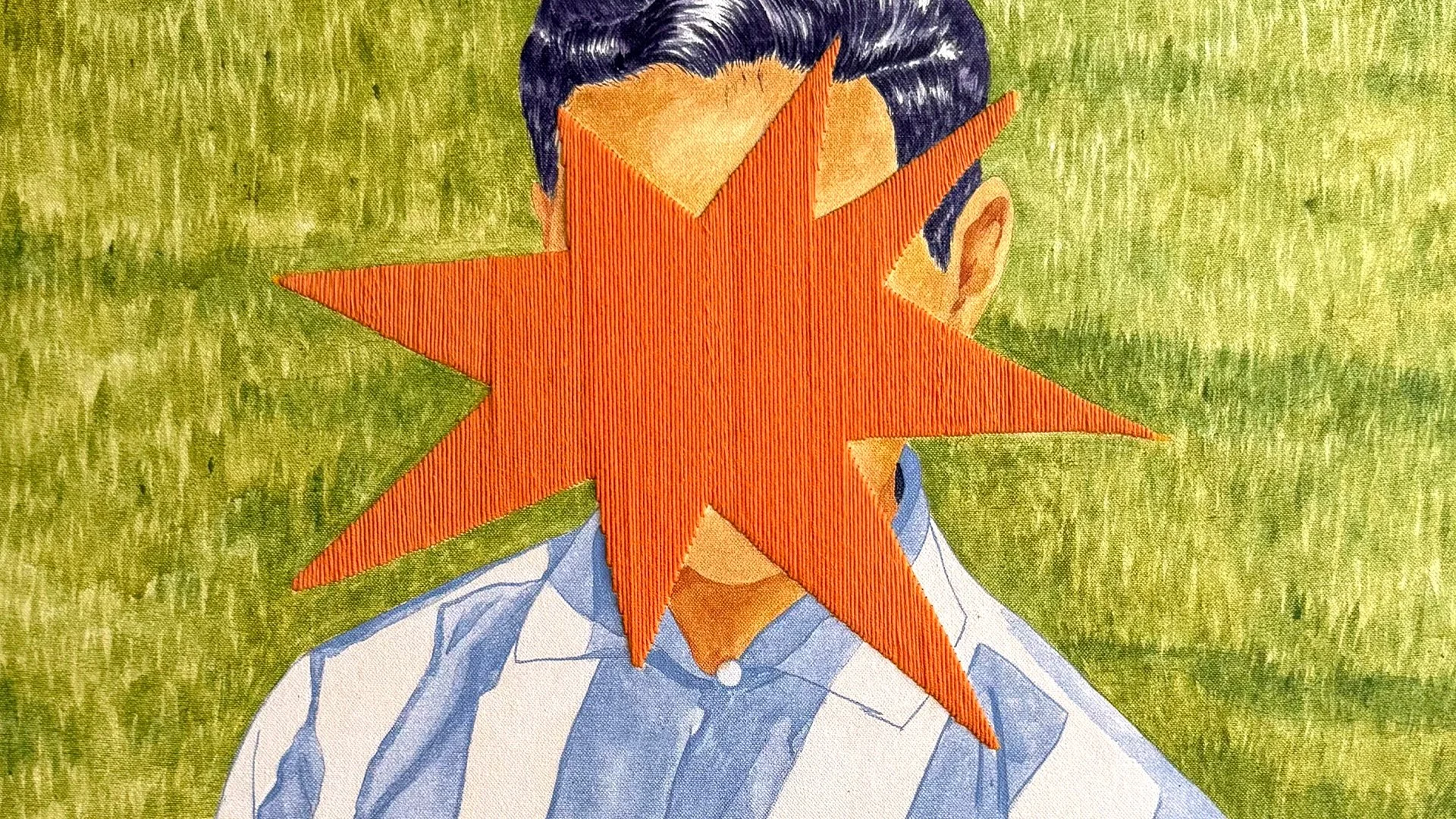
John Darrel Evasco, Treasuring Innocence Before It’s Gone I, 30 x 24 inches, oil on canvas, 2026
Its third exhibition of the year, Not All Memories Carry the Same Weight, curated by founder Prim Paypon, moves precisely within this quieter but no less resonant key.
Bringing together five emerging contemporary artists, gathered from different regions in the country, whose practices diverge radically in medium and visual language, the exhibition circles a deceptively simple but philosophically dense inquiry: how do moments harden into memory, and why do certain memories remain lodged within us long after others slip cleanly through the cracks?
Paypon wisely avoids framing memory through chronology alone. Moments, he explains, “cannot be measured by clocks”, so much as by their “soulful impact”—by their psychic aftertaste, the lingering density they leave behind long after the event itself has packed up and left town.
From this premise emerges the exhibition’s governing metaphor: the vessel. Not merely a container, but a carrier. Emotional vessel. Political vessel. Cultural vessel. Spiritual vessel.
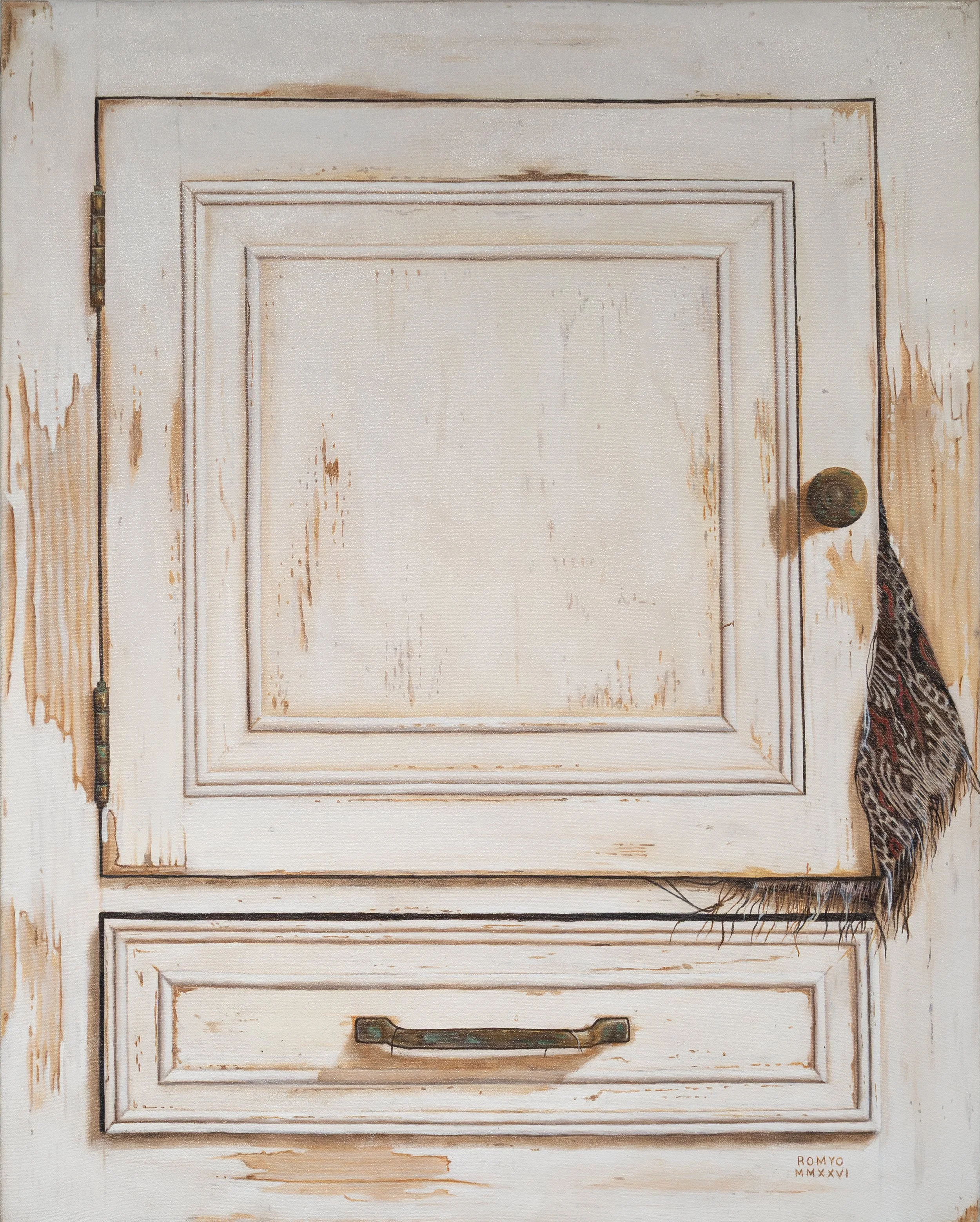
Ro Myo, The Refusal to Be Forgotten, 30 x 24 inches, oil on canvas, 2026
Across surrealism, realism, abstraction, hyperrealism, and mixed media, the artists collectively probe the structures—objects, bodies, rituals, surfaces—through which memory is stored, weathered, transmitted, and kept on the boil.
The exhibition unfolds less like a conventional group show than a species of emotional archaeology, each room digging up a different architecture of remembrance, each work asking what survives after time has had its say.
Bruno: History with Its Paint Still Wet
For Baguio-based artist Bruno, the vessel arrives mounted on horseback.
Working through his signature conceptual realism, Bruno paints warriors and horses with the ceremonial grandeur of historical portraiture, only to quietly sabotage the authority of those images from within. Faces blur at the edges. Backgrounds splinter. Surfaces appear clawed through, as though history itself had dragged a fingernail across the canvas before the varnish could settle.
The horse—long freighted with associations of conquest, masculinity, valor, dominion—becomes inseparable from the rider. Together they move through the works as twin vessels of endurance and identity.
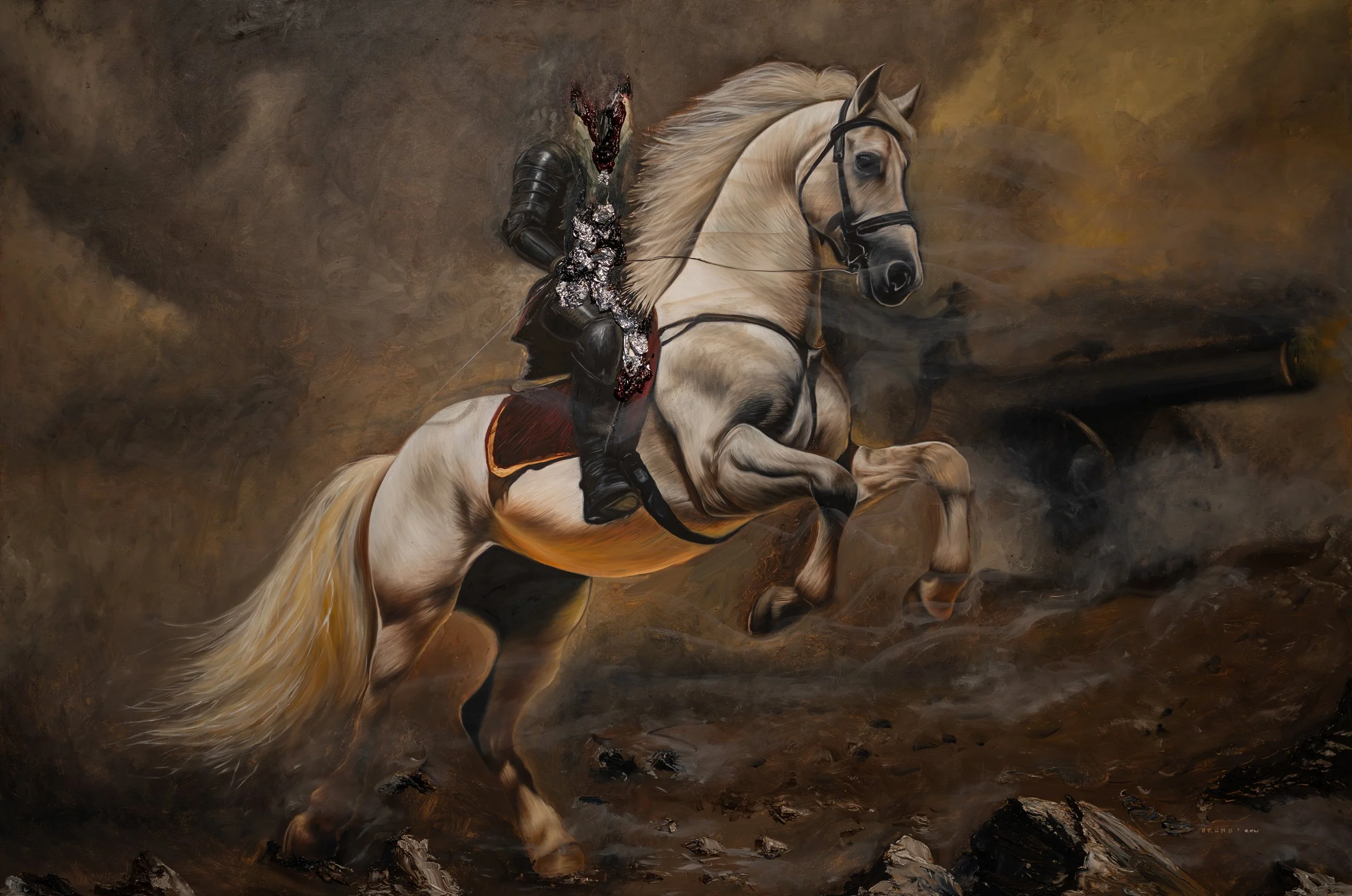
Bruno, Archē, 72 x 48 inches, oil on canvas, 2025
Yet Bruno never lets heroism ride off clean into myth. His figures remain upright, though visibly weather-beaten, carrying themselves with the exhausted dignity of people who have spent too long surviving systems designed to keep moving the goalposts.
The socio-political undercurrent sharpens this destabilization. As Paypon notes, the works gesture toward a painful continuity within the Philippine condition: no matter how hard one works, systems of corruption continue to rig the game.
The defaced surfaces begin reading as political metaphors. History is remembered, though repeatedly tampered with, revised in broad daylight, smudged around the edges until truth itself starts looking negotiable.
What emerges is not resistance rendered triumphant, but survival rendered exhausting. Bruno’s warriors remain upright, though one senses history has already taken a pound of flesh.
John Darrel Evasco: Boxing Up Childhood Before It Slips Away
If Bruno wrestles with collective memory, Sorsogon-based artist John Darrel Evasco turns inward toward the intimate mechanics of childhood remembrance.
Evasco’s process begins not with paint but with clay. Before committing objects to canvas, he painstakingly sculpts replicas of his son’s toys by hand, arranging them afterward into still-life compositions that feel at once affectionate and faintly elegiac.

John Darrel Evasco, Shaping Life Within Clay II, 30 x 24 inches, oil on canvas, 2026
The labor matters. These are not simply painted objects but memories physically handled before being translated into image.
The emotional premise is deceptively ordinary: what becomes of childhood once adulthood comes knocking with muddy shoes and unpaid bills?
For Evasco, toys function as rehearsal spaces for feeling—the first objects through which attachment, courage, imagination, independence, even loneliness, are tried on for size. Eventually, however, they are boxed away. Stored somewhere between sentiment and neglect, left gathering dust while life barrels forward with all the subtlety of a wrecking ball.
That act of storage becomes central to the work. Boxes—whether humble cardboard containers or sturdier wooden crates—operate as literal vessels carrying entire emotional ecosystems within them.

John Darrel Evasco, Treasuring Innocence Before It’s Gone II, 48 x 36 inches, oil on canvas, 2026
Their material differences subtly register class histories as well, reflecting Evasco’s own experience as a former construction worker. There is something notably moving in this trajectory: a man who once built structures for habitation now building structures for memory.
Even the paintings’ surfaces refuse total illusionism. Traces of sculptural texture remain faintly visible beneath the polished realism, reminding viewers that memory is never airtight. It buckles. It fingerprints easily. It carries the evidence of having been thumbprinted by experience.
Ro Myo: Cabinets that Refuse Erasure
For Basilan-born artist Ro Myo, memory takes architectural form through cabinets—domestic objects transformed into repositories of cultural continuity.
Deeply informed by his long engagement with indigenous communities across Mindanao, Ro Myo treats furniture as mnemonic infrastructure.

Ro Myo, The Becoming of What Was Remembered, 30 x 24 inches, oil on canvas, 2026
Cabinets cease functioning as passive domestic fixtures and begin operating like vessels of inheritance, spaces where ancestry, ritual, identity, and regional histories quietly accumulate over generations like dust settling onto heirlooms nobody dares throw away.
Unlike generic still-life arrangements, the objects inhabiting these works carry deliberate ethnographic specificity. Brass bells, woven t’nalak textiles, and culturally resonant artefacts surface throughout the compositions without ever lapsing into ostentatiousness.
Entire histories are folded into restrained visual arrangements that reward slow looking over drive-by consumption.
What gives these works their gravity is their understanding of memory as stewardship over anything of mere nostalgia. Culture survives not accidentally, but owing to someone continuing to carry it forward.

Ro Myo, Where Sound Becomes the Seal, 48 x 36 inches, oil on canvas, 2026
The inclusion of t’nalak deepens the meditation beautifully. Traditionally woven by T’boli dream weavers from Lake Sebu, the textile’s patterns first arrive through dreams before entering material form. Vision becomes labor. Inheritance becomes practice. Memory, meanwhile, keeps one foot in the spiritual realm and another firmly planted in the handmade.
In Ro Myo’s paintings, cabinets cease to function as ordinary furniture altogether. They become modest fortresses against disappearance.
Julieanne Ng: The Shape of What Lingers
The works of Metro Manila-based artist Julieanne Ng occupy the exhibition’s most elusive terrain, though perhaps also its most distilled articulation of memory’s instability.
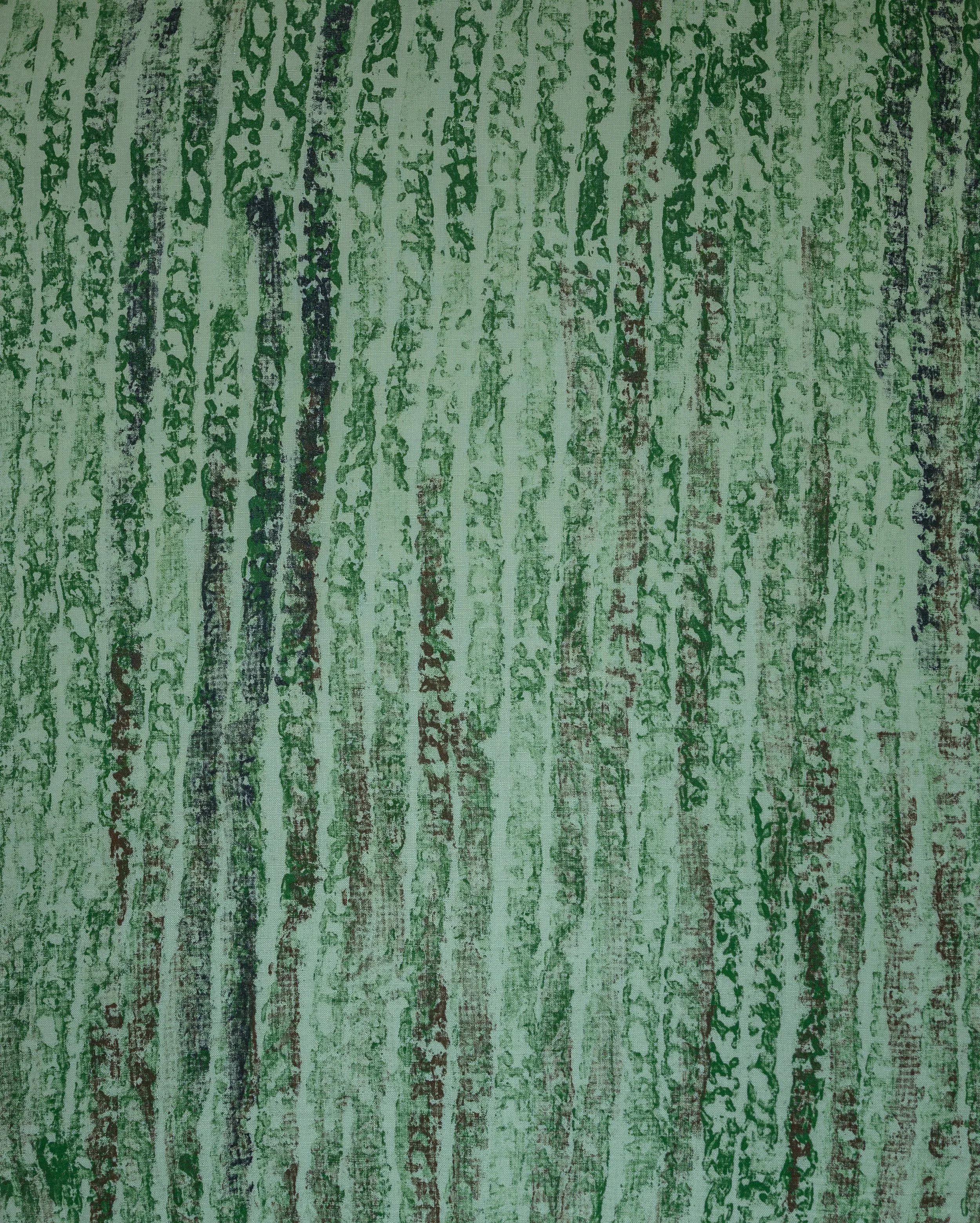
Julieanne Ng, When Nature Moves, We Listen II (Diptych I of II), 30 x 24 inches each, oil and candle print on linen, 2026
Rather than painting conventionally, Ng creates her compositions using candle molds dipped in oil and repeatedly pressed onto linen surfaces. The process matters every bit as much as the resulting image. Candle molds are already vessels—forms designed to contain illumination while anticipating eventual depletion.
The resulting abstractions resemble bamboo groves glimpsed through partial recollection: organic, rhythmic, forever fluttering just beyond full recognition. Forms surface only to dissolve again. Representation slips through the fingers the moment one tries pinning it down.
This ambiguity becomes the work’s emotional engine. Ng understands memory less as documentation than imprint—residue left behind after intimacy, grief, time, or transformation passes through us. Her works do not narrate; they haunt.

Julieanne Ng, When Nature Moves, We Listen II (Diptych II of II), 30 x 24 inches each, oil and candle print on linen, 2026
There is also something furtively liturgical about the repetition embedded within her method. Press, lift, repeat.
Memory here accumulates where pressure replaces declaration via layering, and return. Like candle wax cooling after flame, the images preserve the ghost warmth of what once flickered there.
Ikea Rizalon: Carrying Meaning through Fracture
Metro Manila-based artist Ikea Rizalon approaches the exhibition through the parallel fragility of ceramics and the human body.
Her hyperrealist paintings frequently incorporate embroidery directly onto canvas, puncturing the illusionistic surface with tactile interruptions that resemble sutures, scar tissue, or seams threatening to split.

Ikea Rizalon, Section 5 - Meant for Keeping, 30 x 24 inches, hand embroidery and acrylic on canvas, 2026
The gesture is subtle yet profound: realism here is never entirely smooth because survival itself rarely is.
Within these works, ceramic vessels and human figures mirror one another closely. Both are designed to contain. Both remain vulnerable to rupture.
Cracks, bruises, tears, and fractures cease to signify failure; instead, they become evidence of transformation having taken place.
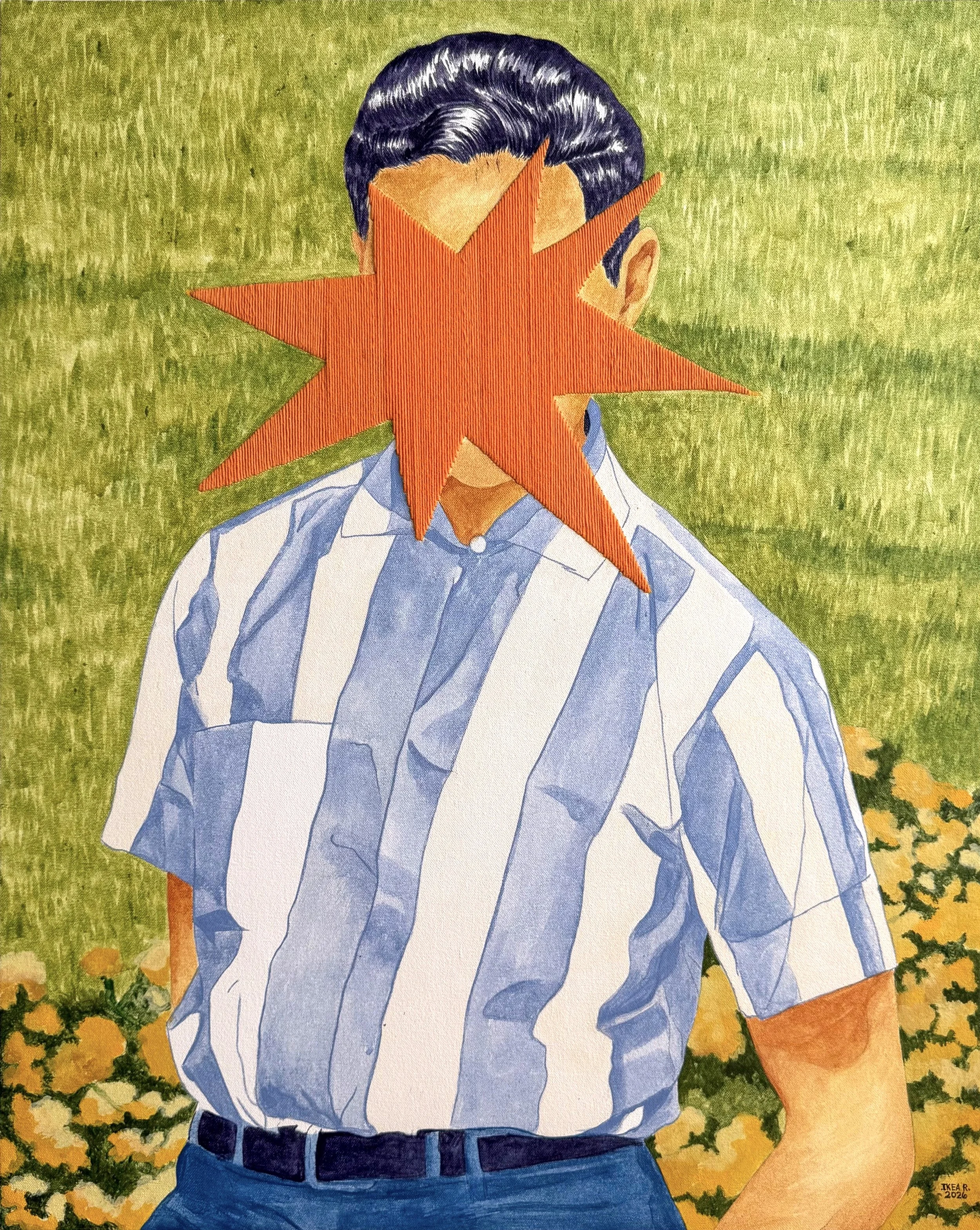
Ikea Rizalon, To Be Whole, 30 x 24 inches, hand embroidery and acrylic on canvas, 2026
Rizalon’s practice gently dismantles the fantasy of pristine endurance. Her paintings suggest that identity is forged by the ongoing labor of sustaining meaning even after the surface gives way.
The vessel does not remain valuable because it never breaks. It remains valuable because it continues holding.
The Weight of What Remains
Paypon incorporates pottery-based seating, moss-filled glass vessels, clay forms, and woven references directly into the gallery environment, ensuring that visitors do not merely observe vessels but physically move among them.
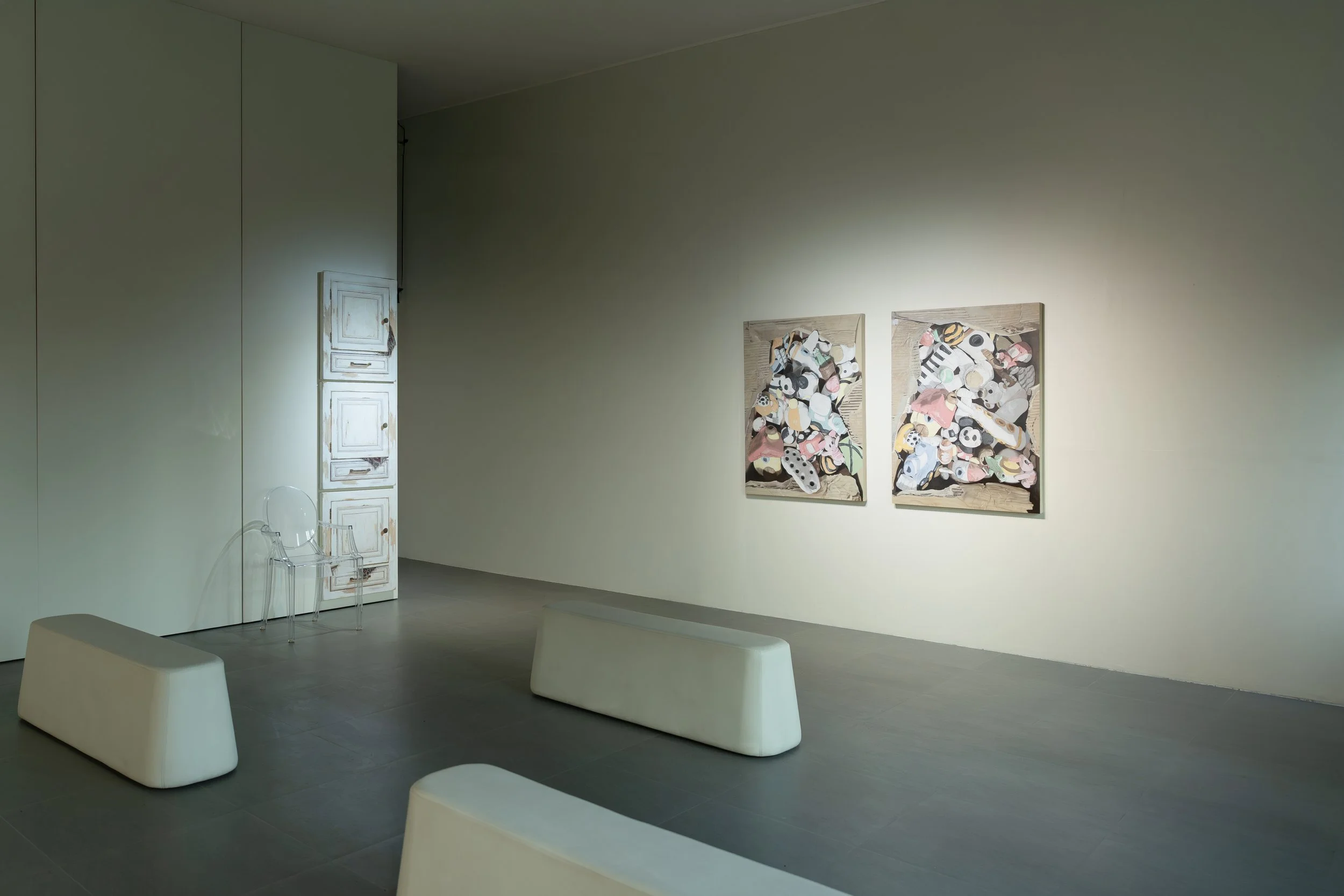
L-R Paintings by Ro Myo and John Darrel Evasco
Even acts as ordinary as sitting become folded into the exhibition’s conceptual bloodstream.
The spatial design reinforces the exhibition’s deepest proposition: memory is never abstract. It requires bodies, surfaces, rituals, containers—structures capable of holding what time alone cannot.
And perhaps that is where the exhibition lands its most placid but most enduring blow. Not every moment survives equally. Some evaporate almost as soon as they arrive.

L-R Paintings by Julieanne Ng, Bruno, John Darrel Evasco, and Ro Myo
Others settle into the self with such density that they quietly reorganize the way one moves through the world thereafter.
Through warriors, toys, cabinets, candle molds, and pottery, The ANNEXT assembles an exhibition less about remembering than about carrying—the invisible labor of holding experience long enough for it to become part of who we are.
The question hovering over the entire show is deceptively simple, though difficult to shake once encountered: what do we continue carrying long after the moment itself has ended—and what, in turn, continues carrying us?