
Before the Bid: How Salcedo Auctions Turns Objects into Stories
At Salcedo Auctions’ Finer Pursuits vernissage, art, memory, and history converge as objects are reimagined through the stories that shape their value.
Words Bernadette Soriano
Photos Courtesy of Salcedo Auctions
June 05, 2026
Long before the auctioneer's cadence gathers momentum, before numbered paddles punctuate the air with decisions worth millions, before a painting begins another chapter under someone else's roof, there exists that quieter inheritance from which all collecting ultimately proceeds: a story.
Such stories lingered in abundance on the evening of May 28, when guests filtered into Salcedo Auctions' Ayala Gallery at NEX Tower for the vernissage of Finer Pursuits: Important Philippine Art and Rare Collectibles, a preview exhibition ahead of the auction's June 6 bidding.
At first glance, the gathering appeared to follow the familiar choreography of the art world—collectors circulating between canvases, diplomats exchanging pleasantries, patrons pausing before masterpieces whose names have long occupied the upper echelons of Philippine art history.
Yet beneath the social ritual ran another current entirely, one concerned not merely with ownership, valuation, or provenance, but with memory itself: how it survives, where it settles, and who, at any given moment, assumes responsibility for carrying it forward.
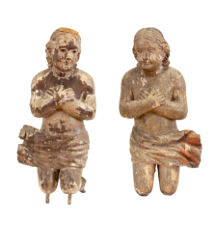
Wooden Angels
For a few hours, the gallery became an unlikely meeting ground between worlds.
Revolutionaries shared space with saints. Modernists stood alongside contemporary artists. A ballet returned through dance. A courtship long ended resurfaced through paint. History, ordinarily confined to archives and footnotes, wandered freely among the guests.
The Story Behind the Lots
If every artwork arrives carrying a provenance, some enter a room carrying an entire constellation.
Among the evening's most arresting presences were two early works by H.R. Ocampo, positioned behind dancers Jimmy Lumba and Jesse Tangalin as they performed excerpts from Filipinescas, the landmark pas de deux of National Artist for Dance Leonor Orosa Goquingco.
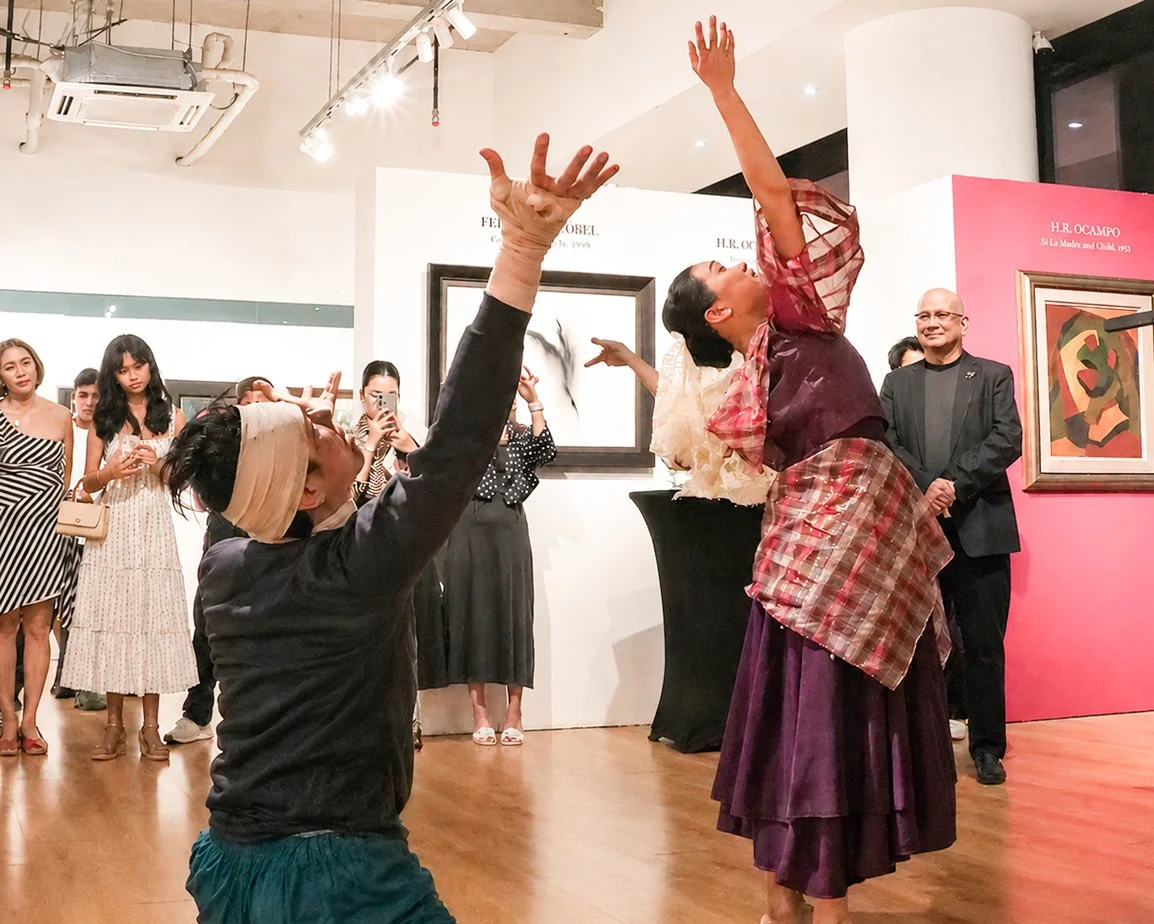
Jimmy Lumba and Jessa Tangalin
Accompanied by the compositions of National Artist for Music Antonio J. Molina, interpreted by concert pianist Zenas Reyes Lozada, the performance briefly collapsed distinctions between disciplines and decades alike. Painting conversed with dance; music entered the exchange; history, for a fleeting moment, seemed less an archive than a living guest in attendance.
Then came the revelation that shifted the works from objects of admiration into vessels of personal history.
Dr. Benjamin Goquingco Jr., son of Leonor Orosa Goquingco, recounted that the paintings had once been gifts from Ocampo himself to his mother. In the years preceding her eventual rise as a towering figure in Philippine dance, Leonor was already situated within the artist’s more personal narrative—as the object of his affection.

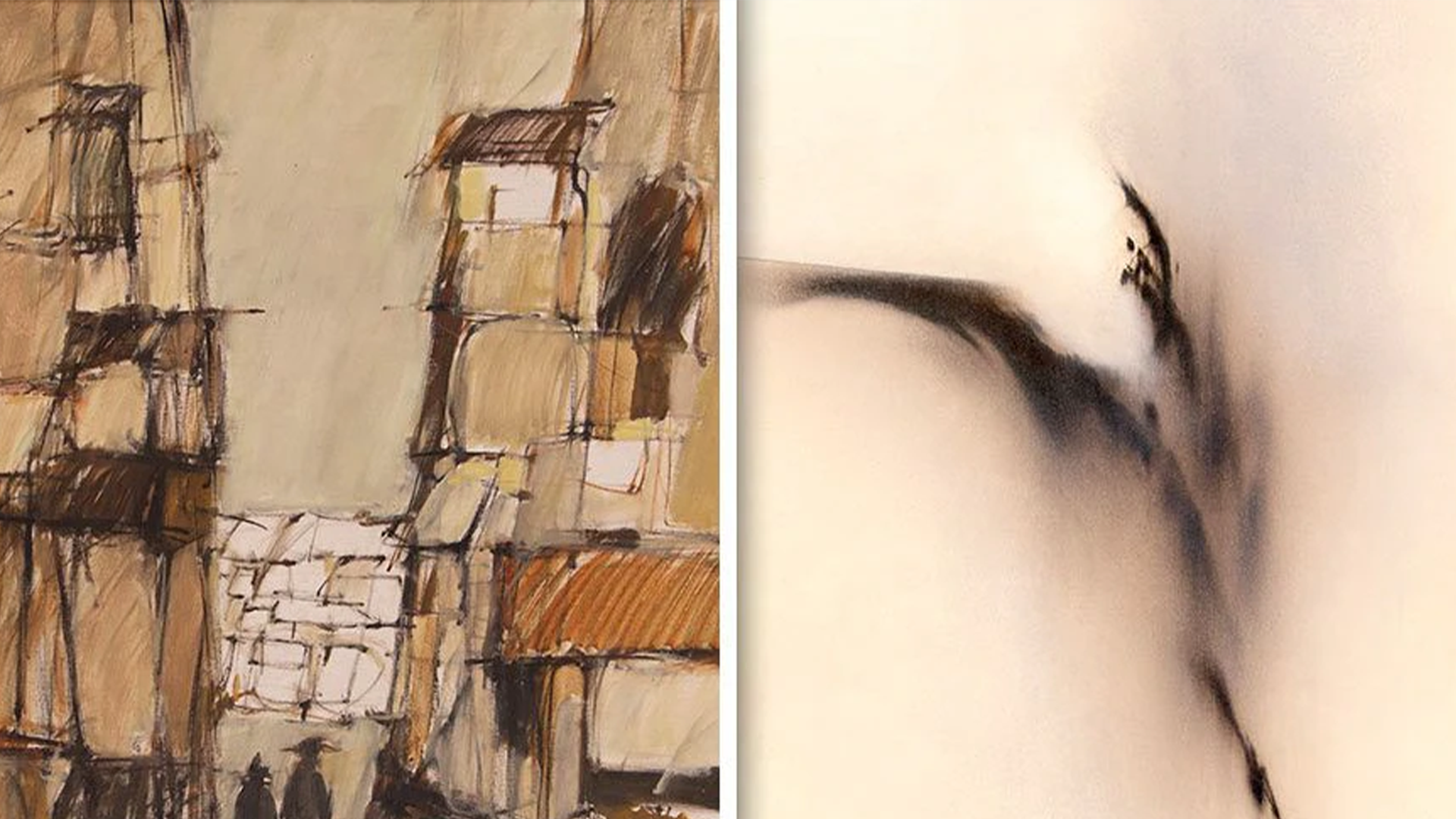
Oscar Zalameda’s untitled oil on canvas of a European village painted in the 1960s and Fernando Zóbel’s Gestos XXVI-Anzac, oil on canvas from 1979
The story unfolded with the sort of detail that no catalogue entry could adequately capture. Ocampo had courted Leonor. She declined. According to Benjie, his mother had once joked that the painter's reputation as a playboy gave her pause.
The romance never reached its intended destination. Friendship, however, endured—a reminder that history often advances through roads not taken as much as through those that are.
Yet the story did not end there.
Before her passing, Leonor left explicit instructions concerning the paintings. Should a full revival of Filipinescas ever take place, the works were to be sold to help fund the production. Benjie recalled her directive with affection and amusement, describing how his mother seemed to continue "calling the shots" even from beyond the grave.
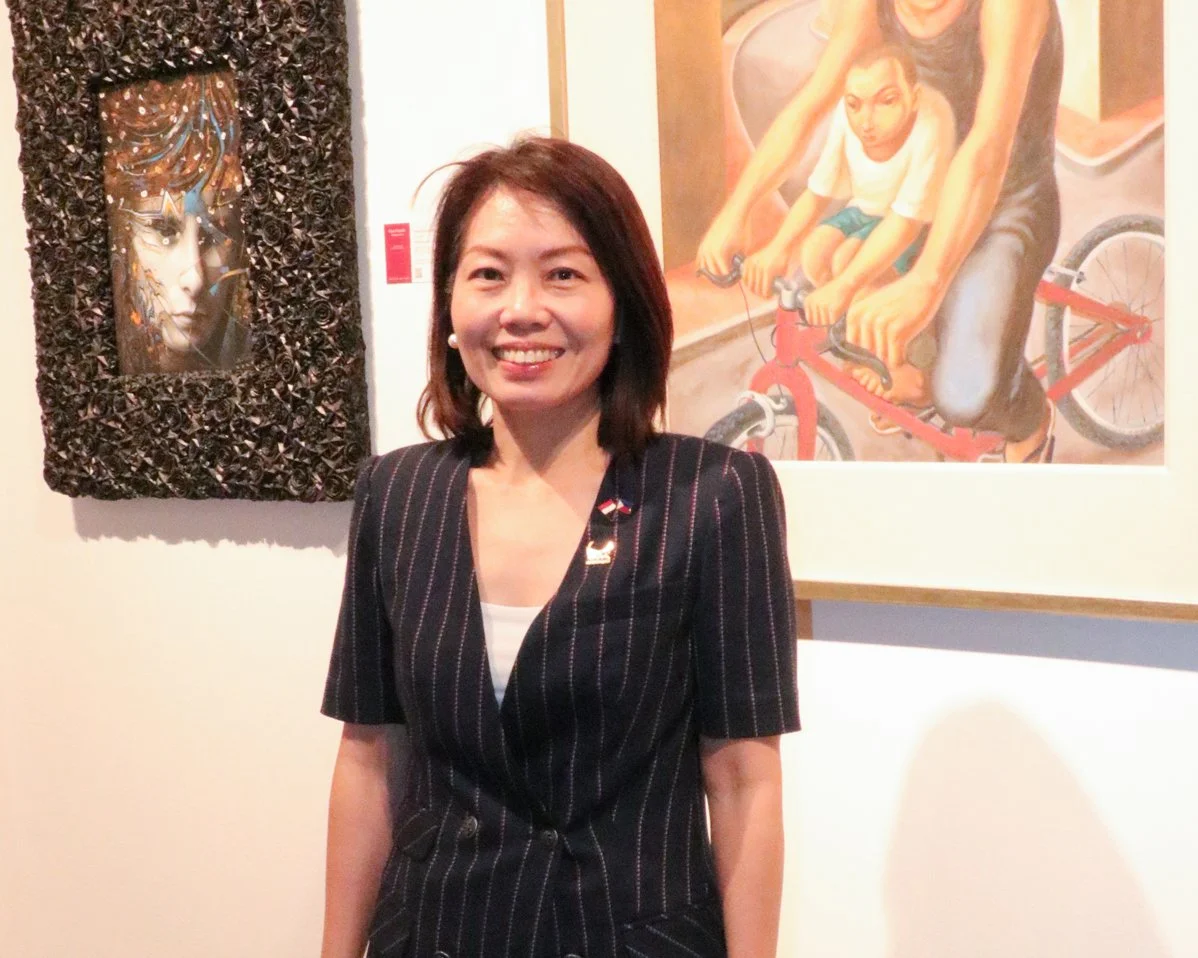
H.E. Constance See Sin Yuan, Ambassador of the Singapore to the Philippines
At that moment, the paintings ceased to function solely as artworks. They became something richer: instruments of continuity, carrying forward the wishes of a National Artist long after her final curtain call.
One left the performance with the curious realization that the evening's most valuable inheritance was not hanging on a wall. It was embedded in the stories attached to the objects.
Defining What Matters
The question sounds deceptively straightforward, almost innocent in its phrasing.
What makes work important?
Entire institutions have been built around answering it.
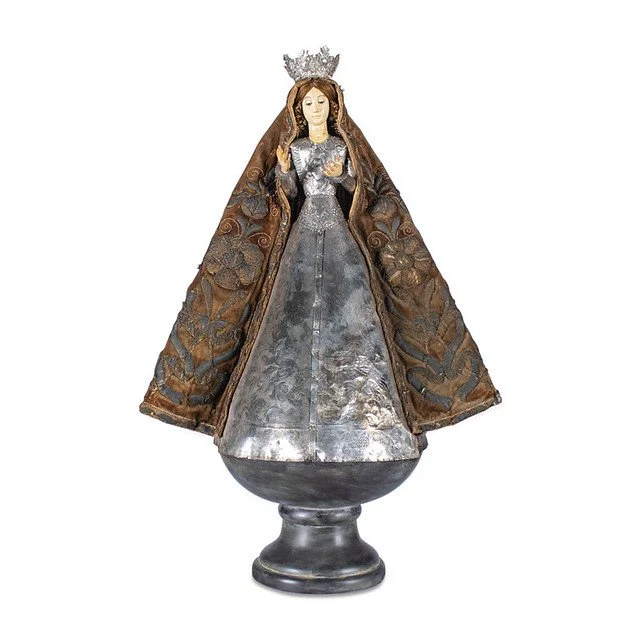
Inmaculada concepcion
At what point does a painting cease to be one object among many and begin occupying a place within a nation's cultural imagination? Who determines significance? Who decides which works deserve preservation, scholarship, visibility, and ultimately, remembrance?
During the exclusive interview with the Art Plus Magazine, Richie Lerma, Chairman and Chief Specialist of Salcedo Auctions, approached the matter with characteristic candor.
"Salcedo Auctions really wears various hats," he said.
The remark carries greater weight than it first appears. Auction houses are almost often imagined through the language of commerce, their public image tethered to estimates, hammer prices, and record-breaking sales.
Lerma's description gestures toward a considerably wider field of responsibilities—one drawing from scholarship, connoisseurship, historical research, and sustained engagement with the market itself.
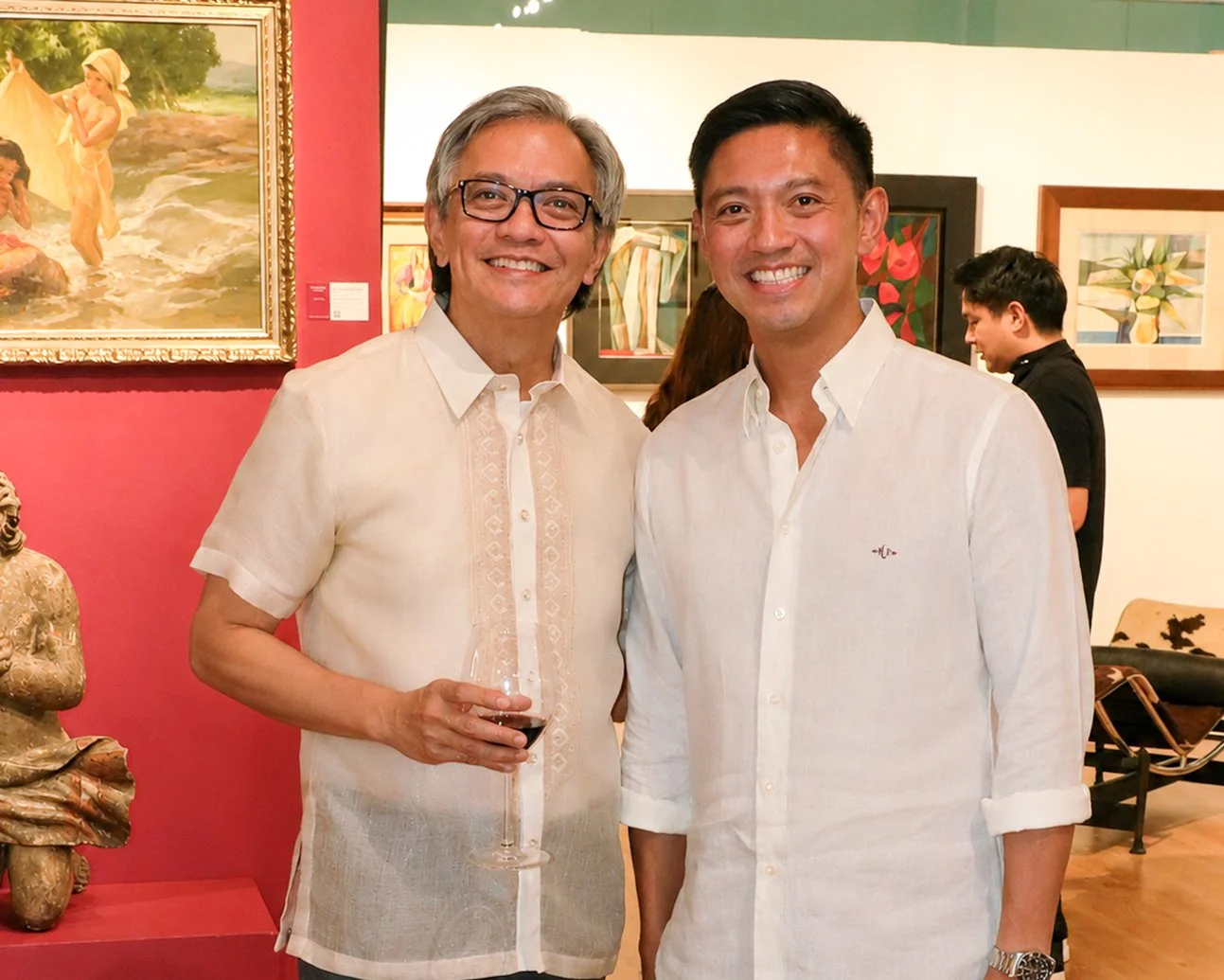
Richie Lerma and Ricardo Lagdameo
"We are primarily, of course, a venue for the sale and acquisition of Philippine art," he explained.
"Where we come in is our connoisseurship, in terms of being able to identify important works, how we define what is important, and how we bring in our years of experience in the academe, in research, in scholarship, and our exposure to the market."
The operative word, perhaps, is not market but define.
After all, significance rarely announces itself at the door. Someone must recognize it. Someone must argue for it. Someone must persuade others that this particular object deserves to remain in the conversation.
Lerma readily acknowledges the subjectivity involved.
"It's always about how we define what important is, and that's very subjective. That's why we always say there is such a thing as the Salcedo standard."
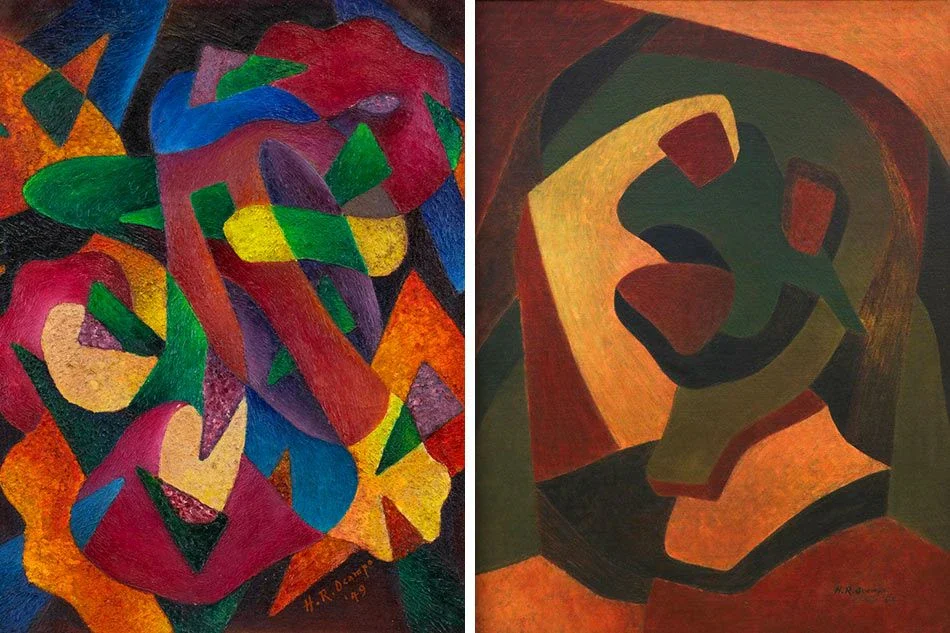
H.R. Ocampo’s gifts to Leonor Orosa Goquingco
The Salcedo standard.
Not a formula. Not an equation. Certainly not a guarantee of consensus. Instead, it functions as a curatorial philosophy—an attempt to balance historical relevance, cultural resonance, scholarly importance, and market interest without allowing any single factor to monopolize the discussion.
Such a framework becomes increasingly important within a contemporary landscape where attention itself has become a scarce resource. Every generation inherits more art, more information, more histories than it can reasonably process. Consequently, institutions play an outsized role in shaping what remains visible.
Over sixteen years, Salcedo Auctions has emerged as one of those institutions.
Asked about changes in collector behavior, Lerma described the auction house as a barometer of the Philippine art market.
"We'd like to be seen as one of the reference points for the market in terms of who to look out for, who to collect, as well as what to look for," he said.
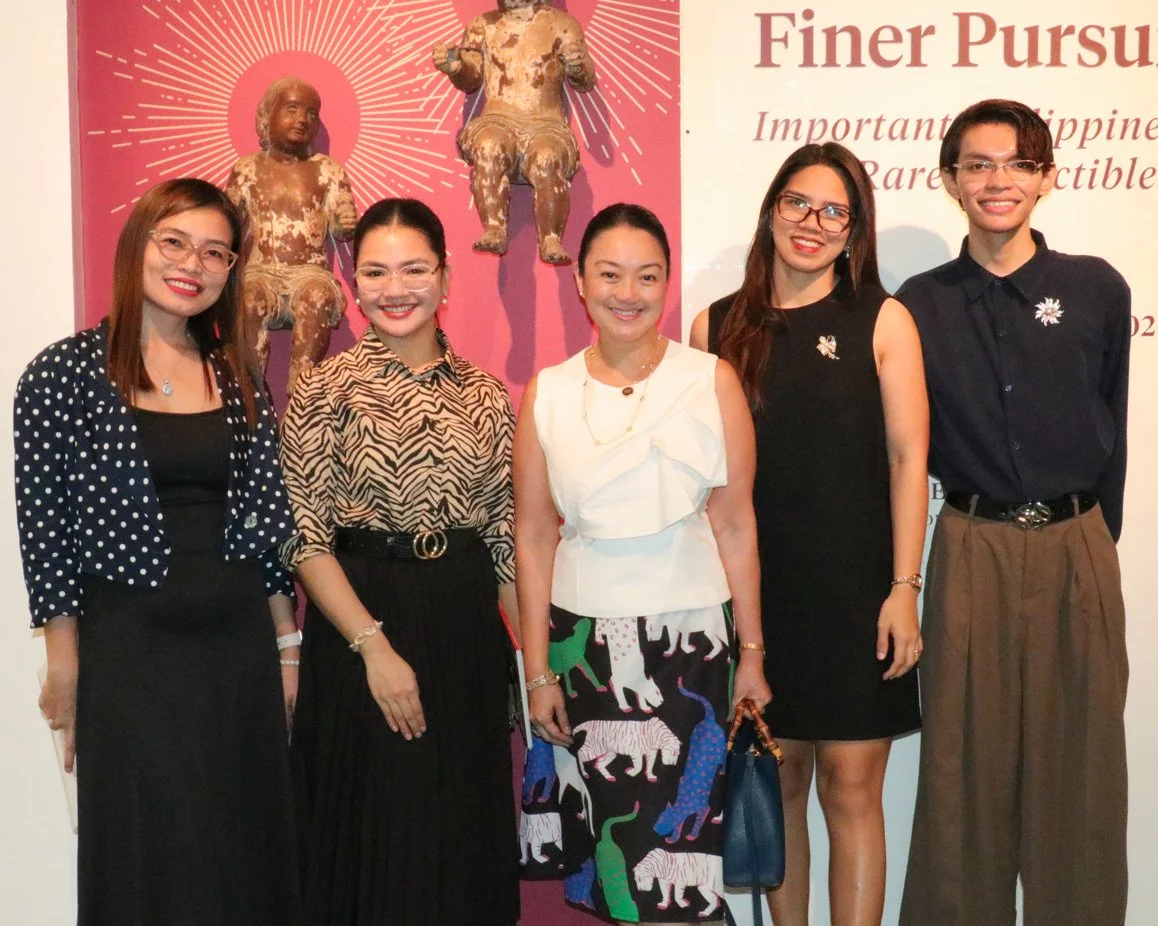
Cindy Ramirez, Angela Belonia, Ching Jorge, Aimee Mapa, Theo Abuan
Reference point implies guidance. It suggests orientation amid abundance. In a world overflowing with objects, artists, movements, and narratives, identifying what deserves closer attention becomes a cultural act in itself.
When History Finds a Steward
The evening's most compelling argument for this role could be found not only in the paintings, but also in the objects surrounding them.
A rare nineteenth-century photographic album, comprising 104 images captured during the waning decades of Spanish colonial rule, afforded visitors an unusually intimate encounter with Philippine history.

Rodel Tapaya’s Jumping Over Thorns, dated 2019 and Elmer Borlongan’s Untitled (Father and Son), dated 2004
Among its most extraordinary holdings was what is believed to be the largest known privately held print depicting José Rizal in the final moments preceding his execution at Bagumbayan, an image widely attributed to Spanish photographer Manuel Arias Rodríguez and among the few surviving visual records of the national hero's martyrdom on December 30, 1896—a photograph that collapses the distance between historical memory and lived reality.
Complementing it were portraits and execution photographs of the Thirteen Martyrs of Bagumbayan, their sacrifice rendered hauntingly immediate through fragile photographic relics that, despite the ravages of time, have endured for well over a century.
Particularly arresting among them is the image of Moisés Salvador, whose torture-weakened body lies prostrate upon the ground, unable to take his place beside his fellow revolutionaries.
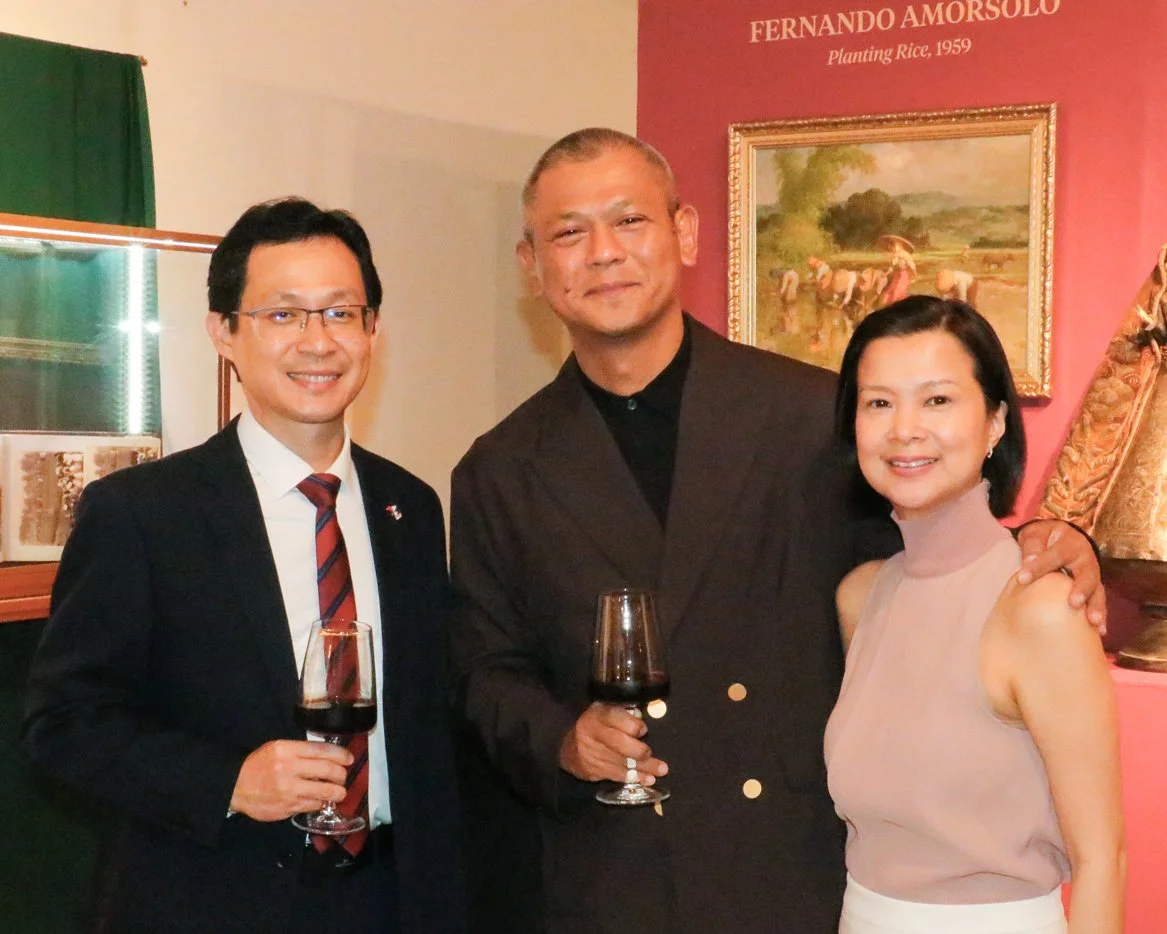
Mr. Tan Foo Koeng - Embassy of Malaysia, First Secretary, Homer Silvestre, Leslie Silvestre
Elsewhere emerged a rare group portrait associated with the Pact of Biak-na-Bato, a visual remnant of a defining chapter in the nation's revolutionary narrative.
Taken in 1897, the photograph includes Emilio Aguinaldo and several revolutionary leaders whose negotiated exile would later give rise to the group known as the Hong Kong Junta, placing the image at the intersection of revolution, diplomacy, and political transition.
Not far from it stood an early nineteenth-century Inmaculada Concepcion fashioned from ivory and silver, attended by antique wooden angels whose quiet vigil evoked centuries of prayer, reverence, and inherited belief.
The cumulative effect proved striking.
Martyrs, angels, revolutionaries, dancers, painters, saints, collectors—figures who would never have occupied the same room in life found themselves assembled within a single exhibition.
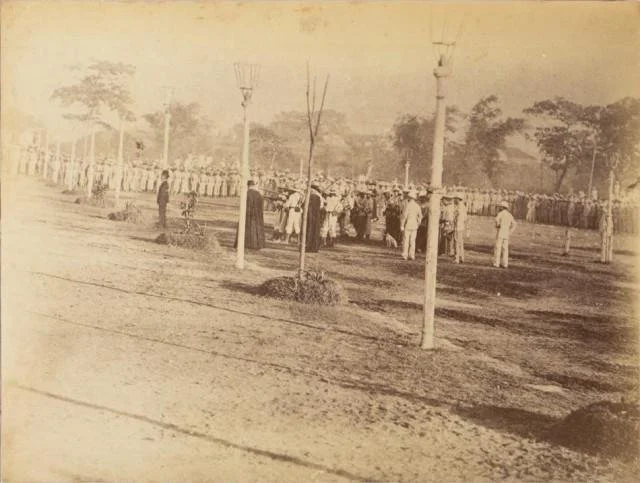
Rizal’s Execution
One began to understand why Lerma resists framing art and commerce as opposing forces.
When asked whether tension exists between viewing artworks as cultural objects and financial assets, he pointed toward some of the most celebrated works in human history.
"The great Sistine Chapel, for example, of Michelangelo. The Mona Lisa, for example, of Leonardo da Vinci. Products of patronage. They were commissioned works. There was commerce involved in their making."
His point was neither defensive nor apologetic.
History, after all, offers little evidence that artistic achievement flourishes in isolation from systems of support.
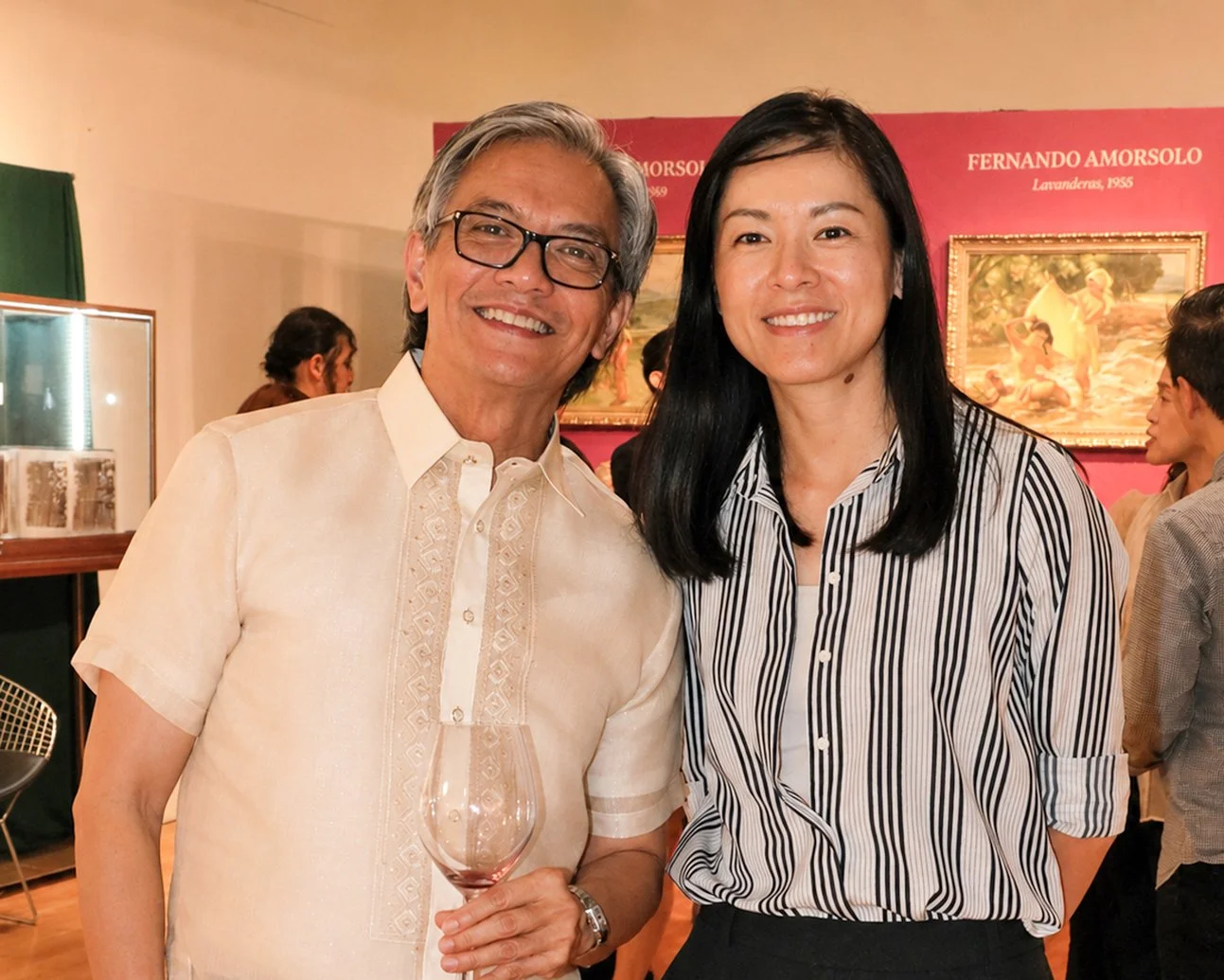
Richie Lerma and Liwei Tai, Country Head of Singapore Airlines' operations in the Philippines
Patronage has always existed in one form or another. Markets evolve. Institutions emerge. Collectors come and go. Through it all, art survives because someone chooses to sustain it.
"There is always the financial aspect when it comes to art," Lerma said. "We can never remove that from our views. It's not the dominant factor. It's part of the ecosystem that comes in the creation of art."
Perhaps that is the lesson embedded within the vernissage itself.
A painting funds a ballet, a photograph preserves a revolution, an auction becomes an archive, and an object acquires another custodian.
By evening's end, guests departed carrying catalogues and conversations, though the most enduring takeaway resisted easy valuation. The works on display possessed estimates, certainly. Many would soon acquire final prices.
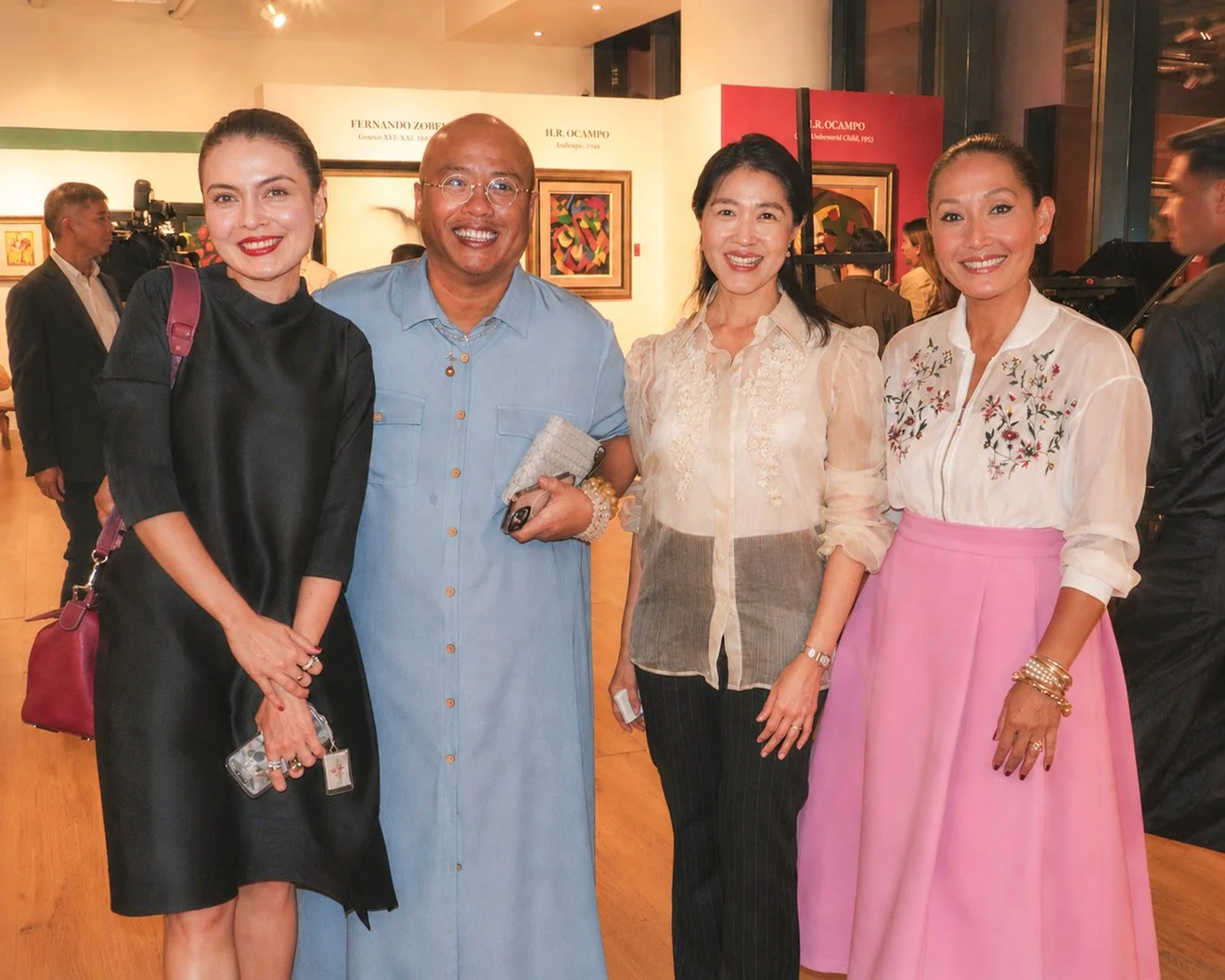
Carol Hamilton, Luis Espiritu, Karen Lerma, Mitch Suarez
Their significance, however, occupied a different register altogether.
For Lerma, that distinction remains central to the institution's mission.
"It's not simply a business as It's a passion, it's a commitment, it's a calling for us to be able to bring this out."
Perhaps that is what a vernissage ultimately accomplishes.
Not the selling of art.
Not even the anticipation of sale.
What it offers, before the first bid is cast and before ownership changes hands, is an opportunity to encounter the stories that make those transactions matter in the first place.
Because ownership is fleeting, but what endures are the stories we choose to keep alive.