Art As Dissent
These Quezon City artists and collectives approach protest and art-making in different forms—but always buoyed by creative expression and care beyond self.
Words Khyne Palumar
Photos courtesy of Patreng Non, Jo Tanierla, and TkTk Feminist Printmakers
March 25, 2026
Patreng Non
Last October at Gravity Art Space, Patreng Non laid out over 40 used pots and pans across a jumbo-sized banig for her group exhibition piece, Kumakalampag. The work draws from the kalampag protests she first witnessed as a kid during trips to Marikina’s wet market with her mom. Demonstrators would bang on steel and aluminum cookware to protest attempts to privatize public markets, which would drive up prices and threaten jobs. At Gravity, Patreng aimed to recreate the same spirit of refusing silence, drawing in every kind of participant: toddlers played by the banig with their parents, and others drummed while shouting a familiar protest chant tied to the flood control fiasco: ‘Ikulong na ’yan, mga magnanakaw!’ (Jail the thieves!)
Patreng Non
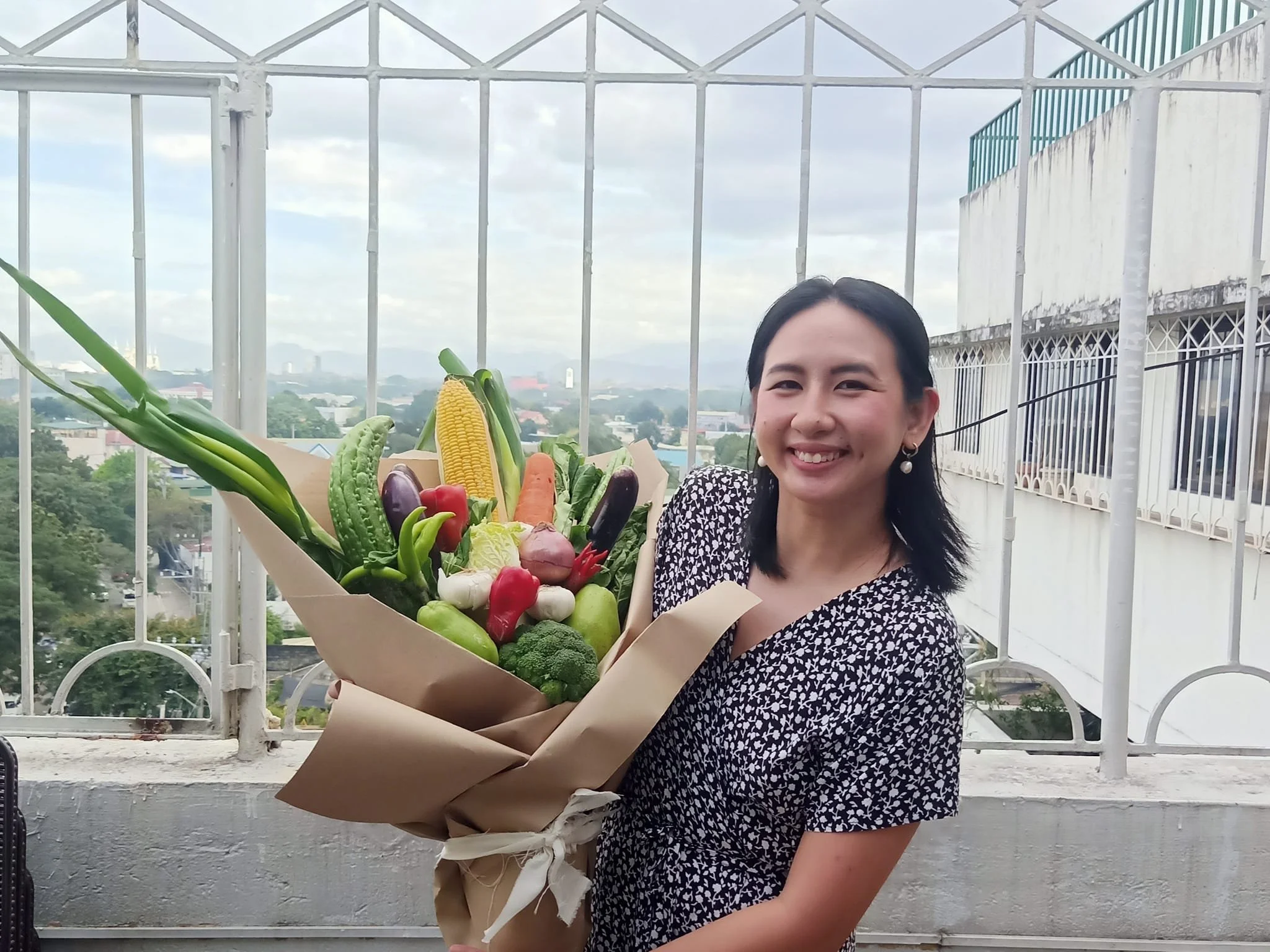
Like many of Patreng’s projects, Kumakalampag was about participation. “It’s about caring, connecting, creating music and dialogue,” she says. Now 31, the University of the Philippines Fine Arts alumnus admits that she’s softened from her more intense student-activist days. “Sobrang galit ko noon—puro galit at paniningil. Ngayon, may galit at paniningil pa rin, pero nandoon yung acceptance and meeting people where they are.” (I was really angry then—all rage and demands for accountability. Now there’s still anger, but also acceptance and meeting people where they are.)
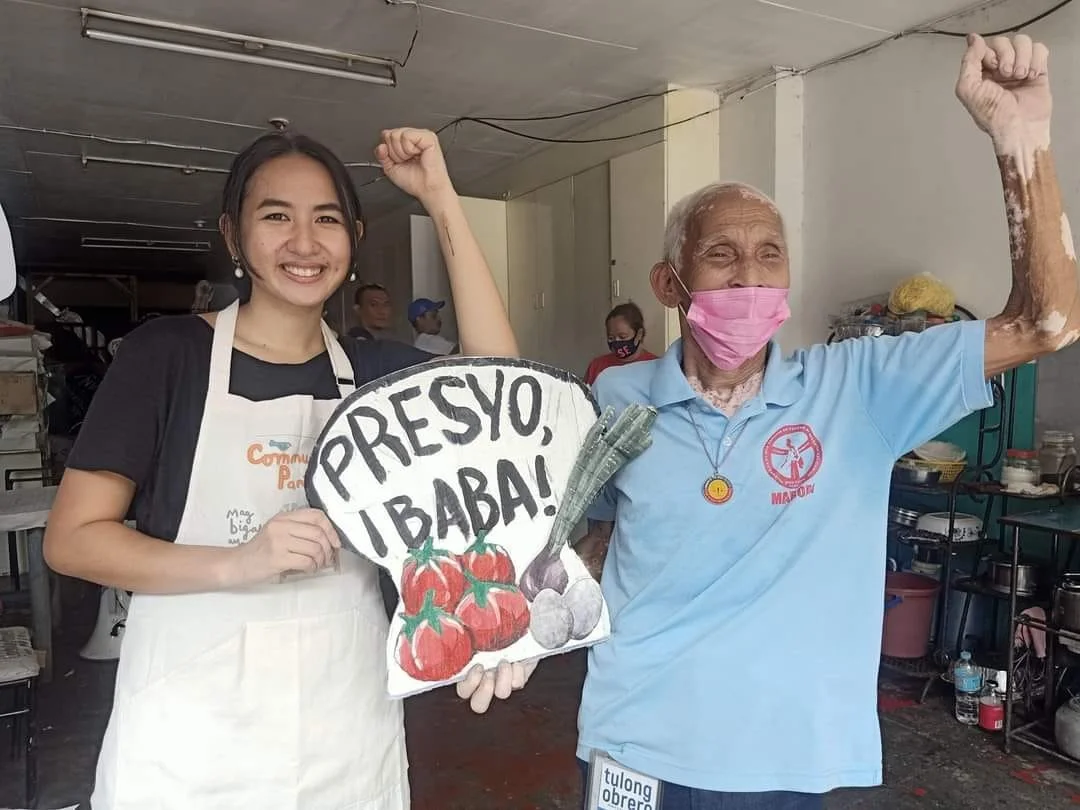
That shift came post-pandemic, after mounting another interactive work of sorts that stretched far beyond gallery walls: the Maginhawa Community Pantry. When she rolled out a food-filled bamboo cart along 96 Maginhawa St. in 2021, Non became the reluctant face of a care-driven movement that spawned hundreds of pantry iterations nationwide, offering aid without shame or judgment. “Magbigay ayon sa kakayahan, kumuha batay sa pangangailangan” (Give what you can, take what you need), read the cardboard on Non’s cart that’s become a widely echoed pantry motto.
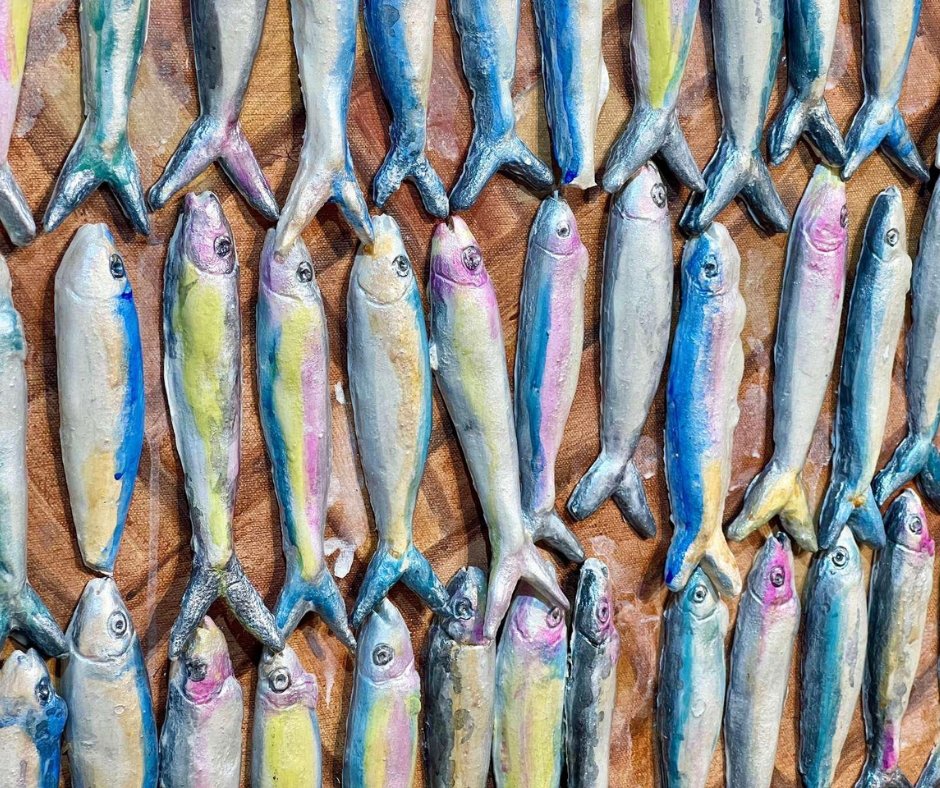
Pagtutuyo
Non tells Art+ now that she refuses to call it an act of pure selflessness as it also stems from intimately difficult experiences: “Personal siya kase naramdaman ko ang magutom,” (It’s personal because I’ve experienced hunger). She recalls periods of hardship as the youngest of four raised by a single mother, with a robbery incident wiping out their tuition money and sending her mom into depression. Patreng and her siblings would subsist on meals of rice with Knorr cubes dissolved in water, and imagine “camping nights” by candlelight when their electricity was cut off. “Really, what I’m doing is helping myself process and face my own trauma. Kasi kung nangyari yung pandemya nung bata kami—100% sure ako we wouldn’t survive,” she says.
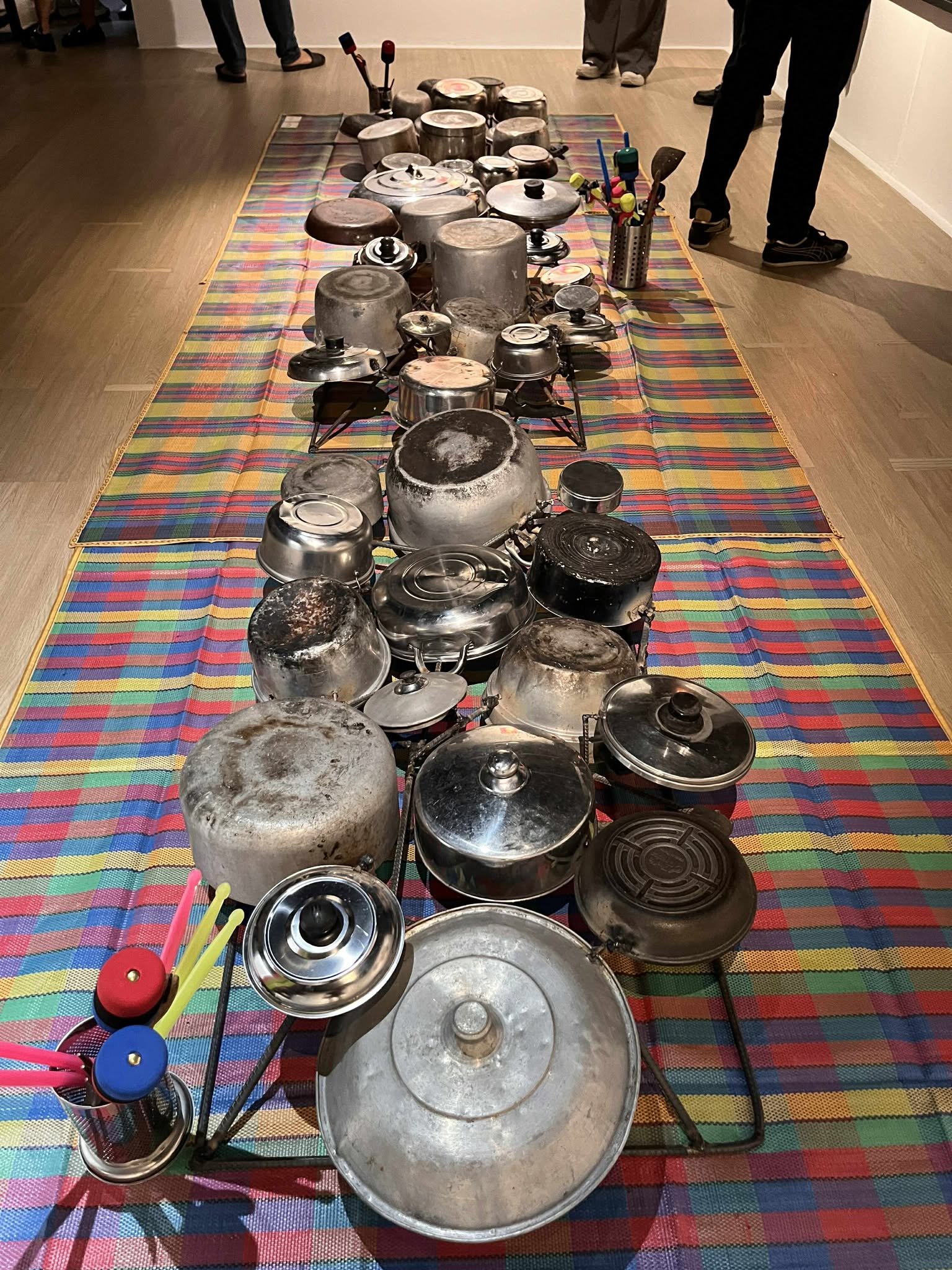
Kumakalampag
The pantry drew both praise and scrutiny, and Non was tacked with labels that scaled from the extreme (saint and witch) to the dangerous (rebel communist). It took a toll on her mental health, but she’s since learned to let opinions slide and focus on the work. Today, even with decreased attention, the pantry remains active online (Community Pantry PH on Facebook)—accepting donations and helping people recover from fires and typhoons, supporting cash-strapped parents during back-to-school season. Patreng is quick to point out that it’s no one-woman show, but a vast and largely self-sustaining network, comprising community kitchens and gardens to a small poultry initiative in Marawi. “Expert sila,” she says, describing how organizers can break down vegetable deliveries of up to 10 tons and distribute them across multiple hubs.
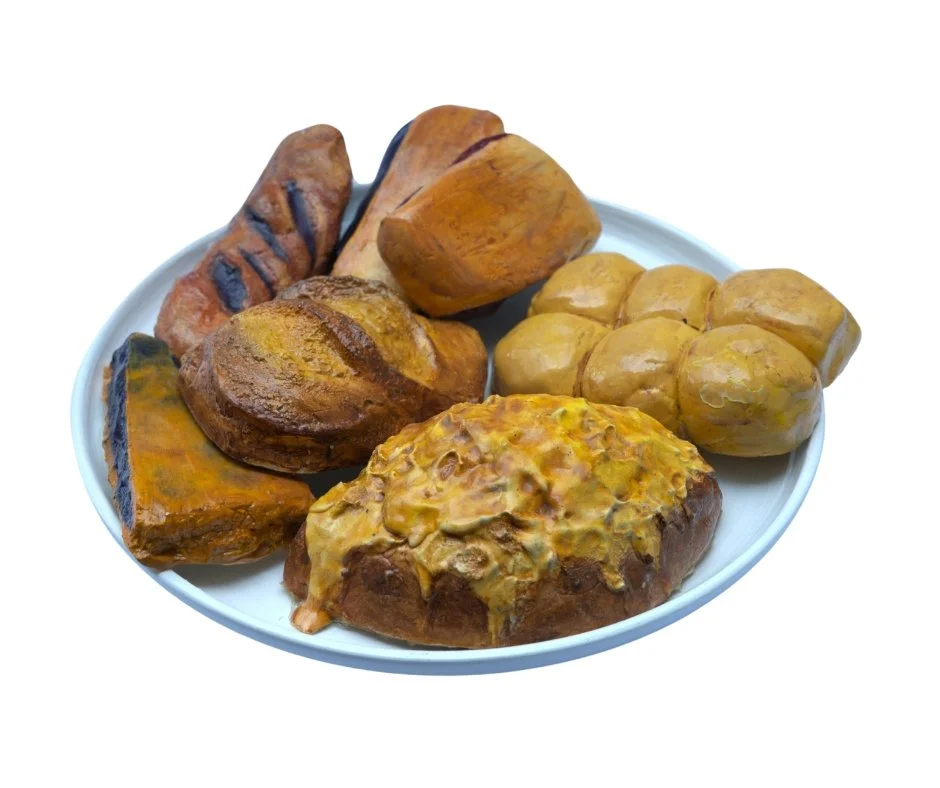
First Comes Food
In the last three years, Patreng has found her way back to making art. But consciously or not, many of her sculptures, including Kumakalampag, circle back to food. “Ayoko sana. Pero laging food yung ending—siguro dahil matakaw ako,” she jokes. (I try not to—but it always ends up being about food. Maybe because I love to eat.) Self-deprecation aside, Patreng’s works have made pointed statements on worker’s rights, food security, and women’s bodies. For her 2024 show Panalangin Para Sa Lupa, she created close to 100 life-sized onion sculptures, focusing on onion farmers’ plight and calling the piece an “interfaith prayer for land justice and peace.” Then in Pagtutuyo, Non sculpted dozens of dried fish to spotlight the fish oversupply in Iloilo that resulted in food waste and a price crash.
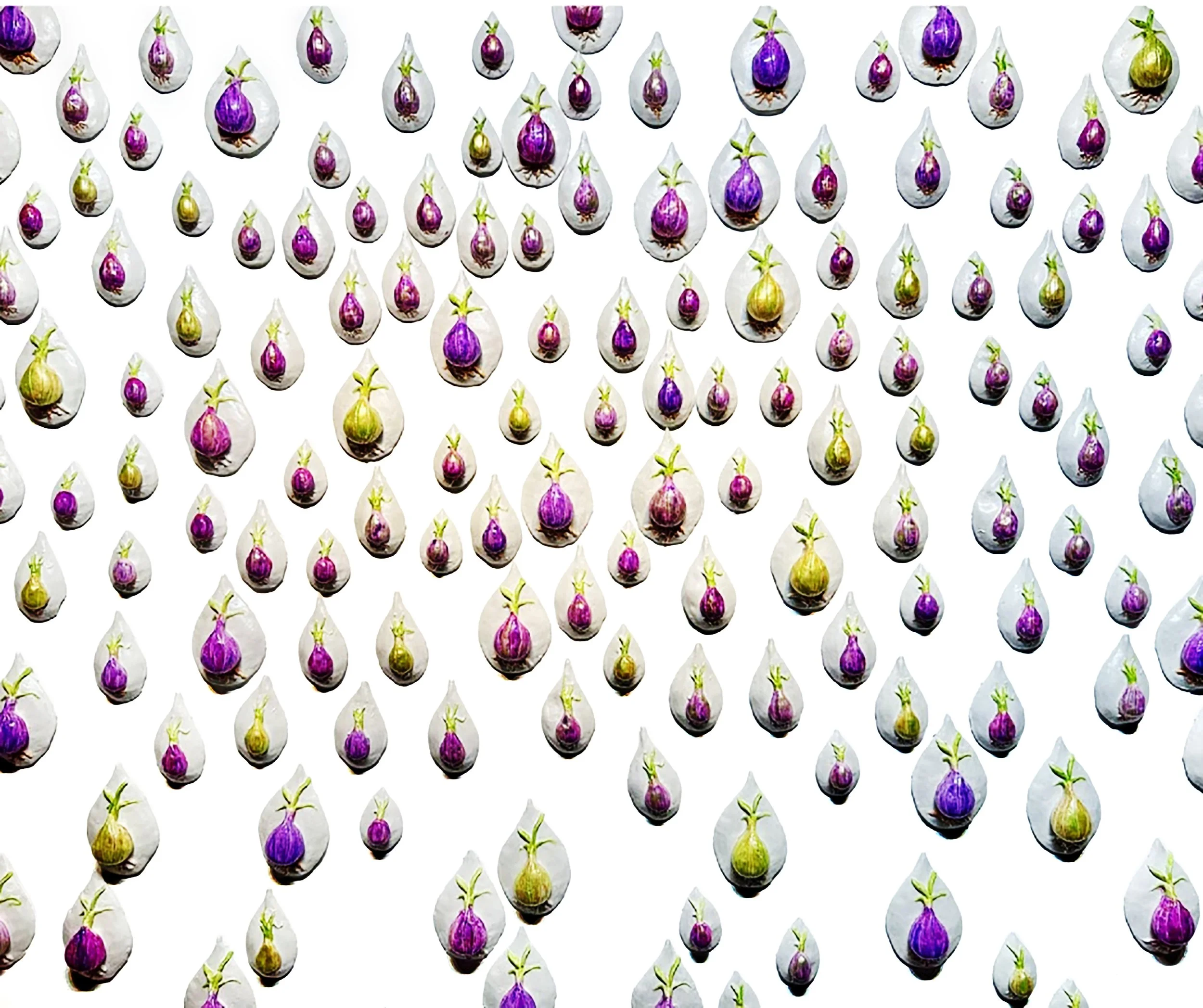
Panalangin Para Sa Lupa
In Fruits of Labor, she offers a nuanced portrayal of the female genitalia and changes brought on by childbirth, illustrating cervical dilation by carving fruits—aratiles, calamansi, strawberry, mangosteen, and melon.
But there’s one art project Patreng dreams of doing that involves a different kind of nourishment: an “unsafe” playground where kids can hammer, tinker, and build with scrap. “Fascinated ako sa public playground na ‘unsafe’ pero safe in the sense na pwede ka mag-experiment and express freely and play,” Non says. That playful spirit is also how she moves between art and advocacy. “Pakiramdam ko bawat aspect, naglalaro ako. Childish talaga ako,” she says. (I approach each part playfully. I can be really childish.)
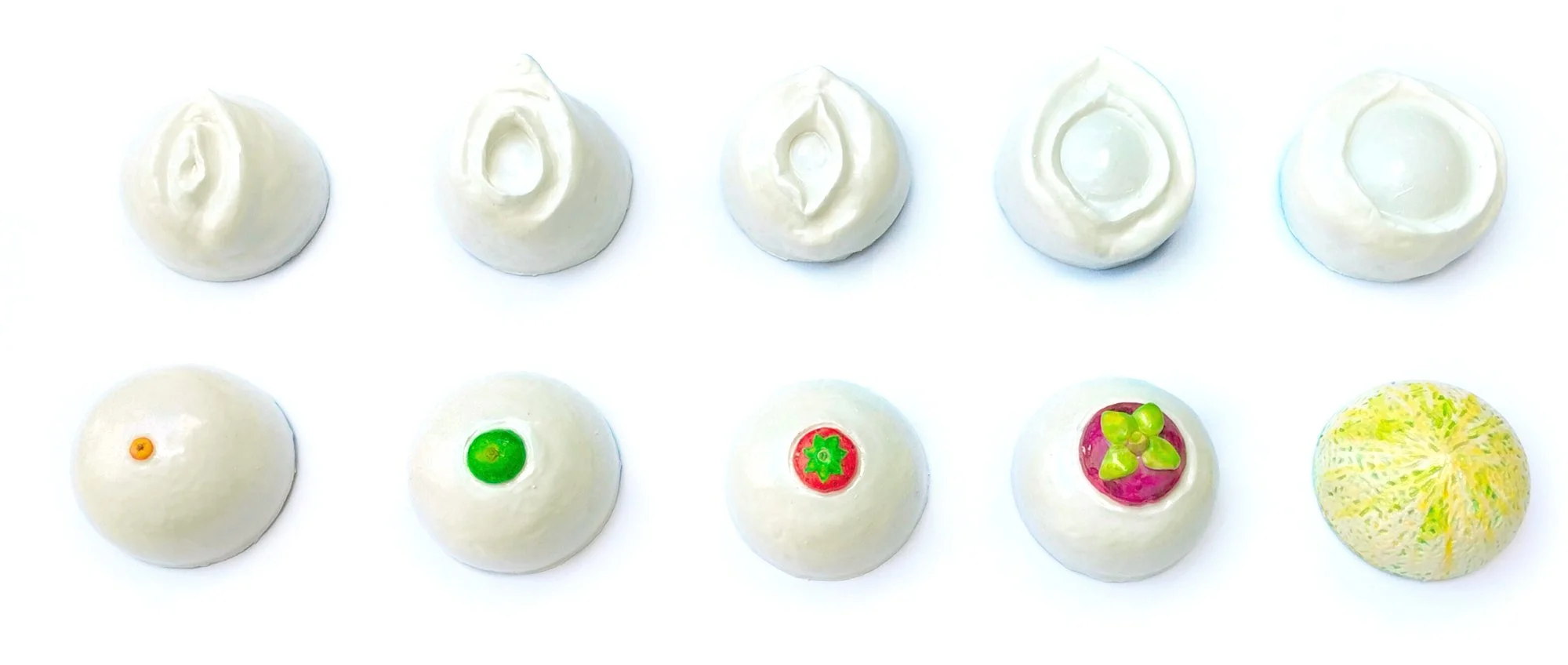
Fruits of Labor
This childlike nature is also coupled with care, which informs everything Non practices, most of all, her activism: “Para sa akin, compassion is a form of protest,” she says. “Nag po-protesta ka because it comes from a place of love na people deserve better,” she says. “Yun yung mga lessons na naituro sa akin ng pantry. Pwede kang maawa sa tao, pero kailangan mo rin silang i-empower at kailangan maging malinaw kung sino ang sisingilin.” (That’s one of the lessons the pantry taught me. You can feel compassion for people, but you also have to empower them, and get clear about who to hold accountable.)
Jo Tanierla
In his more than eight years as an exhibiting visual artist, Jo Tanierla has often felt the need to insert political and social commentaries in his art, even when he just feels the urge to pick up a pencil and draw the sea. “Pero consciously, hindi pwedeng dagat lang ida-drawing ko dahil maganda siya i-drawing,” (But I’m unable to consciously just draw the sea because it’s pretty) he tells Art+ one afternoon, coming from a morning fieldwork for Tambisan sa Sining—a cultural mass organization that primarily advocates workers’ rights.
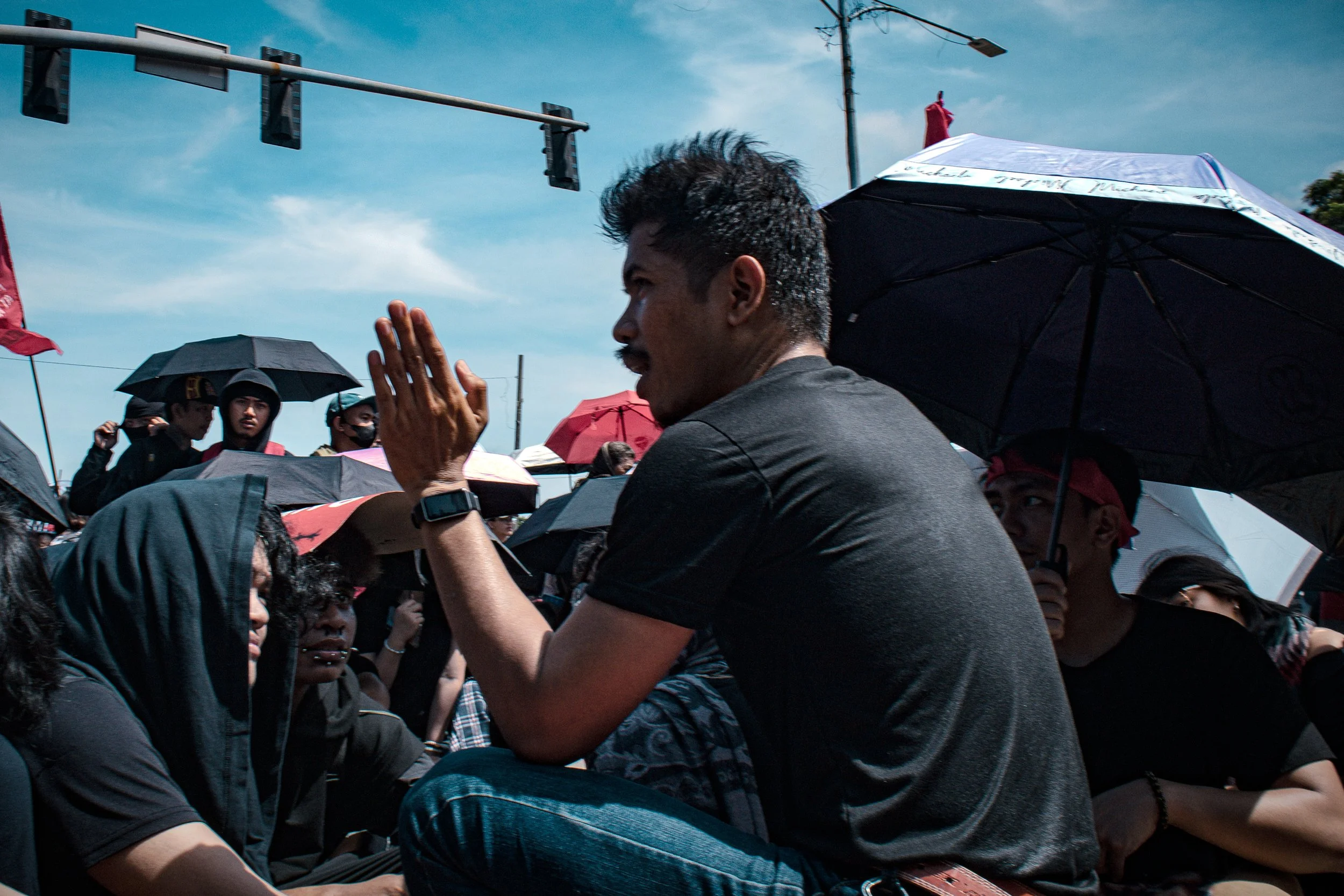
Photo by Ethane Manching
Tanierla is quick to point out that the collective’s labor-led advocacy is far-reaching and connects to everything and everyone. “Workers’ rights don’t exist in a vacuum,” he says. “When farmers are dispossessed of their land, they’re forced to move to the cities in search of livelihood and become workers. Labor rights also involve students, because eventually they, too, will become part of the labor force. The same goes for women—who make up more than 50% of the labor force, so too are the LGBTQ+, etc. Tambisan primarily fights for workers’ rights, but these are the rights of all sectors of society, they are the rights of the entire population.”
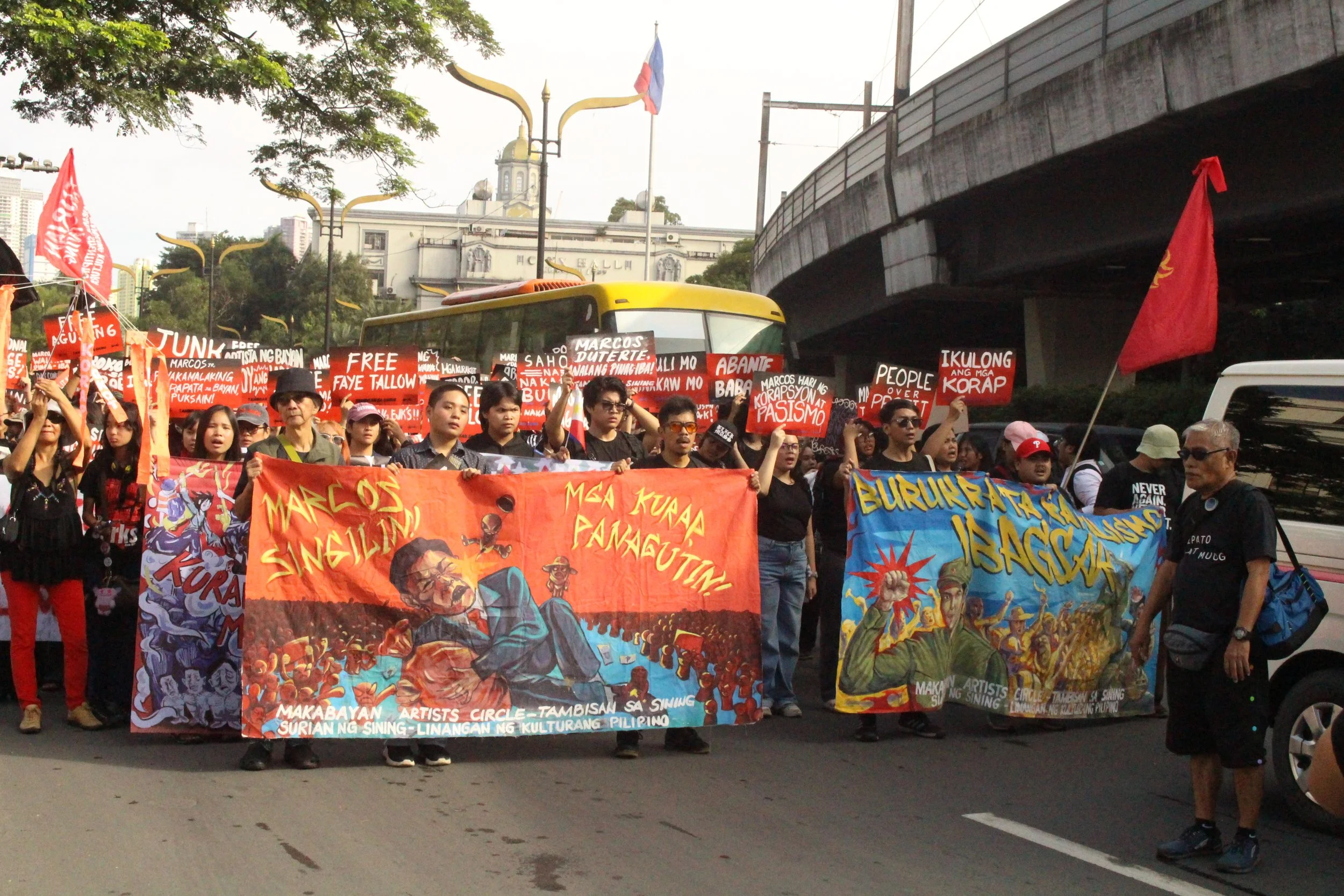
Tambisan Sa Sining | Photo by Francis Villarino
Tanierla’s sense of duty to create commentary-laden works, even before Tambisan, was further fueled in 2016—when ex-President Rodrigo Duterte launched a drug war campaign that killed thousands and led the International Criminal Court to pursue charges of crimes against humanity. Tanierla said the flagrant injustices of that regime “politicized” him, and in 2019, he received a sense of structure and political education when he joined Tambisan—first as a member, and now as its national chairperson. He sees art as both a standalone tool and a supplement to “amplify” the call to hold corrupt leaders accountable, from placards that plainly read: “Marcos, Duterte: Panagutin,” to effigies being burned as a more visceral and confrontational form of protest.
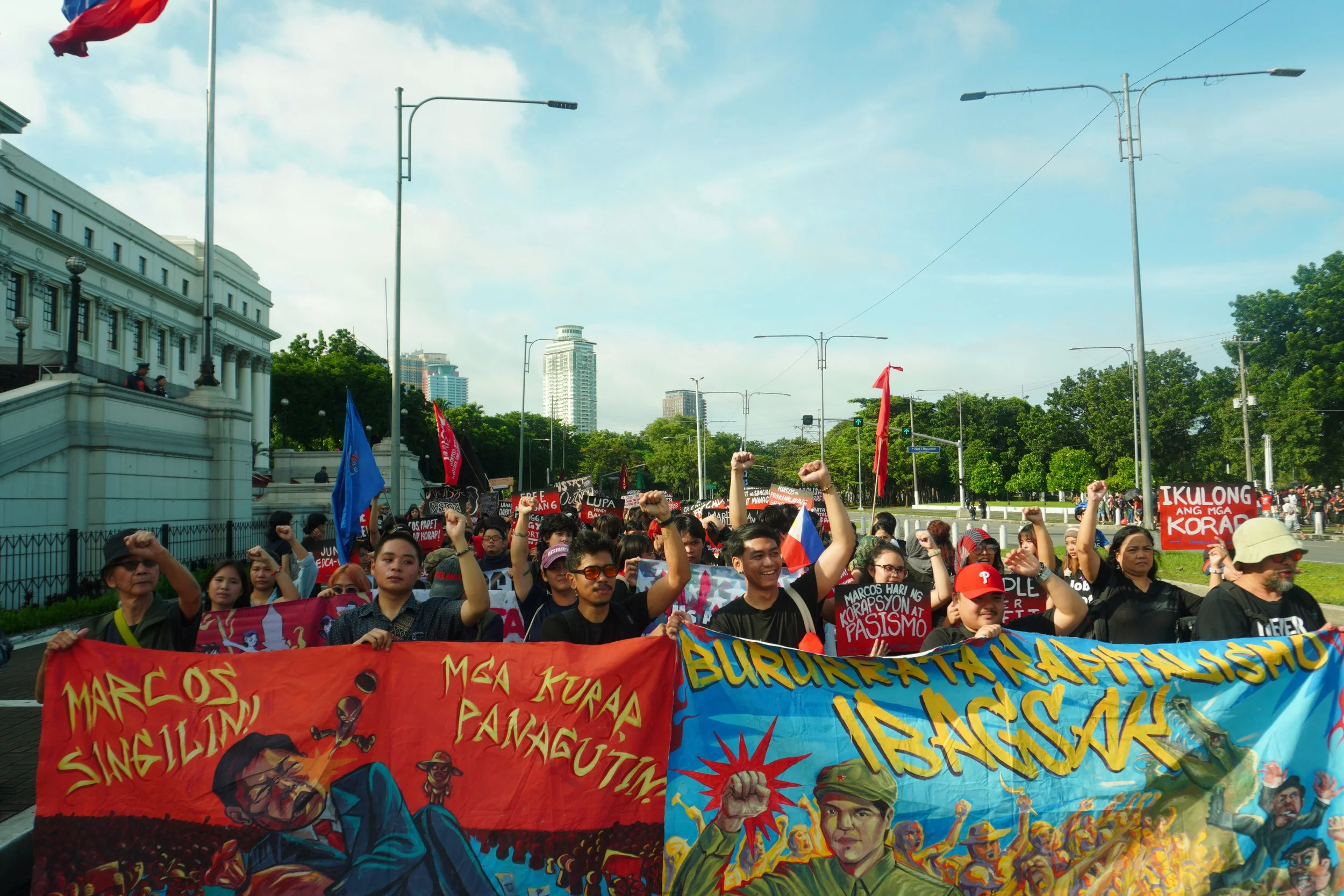
Tambisan Sa Sining | Photo by Lian Casimiro
Tambisan, founded in 1979, has a long history of creating socially conscious art, including songs reflecting workers’ struggles, and stage productions like Mayo Uno ng Ating Paglaya—considered the first progressive performance at the Cultural Center of the Philippines after the late dictator Ferdinand Marcos Sr.’s fall.
Separate from Tambisan, Tanierla—a University of the Philippines Fine Arts graduate, and Ateneo Art Awardee—has, as it happens, a predilection for drawing the sea. He’s captured the intensity of the swirling body of water in Ang Daluyong (The Current) and in a piece titled Doon kung saan halos patag at tumitigil ang mga alon, doon mababasag ang tanikala (there where the waves are still, is where the chains will break)—he alludes to internal tumult and working-class weariness.

A side-by-side-comparison of a workers and Adam Smiths left hands
The 36-year-old hyperrealist—who’s worked with different mediums including charcoal, watercolor, oil, and soft pastel—can convey melancholia in nature scenes (a weed growing through a stone, and a view of Mount Makiling), just as effectively in mundane snapshots (a woman carrying a canvas bag and a boy folding laundered sheets). Tanierla also doesn’t shy away from depicting violence in his art—drawing dead bodies in barracks ditches and flies-swarmed soldiers to confront the country’s blood-tainted colonial history.
One standout piece is a graphite drawing of a floating hand titled A side-by-side comparison of a worker’s and Adam Smith’s left hands, which pokes fun at the economist and father of capitalism. “Sa pananaw ni Adam Smith, may invisible hand yung ekonomiya, that if each stakeholder does their best, they would benefit. That’s the framework of The Invisible Hand. Do your best, hindi ka maghihirap,” (you won’t suffer) Tanierla says, but quickly offers a rebuttal.
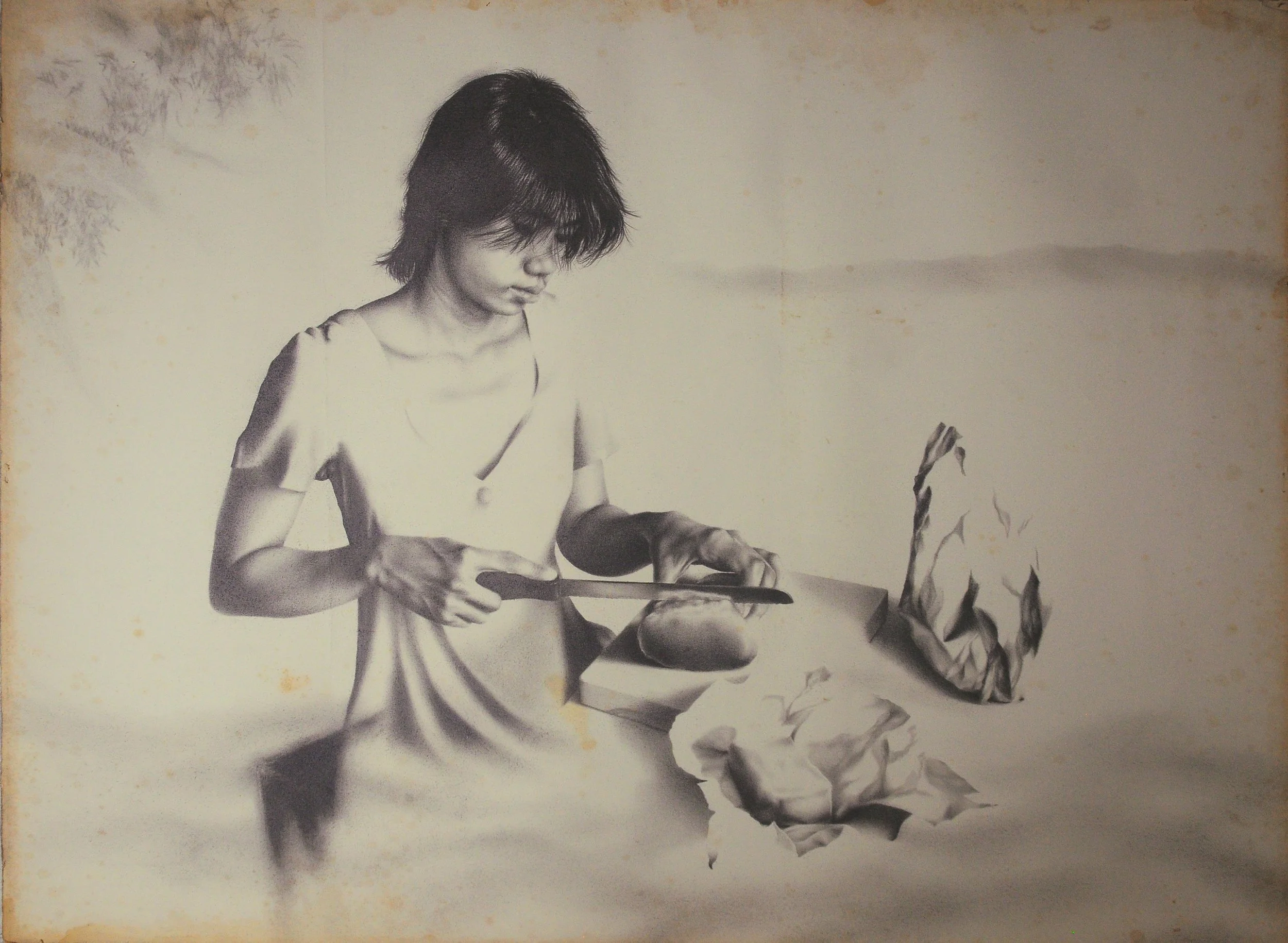
agahan matapos mabasag ang tanikala (breakfast in the aftermath)
“That statement is superficial at sobrang malayo sa katotohanan,” (far from the truth) he says. Capitalism hinges on “concentration and accumulation,” Tanierla explains, eventually producing monopolies that erase real competition and a free market. The “invisible hand” only made sense in a short window before monopolies took over and invoking it today in a monopoly-driven economy is “ridiculous,” he says.
Tanierla’s graphite on Manila paper illustration says as much. “Sa left side, kamay ng mga manggagawa. Sa right side, blank Manila paper lang—commentary kung gaano ka-ridiculous yung invisible hand. Kasi kung totoo yung invisible hand, bakit mahirap pa rin yung mga manggagawa na araw-araw naghihirap, bakit mahirap pa rin yung mga magsasaka?” (Because if the invisible hand were really true, why are workers, who struggle every day, still poor, and why are farmers still poor?)
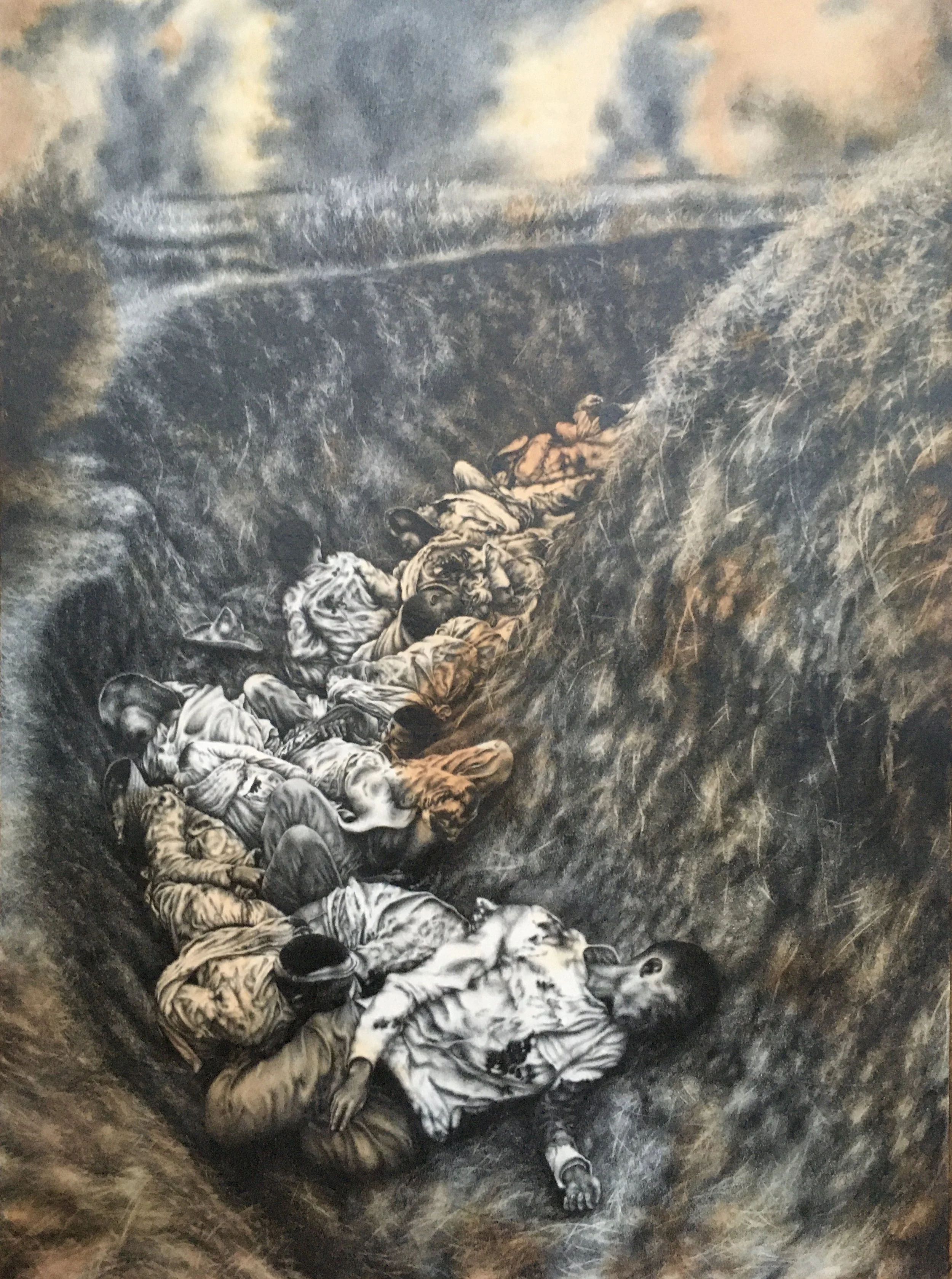
Dagundong at tupok (boom and blaze)
These questions and more, permeate Tanierla’s art. He sees himself moving towards more narrative works and dreams of painting a mural—but his preference and strength lies largely with graphite pens. “May affinity talaga ako sa lapis, definitely,” he says, citing its simplicity and availability as early as his early elementary school days. “Nang magsimula ako mag-drawing nung Grade 1, yun talaga yung available, lapis. May time na imbes mag-review, mag-do-drawing lang ako bago mag-exam.” Tanierla’s first drawings were of Ironman, which he remembers copying from a seatmate out of boredom. Those sketches snowballed into a daily habit and a measured practice he’s kept at three decades on.
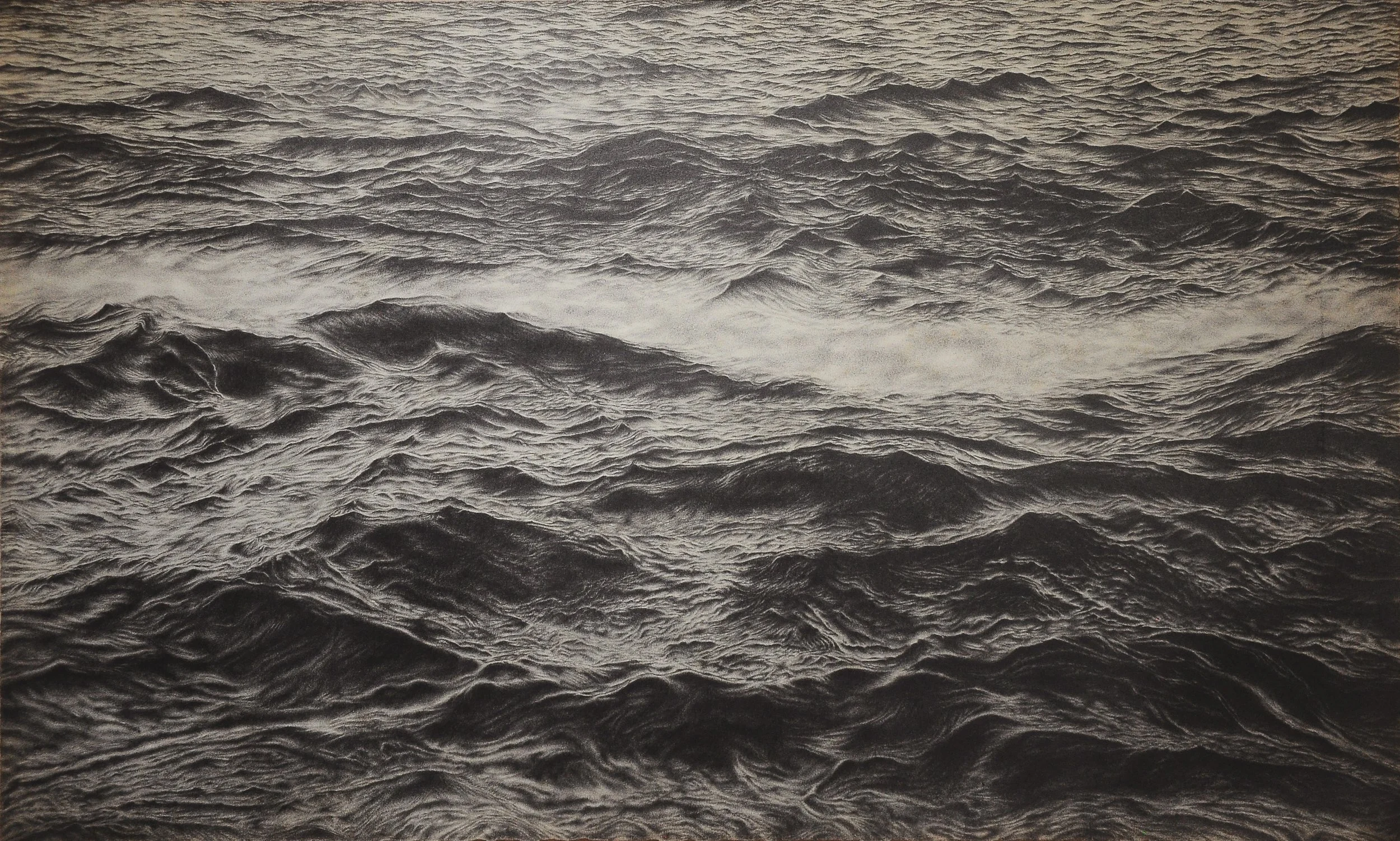
doon kung saan halos patag ang tubig at tumitigil ang mga alon, doon mababasag ang tanikala (there where the waves are still is where the chains will break)
Right now though, Tanierla’s collective-centered work takes precedence over his personal art. He considers himself a labor rights advocate first. “Mas iniisip ko ang sarili ko na aktibista at organisador, pero siyempre hindi ko bibitawan ang pagiging artist, dahil bahagi yun ng paglaban sa lahat ng fronts,” he says. (I see myself primarily as an activist and organizer, but of course, I can’t let go of being an artist—because that, too, is part of the struggle on all fronts.)
TkTk Feminist Printmakers
A feminist printmaking collective might sound measuredly niche, but TkTk (pronounced takatak, after the clatter of wood slabs) came together with hardly any pressure or deliberation. “It was very organic,” says Gale Villaflor—one of the group’s founding members, which include Mariel Sandico, Ena Marie Villa, Elaine Clemente, and Yllang Montenegro.
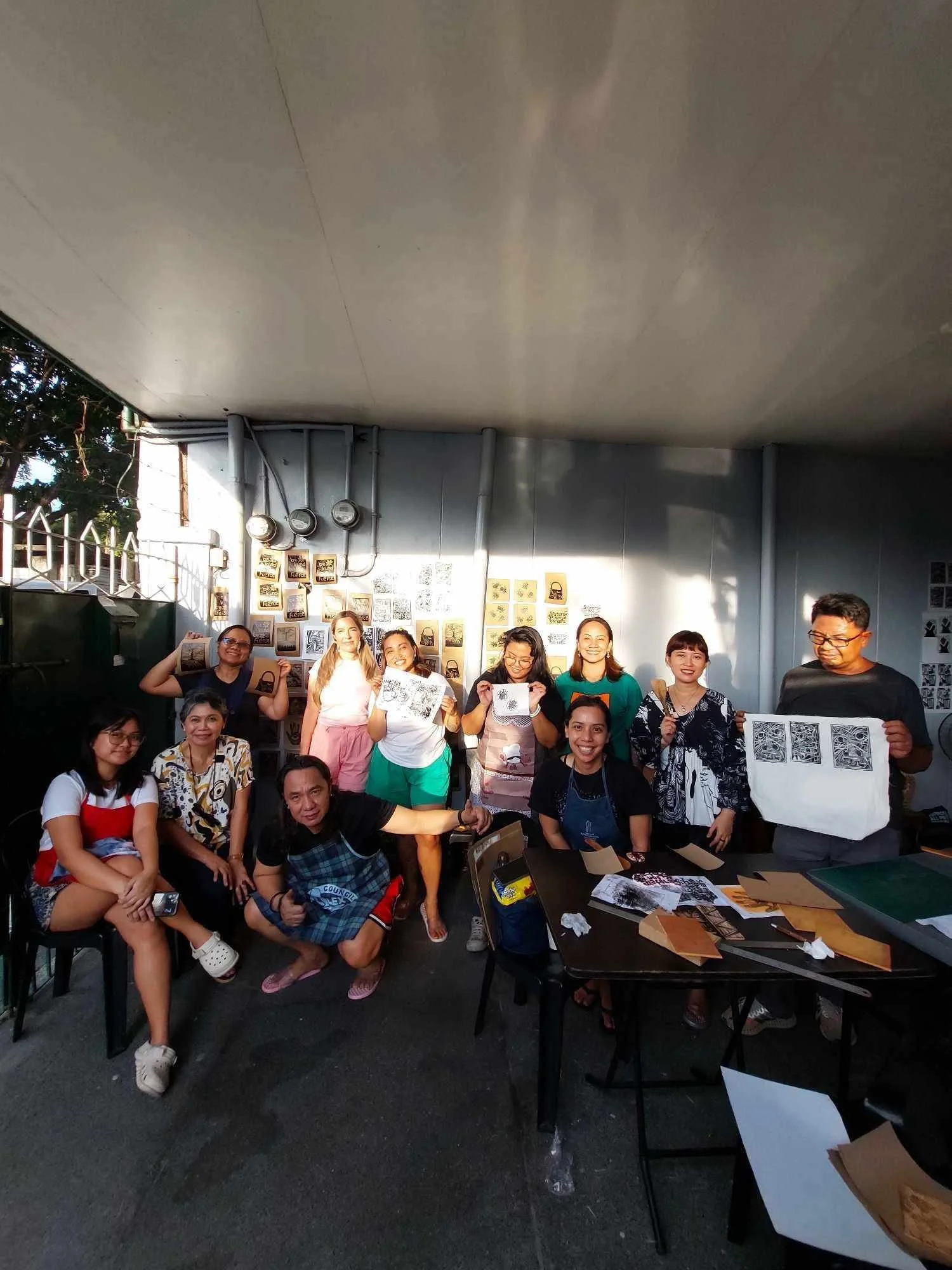
First group photo of TkTk Feminist Printmakers founders during their first Printmaking Tipar (printmaking party/session) in April 2025 at The O Home QC
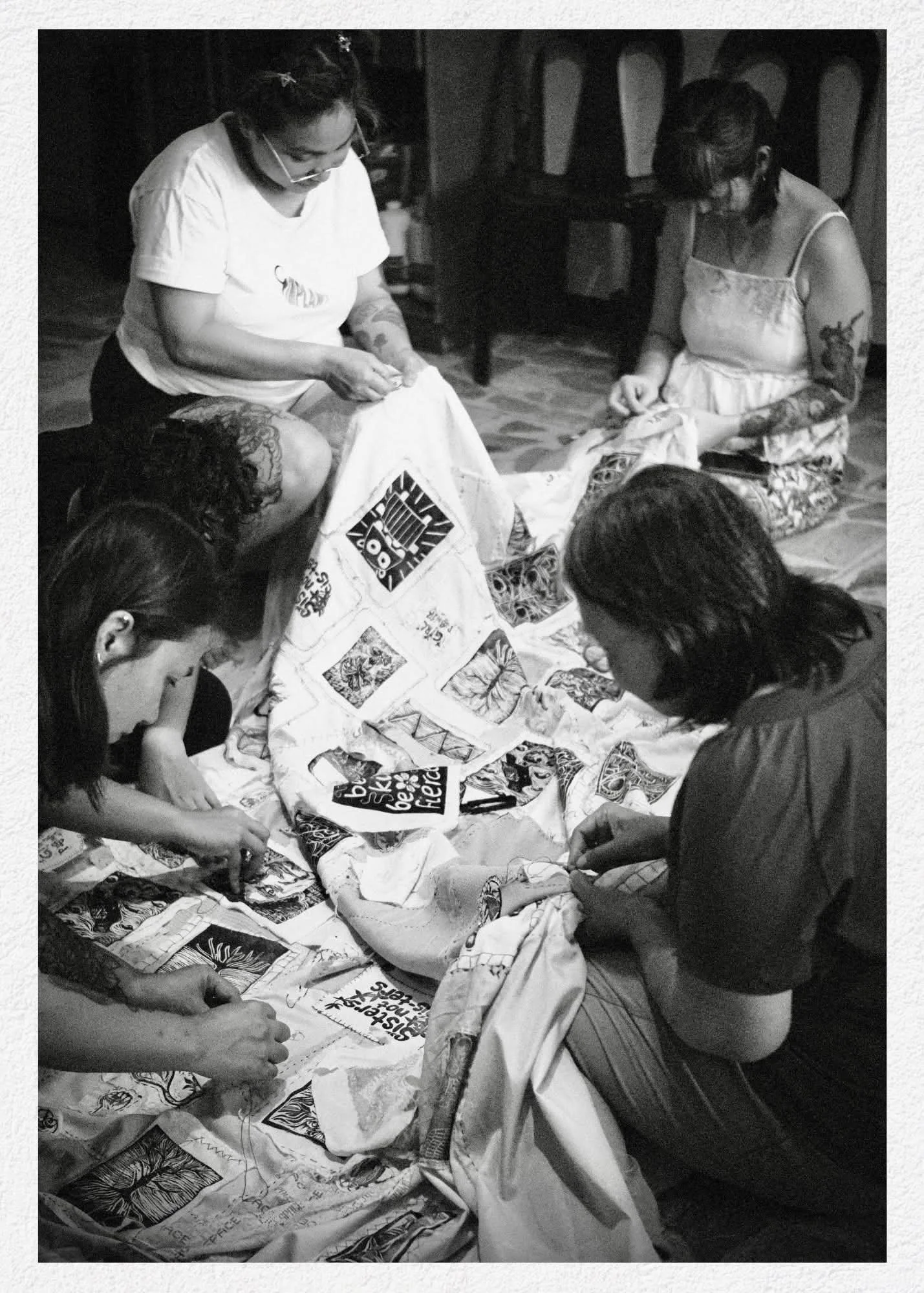
What began last April as a collaboration to produce a 6-by-11-foot graphic-print exhibition piece at Gravity Art Space, has since grown into a collective of roughly 20 members from different disciplines with feminist-forward advocacies—from environmental to mental health and sex workers’ rights. Not everyone has an art background, but each shares in the curiosity and practice of carving designs in a block, rolling it in ink, and pressing the images on a canvas of their choosing. The longstanding art form may seem slow, primitive, and labor-intensive, but TkTk’s members all agree that it’s largely the point.
“Kami ay naglilimbag tungo sa kalayaan” (We’re printing towards freedom), their manifesto reads. Each TkTk member may have a different take on expressing freely, but it’s what drives the collective’s practice. “Malaya in the sense na hindi mo kailangan magkaroon ng certain expertise sa isang bagay to create. Malaya kang lumikha kahit sino ka pa,” (Free in the sense that you don’t need a certain kind of expertise to create. You’re free to make art no matter who you are) explains Clemente, an art teacher with a lengthy background in advertising. She relishes printing with “like-minded and like-hearted” people at TkTk: “When you’re in a multinational company, you don’t really have the freedom to express your advocacies. Here, you can express them—you gain a voice.”
Villa, who works for a migrants’ rights-focused non-profit, sees printmaking as a way to broaden her skillset and viewpoint. “I don’t really have much of a creative background, but I’m trying to develop one. I think especially now that the world feels so chaotic, printmaking—or any kind of hands-on, physical work—can give you a different perspective. At first, I thought it would be easy and simple, but the process is both challenging and rewarding for me,” she says.
Sandico, an artist who works in commercial graphic design, wanted to stave off digital fatigue. “When you work digitally, your output has to be fast, and you’re not always creating consciously. With printmaking, you learn how to slow down,” she says. Though Sandico started printing solo during the pandemic, she enjoys it more as a shared activity. “I was really happy when TkTk came together because I wasn’t printing alone anymore. That’s what’s great about it, it’s centered around connection and community.”
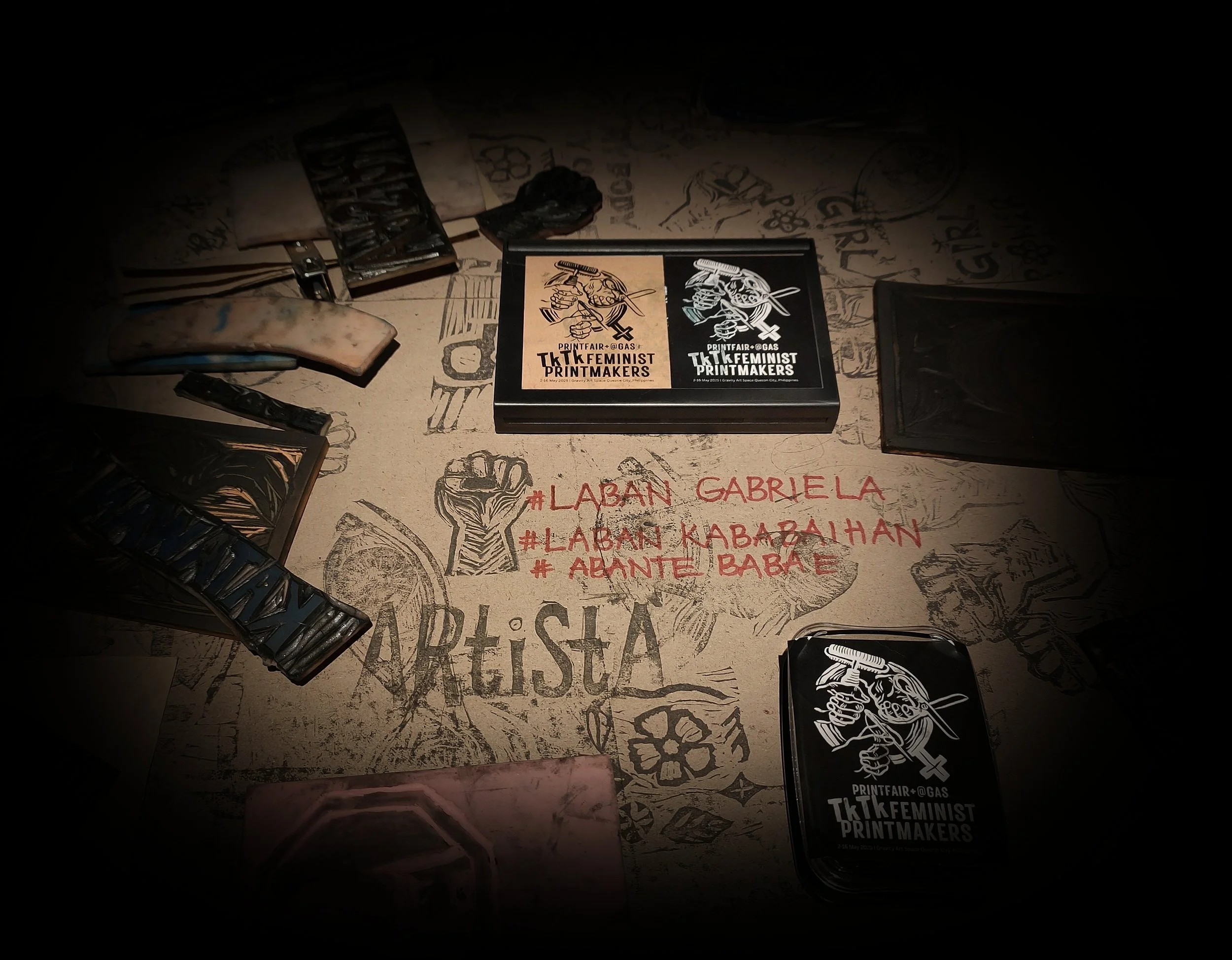
TkTk box covered in prints stamped by guests at Gravity Art Space’s Print Fair + @GAS: Graphic Protests
“For me, it was reducing screen time. I wanted a creative outlet that didn’t involve constantly holding a phone or being in front of a computer,” says Villaflor, a developmental worker and anthropologist who’s also been integrating printmaking in her day job. She adds that while each TkTk member has personal reasons for getting into printmaking, the medium has practical applications in collective work and advocacy art, as designs can be printed in infinite amounts and the workload can be shared. “One person might do the carving, but everyone can print together. I was also in a workshop where someone designed a large image for printing, then divided it into six parts for carving. Different people carved each section, and because the image was so big, we had to print it collectively,” Villaflor says.
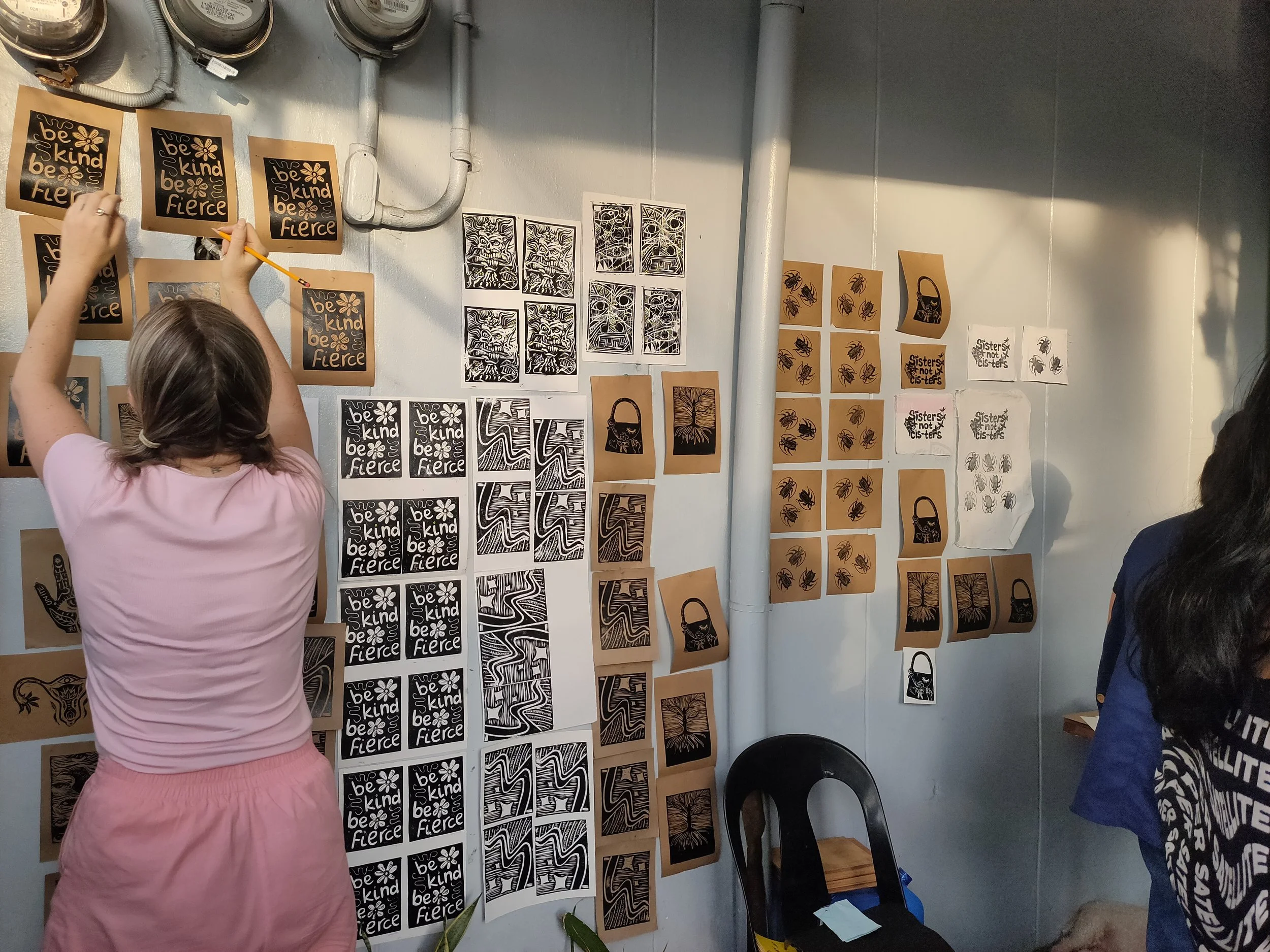
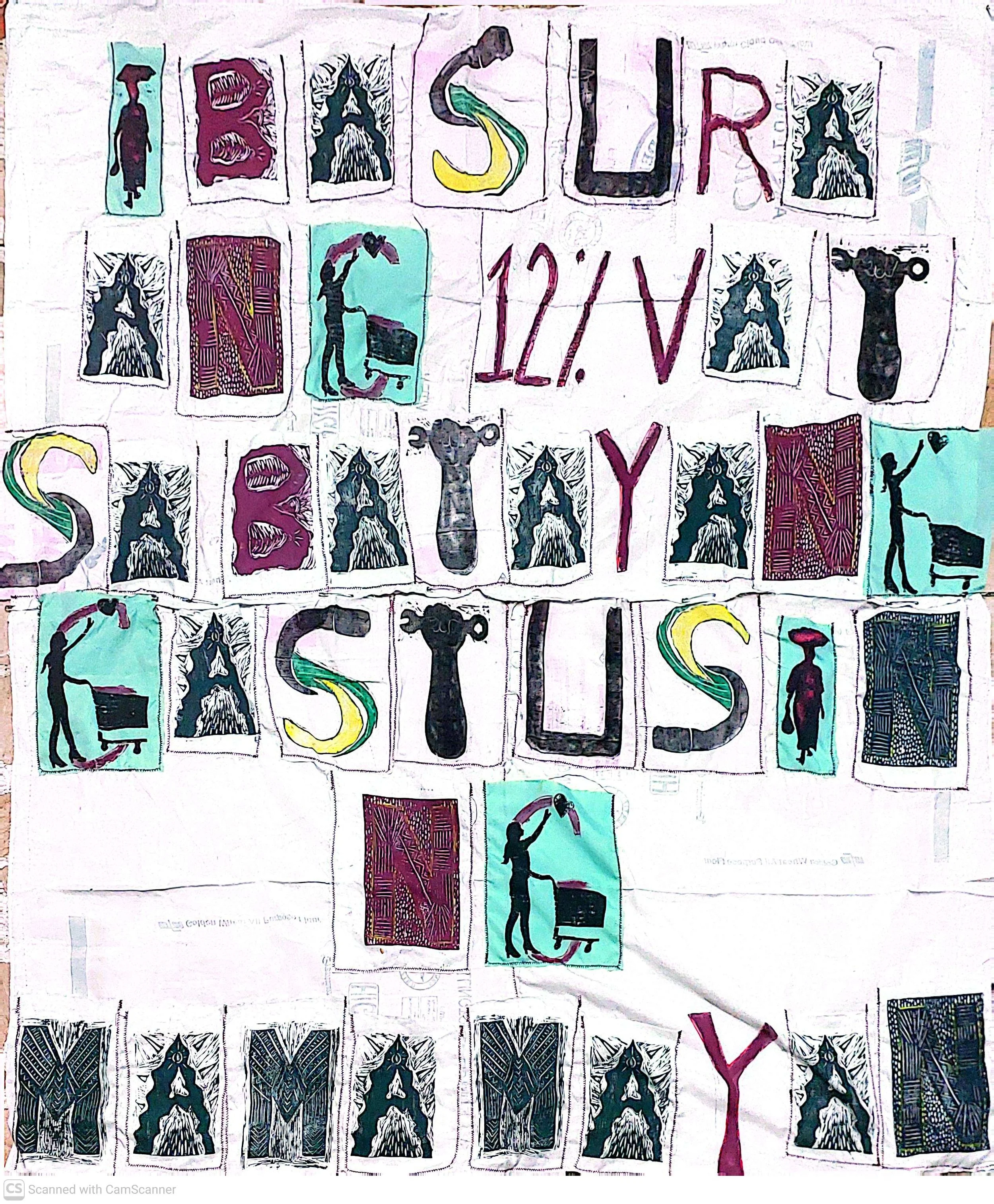
“Of course, murals can also be made by many people at the same time. But what makes printmaking special is it allows for mass production. So for campaigns, it’s very useful,” she adds. One such campaign made use of letras y figuras. Members of TkTk carved out each letter of the alphabet for use on multiple projects—most prominent of which is last year’s State of the Nation protest banner that read: “Ibasura ang 12% VAT sa batayang gastusin ng mamamayan” (Abolish the 12% VAT on citizens’ basic expenses).
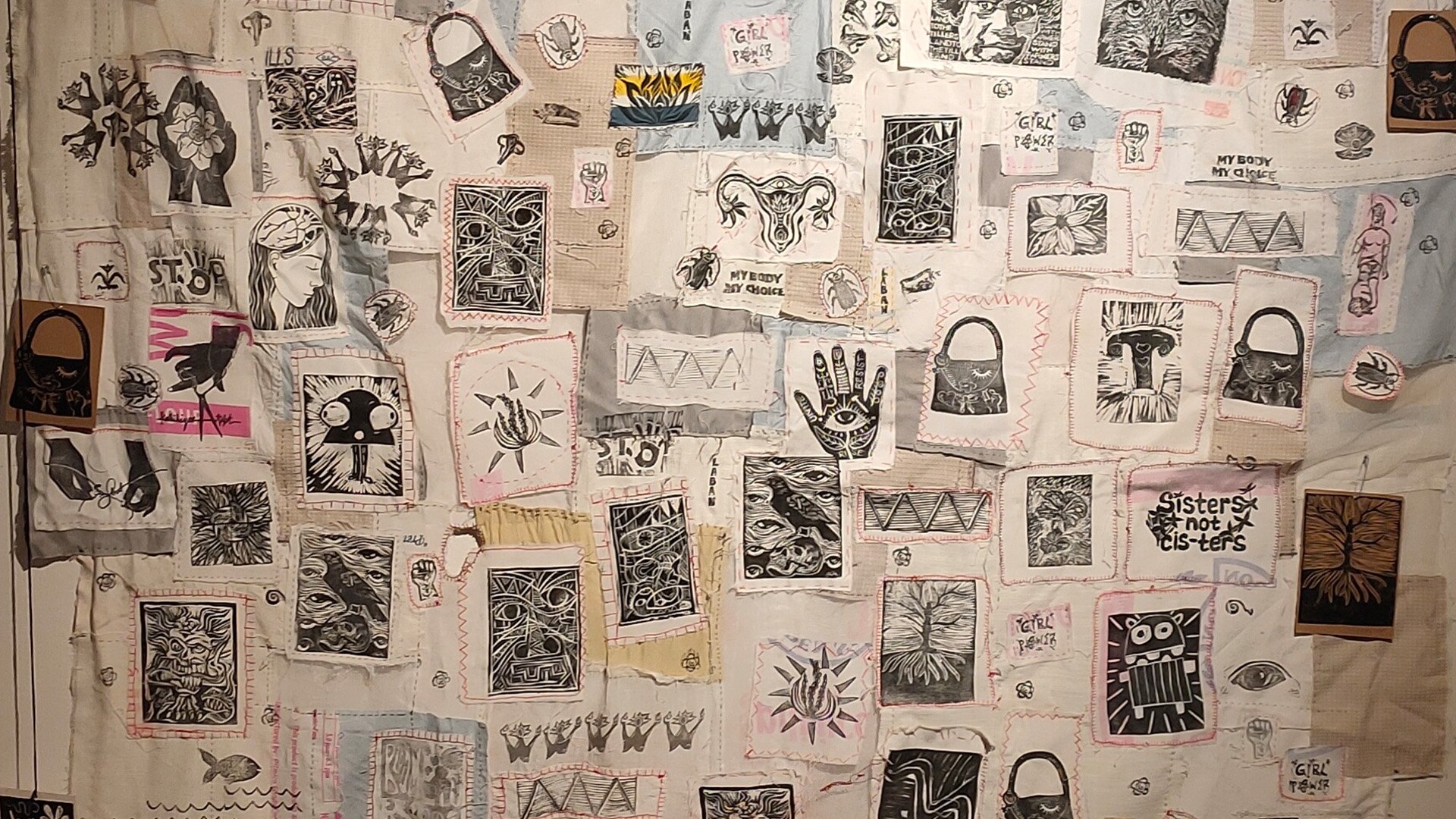
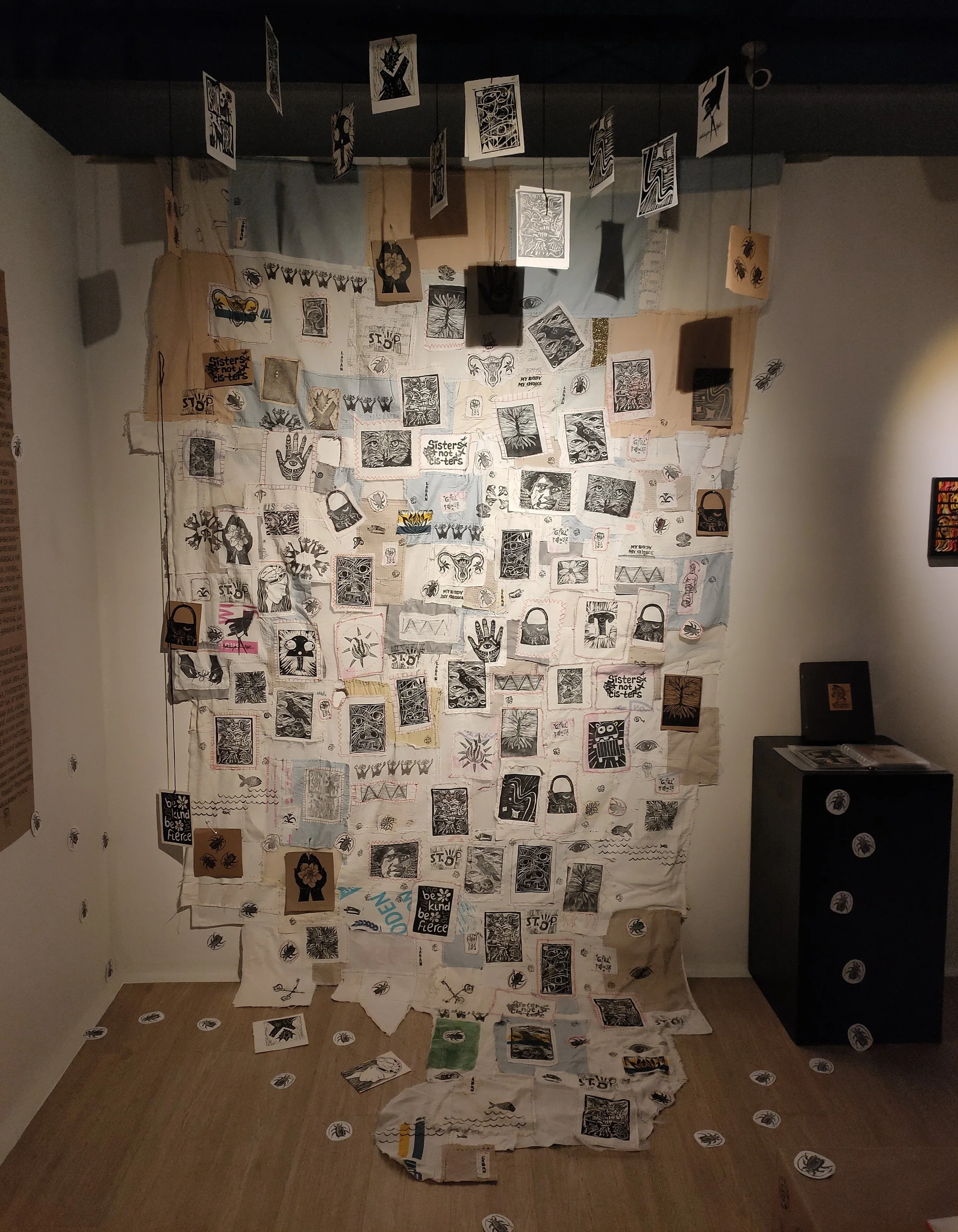
TkTk’s first collective print shown at Gravity last June were expressions on the International Day for the Elimination of Violence Against Women. Illustrations of uteruses, flowers, and other vulvar forms, alluding to both softness and strength, were printed individually and sewn together into an 11-foot-tall tapestry. It included statements that called out: “Be kind, be fierce,” “My body, my choice,” and simply: “Stop.” The group’s works have also spanned collaborations with non-TkTk artists, from botanical prints for members of the food-focused Hapag Ugnayan, to prints featuring drawings of Filipino political prisoners.
TkTk’s many communal activities happen at O Home—a studio inside Montenegro’s house that hosts printmaking fairs and parties or “tipar” as they call it, focused on sharing knowledge and encouraging the art form’s practice. Villaflor and the team describe it as a “no judgment” and “no pressure” space where you’re allowed to ask about paints, explore carving techniques, and just experiment. “No two prints are alike. There’s an aspect of play in mixing the paints and satisfaction in the final print,” says Sandico, recalling sessions that stretch into whole-day affairs, from carving to cleanup, all while sharing the studio’s limited but free resources and relishing face-to-face chats.
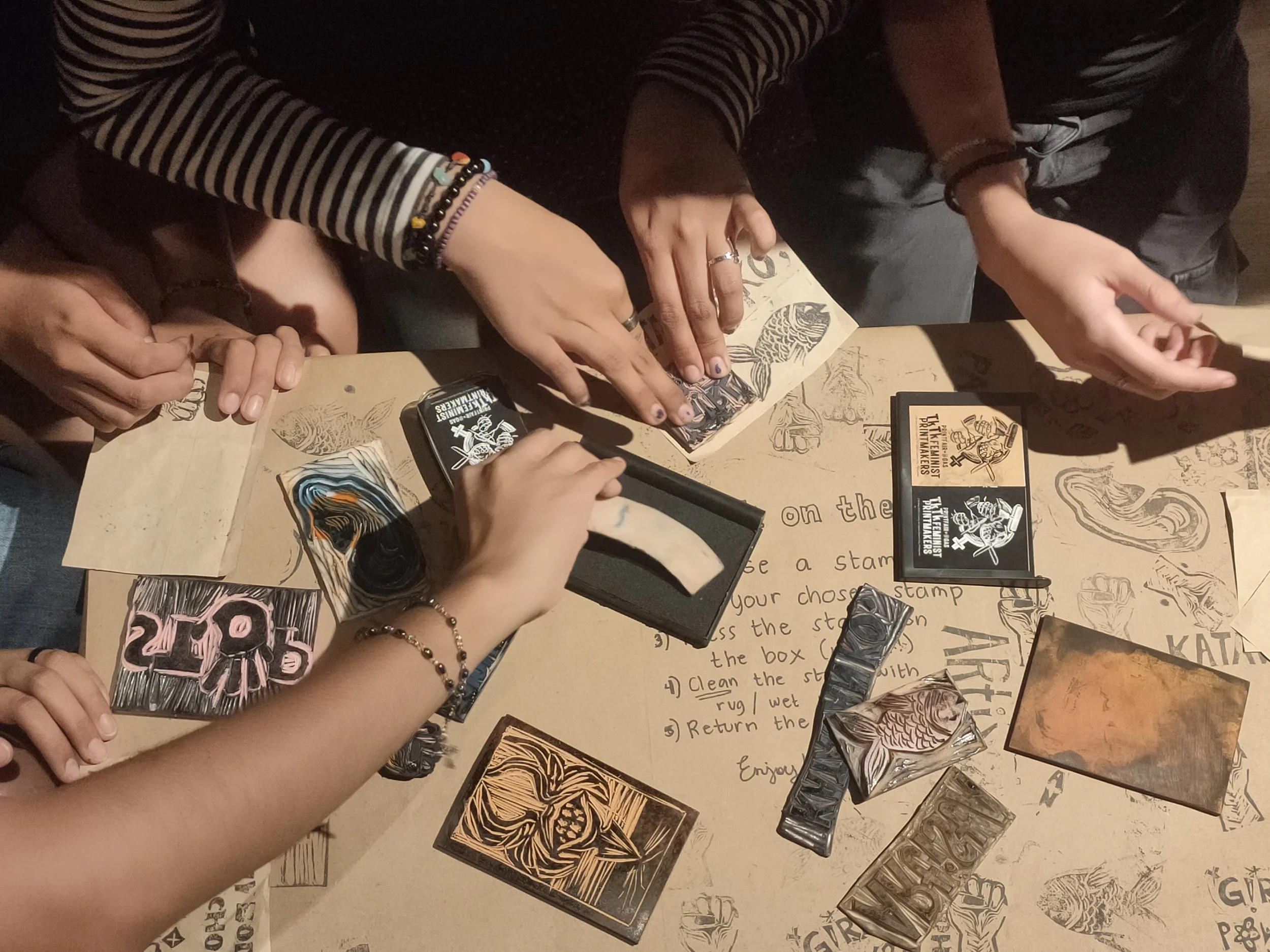
The TkTk box, a kraft paper covered box where people can freely print using the TkTk stamp collection, as part of the TkTk’s interactive exhibit at Gravity Art Space for the Print Fair + @GAS: Graphic Protests.
Villaflor points out that this laidback and generous environment is part of what makes TkTk a “feminist safe space.” “When I started, I didn’t buy printing materials because I wasn’t sure I’d stick with it. TkTk lets me borrow tools, and if you buy your own, you can return it. I think that’s also feminist care.” She adds that TkTk’s “loosely organized structure—no secretary, no chair, no hierarchy”—is also its strength, keeping the collective flexible and collaborative. They’re now looking at grants to fund future projects after connecting with similar artists and groups, from a visiting artist from Hong Kong, to members of Gabriela New York. “The goal is to create not just a physical space, but an accessible space where anyone interested in printmaking is welcome,” says Villaflor.